







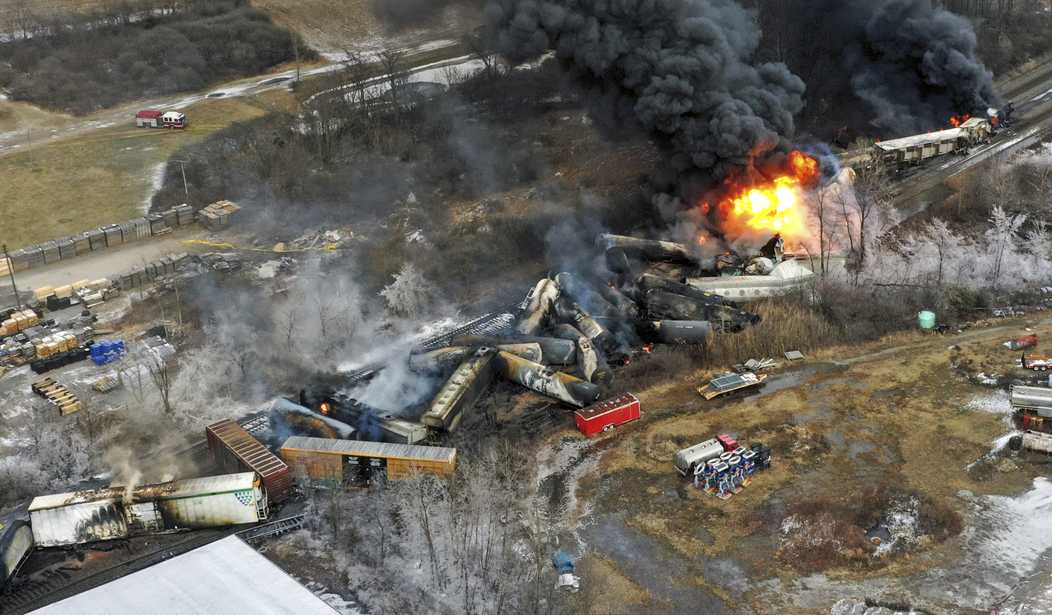
The National Transportation Safety Board (NTSB) released its preliminary report on the Norfolk Southern train derailment in East Palestine, Ohio, Thursday morning, providing more information on how the disaster developed.
"On February 3, 2023, about 8:54 p.m. local time, eastbound Norfolk Southern Railway (NS) general merchandise freight train 32N derailed 38 railcars on main track 1 of the NS Fort Wayne Line of the Keystone Division in East Palestine, Ohio," the NTSB report reiterated. "The derailed equipment included 11 tank cars carrying hazardous materials that subsequently ignited, fueling fires that damaged an additional 12 non-derailed railcars."
The train was composed of two head-end locomotives, 149 railcars, and one distributed power locomotive located between railcars 109 and 110. Of the 149 railcars, 20 were "placarded hazardous materials tank cars transporting combustible liquids, flammable liquids, and flammable gas, including vinyl chloride," the preliminary report explained.
The train was traveling roughly 47 miles per hour when it derailed, less than the maximum authorized speed of 50 miles per hour, and the positive train control system was enabled an in operating order when the accident took place, according to the NTSB.
Here's how things literally went off the rails:
Train 32N was operating with a dynamic brake application as the train passed a wayside defect detector on the east side of Palestine, Ohio, at milepost (MP) 49.81. The wayside defect detector, or hot bearing detector (HBD), transmitted a critical audible alarm message instructing the crew to slow and stop the train to inspect a hot axle. The train engineer increased the dynamic brake application to further slow and stop the train. During this deceleration, an automatic emergency brake application initiated, and train 32N came to a stop.
After the train stopped, the crew observed fire and smoke and notified the Cleveland East dispatcher of a possible derailment. With dispatcher authorization, the crew applied handbrakes to the two railcars at the head of the train, uncoupled the head-end locomotives, and moved the locomotives about 1 mile from the uncoupled railcars. Responders arrived at the derailment site and began response efforts.
It took until February 5 for responders to mitigate the fires, at which point "five derailed DOT-105 specification tank cars (railcars 28–31 and 55) carrying 115,580 gallons of vinyl chloride continued to concern authorities because the temperature inside one tank car was still rising."
According to the NTSB, this "increase in temperature suggested that the vinyl chloride was undergoing a polymerization reaction, which could pose an explosion hazard." So, "[r]esponders scheduled a controlled venting of the five vinyl chloride tank cars to release and burn the vinyl chloride, expanded the evacuation zone to a 1-mile by 2- mile area, and dug ditches to contain released vinyl chloride liquid while it vaporized and burned. The controlled venting began about 4:40 p.m. on February 6 and continued for several hours," the NTSB reported.
Since the derailment, the NTSB said it has collected the "wheel bearing and affected wheelset" as well as the "vinyl chloride tank car top fittings, including the relief valves."
The ongoing NTSB probe will "focus on the wheelset and bearing; tank car design and derailment damage; a review of the accident response, including the venting and burning of the vinyl chloride; railcar design and maintenance procedures and practices; NS use of wayside defect detectors; and NS railcar inspection practices," according to the investigators.
NTSB issues preliminary report on Feb. 3 Norfolk Southern freight train derailment in East Palestine, Ohio: https://t.co/urnInBf9uH
— NTSB Newsroom (@NTSB_Newsroom) February 23, 2023
Investigation: https://t.co/sPOVrteqkW pic.twitter.com/g6EJTxBHTO


Join the Conversation
VIP members get the ability to comment on articles.