





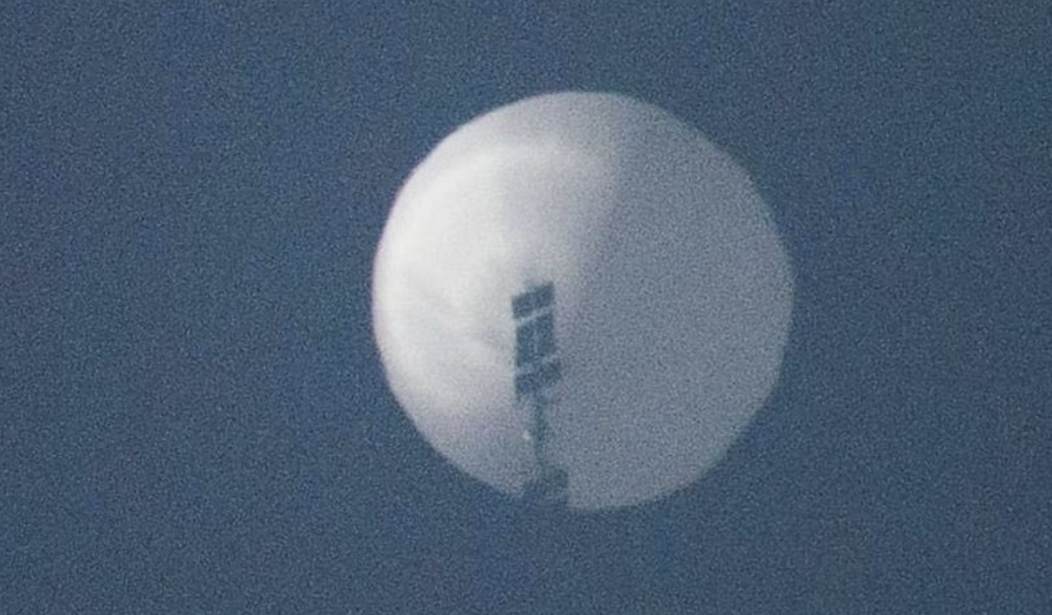
After finally shooting down the Chinese spy balloon on Saturday, the U.S. government provided more information on what they've learned since the surveillance craft was sent crashing into the Atlantic Ocean off the coast of South Carolina.
According to General Glen D. VanHerck, commander of United States Northern Command (NORTHCOM) and North American Aerospace Defense Command (NORAD), the spy craft did have some ability to steer itself but largely relied on high-level wind currents to move along.
Gen. VanHerck acknowledged the balloon had some steering capability. But it also relied on wind currents. He said the balloon's path appears to have been "purposely built" to rely on wind currents.
— Dan Lamothe (@DanLamothe) February 6, 2023
He also said China's spy balloon was more than 200 feet tall, carrying a payload that was similar in size to a smaller passenger jet that weighed more than "a couple thousand pounds."
BALLOON SIZE: Up to 200 feet tall, and compared the payload to a regional jet, which would weigh an excess of “a couple of thousand pounds.”
— Kellie Meyer (@KellieMeyerNews) February 6, 2023
VanHerck revealed that the Pentagon assessed the payload may have contained explosives "to detonate and destroy the balloon" if China deemed it necessary.
Wow: Northcom chief Gen. VanHerck says the balloon was up to 200 ft tall, with a payload the size of a jetliner. It weighed "in excess of a couple thousand lbs" and potentially carried explosives " to detonate and destroy the balloon."
— Lara Seligman (@laraseligman) February 6, 2023
In the end, the United States took the balloon down, creating a debris field of around 1,500 square meters in about 50 feet of open Atlantic water.
NEW on Chinese balloon recovery: Gen. VanHerck of NORTHCOM says Navy ships are now collecting debris and mapping the ocean's surface -- they expect the debris field is around 1,500 square meters. EOD are out in a RHIB boat to pilot unmanned subs to scan for hazardous debris.
— Matt Seyler (@MattSeyler) February 6, 2023
According to VanHerck, currents in the area have caused some difficulties with recovery of debris, but the Federal Bureau of Investigation and Naval Criminal Investigative Service (NCIS) are coordinating with U.S. vessels to collect and catalog debris. There's still a lot of the payload yet to be recovered and analyzed, so there's likely to be even more revelations in the days ahead — even if civilians aren't privy to it.
The USS Carter Hall, an amphibious dock landing ship, will serve as the command vessel for the search.
— Dan Lamothe (@DanLamothe) February 6, 2023
The USNS Pathfinder, an oceanographic vessel, is now on scene and mapping below the surface to search for debris, he said.
Some pieces of the spy balloon may wash up on American shores in the coming days, bringing a warning from VanHerck that any civilians seeing ChiCom flotsam should avoid it and contact law enforcement to arrange for recovery by the proper authorities.
Taking a step back, VanHerck also attempted to explain why the balloon was left to drift over the continental United States for days before action was taken to down the balloon — rather than before it was over the continental United States, namely ICBM silos at Malmstrom Air Force Base in Montana. "It wasn't time," VanHerck said as to why the Chinese spy balloon was not downed when picked up over Alaska.
"It was my assessment that this balloon did not present a physical military threat to North America -- this is under my NORAD hat -- and therefore, I could not take immediate action because it was not demonstrating hostile act or hostile intent," Gen. VanHerck told reporters.
— Dan Lamothe (@DanLamothe) February 6, 2023
The NORAD/NORTHCOM commander explained it was his "assessment that this balloon did not present a physical military threat to North America...and therefore, I could not take immediate action because it was not demonstrating hostile act or hostile intent."
So, a Chinese spy balloon with unknown intentions and capabilities entering U.S. airspace doesn't constitute hostility? I'm sure Beijing will be thrilled to learn this.
Amid claims from the Biden administration that Chinese spy balloons were aloft over the United States repeatedly during the Trump administration — which the 45th president and senior members of his administration have disputed — VanHerck seemed to confirm the presence of spy balloons from China over U.S. between 2017 and 2021. It's just that "we did not detect those threats," VanHerck claimed, calling it "a domain awareness gap that we have to figure out." No kidding.
VanHerck said the previous surveillance balloon incidents that occurred during the Trump admin and early under Biden were not spotted by NORAD at the time: "We did not detect those threats. And that's a domain awareness gap that we have to figure out," he said.
— Matt Seyler (@MattSeyler) February 6, 2023
So, if the United States didn't know that balloons were over the U.S. previously at the time they supposedly prowled our skies, how do we now know they were there at all? As usual, VanHerck refused to say how such a conclusion was reached.
So yet again, more questions than answers remain after the latest update from the government that promises its citizens transparency and trust.



Join the Conversation
VIP members get the ability to comment on articles.