







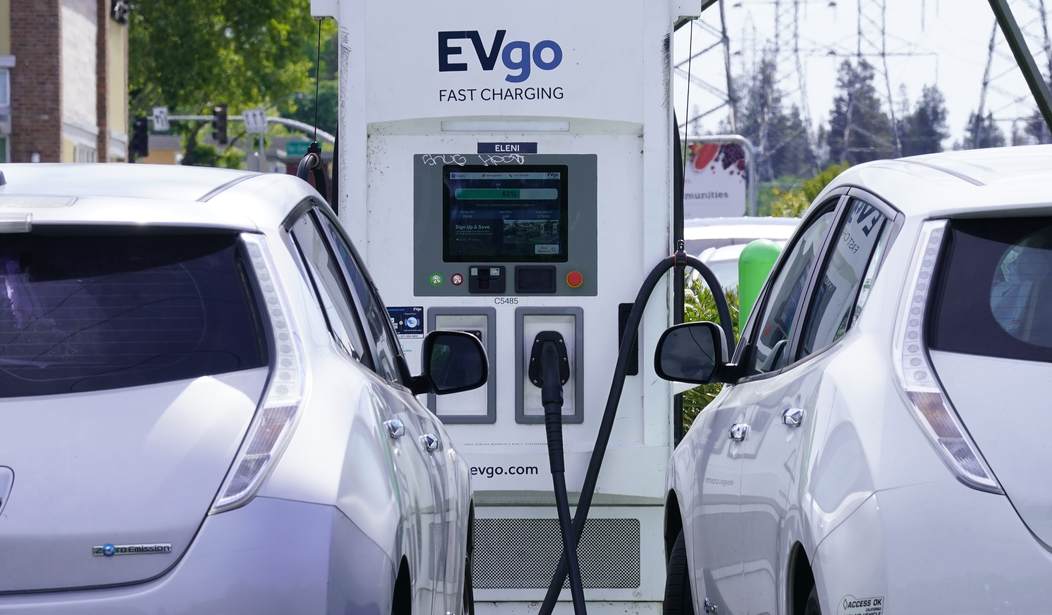
Electric vehicle Maker Rivian says it faces a $100 million hole because of changing fuel economy standards, according to the Wall Street Journal.
Former President Joe Biden offered many incentives for electric vehicles in an attempt to lure Americans away from driving vehicles with internal combustion engines. So he created hundreds of millions of dollars of tax credits tied to fuel economy rules so automakers can buy and sell them.
He wanted the U.S. to reach net zero emissions by 2050. But the One Big Beautiful Bill removed the civil fines on automakers for violating federal fuel economy standards, according to the Sidley law firm.
"Conversely, the likely reduction in the value of CAFE compliance credits will affect electric vehicle manufacturers that rely on the sale of those credits as a source of revenue," the law firm wrote. "The One Big Beautiful Bill Act also disincentivized electric vehicles in other ways, particularly by eliminating tax credits for the purchase of new and used electric vehicles."
Biden had mandated that about 67% of new car sales be electric by 2032. Pres. Trump revoked that mandate.
In many states, most people don’t want to drive EVs. In Michigan, Gov. Gretchen Whitmer set ambitious EV targets: 2 million EVs driving on roads by 2030 and 1 million chargers for them. But the state has fallen 1.9 million short with five years to go.
Residents in some states have adopted EVs, but not most, according to the U.S. Department of Energy. About 1.2 million EVs are registered in California,
The transportation sector accounts for about 33% of all domestic greenhouse gas emissions.
The main barriers to EV adoptions are a higher cost, range anxiety, and a limited charging network.
Rivian hasn’t responded to a request for comment. The company's headquarters is in Irvine, California.
In January, the Department of Energy announced a $6.5 billion loan to Rivian for an auto plant in Georgia. The loan will help create jobs and strengthen U.S., leadership in EV manufacturing and technology said Rivian Founder and CEO RJ Scaringe in a statement.
“This loan would enable Rivian to more aggressively scale our U.S. manufacturing footprint for our competitively priced R2 and R3 vehicles that emphasize both capability and affordability. A robust ecosystem of U.S. companies developing and manufacturing EVs is critical for the U.S. to maintain its long-term leadership in transportation.”
The company loses over $100,000 on every vehicle it sells, according to the Wall Street Journal.
Rivian aims to reach net-zero carbon emissions, it says on it's website.
“We are focused on accurately accounting for the comprehensive impact of our business through transparent impact reporting.”
The Zero Emission Transportation Association’s Executive Director, Albert Gore welcomed the release of interim final guidance for the National Electric Vehicle Infrastructure Formula Program by the Federal Highway Administration:
“The number of public charging connectors in the United States has more than doubled since 2021, and 2025 is projected to be the strongest year yet for EV charging infrastructure expansion, according to industry analysts." Gore said in a statement. "This is a testament to the collaborative efforts between the public and private sectors to accelerate the installation of public charging. Still, much more work is needed to build a robust nationwide network to support America’s growing EV fleet. Initiatives like the NEVI program play an important role in this buildout. By empowering states to build charging based on their specific needs, NEVI helps fill in any gaps in the network. This will help to ensure that EV drivers can find charging when and where they need it."
Editor’s Note: Do you enjoy Townhall’s conservative reporting that takes on the radical left and woke media? Support our work so that we can continue to bring you the truth.
Join Townhall VIP and use the promo code FIGHT to get 60% off your VIP membership!


Join the Conversation
VIP members get the ability to comment on articles.