





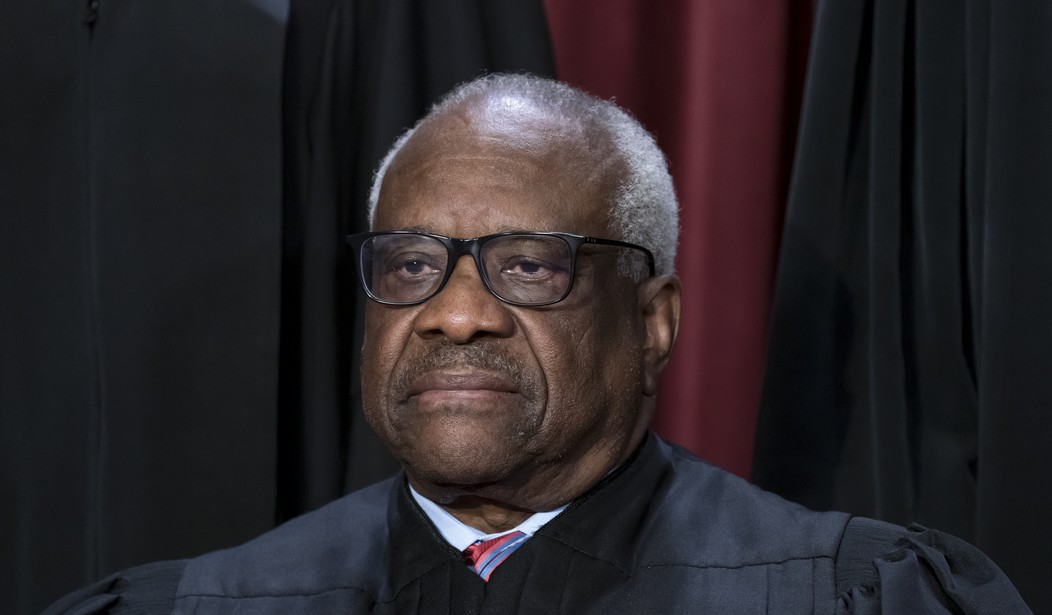
Conservative Supreme Court Justice Clarence Thomas expressed strong criticism after the highest court declined to hear a case involving pro-life activists and their free speech rights. In a rare public statement, Thomas condemned the decision, arguing that the Court's refusal to consider the case undermines fundamental First Amendment protections. The case in question involved activists challenging restrictions on their ability to express anti-abortion views, a matter Thomas believes the Court should have addressed to safeguard free speech amid increasing government regulations.
On Monday, the U.S. Supreme Court declined to hear two cases involving pro-life groups who challenged laws banning protests near abortion clinics. The Court rejected appeals from Coalition Life, or the "America's Largest Professional Sidewalk Counseling Organization," in New Jersey and Illinois. Both had appealed lower court rulings that dismissed their lawsuits. They argued that "buffer zones,” which were set in place after a previous Supreme Court decision in Colorado, keep patients from facing harassment. Thomas criticized the law, which was grounded in the 2000 Hill v. Colorado decision that upheld a similar law based on a "right to avoid unwelcome speech" under specific circumstances.
In a dissent, Thomas said he “would have taken this opportunity to explicitly overrule Hill.”
“For now, we leave lower courts to sort out what, if anything, is left of Hill’s reasoning, all while constitutional rights hang in the balance,” Thomas wrote.
He argued that the Supreme Court mistakenly treated the Hill case differently from other First Amendment cases because of its abortion context, stating, "Hill's abortion exceptionalism turned the First Amendment upside down.”
The Hill case “has been seriously undermined, if not completely eroded, and our refusal to provide clarity is an abdication of our judicial duty. This case would have allowed us to provide needed clarity to lower courts.”
Thomas argued the case contained "numerous" errors and contradicted over fifty years of established First Amendment principles, stating, "This Court had never—and since Hill, has never—taken such a narrow view of content-based speech restrictions.” He also claimed that the Supreme Court's First Amendment jurisprudence was manipulated to specifically disadvantage anti-abortion activists and their right to persuade women that abortion is wrong.
In 2000, the highest court upheld a Colorado law in a 6-3 decision that prohibited individuals from approaching abortion clinics within eight feet of another person and within 100 feet of a healthcare facility entrance without consent. This law applied to things such as handing out fliers, displaying signs, or engaging in protests.
Thomas called the decision “absurd,” “defunct,” “erroneous,” and “long-discredited.”
Join the Conversation
VIP members get the ability to comment on articles.