







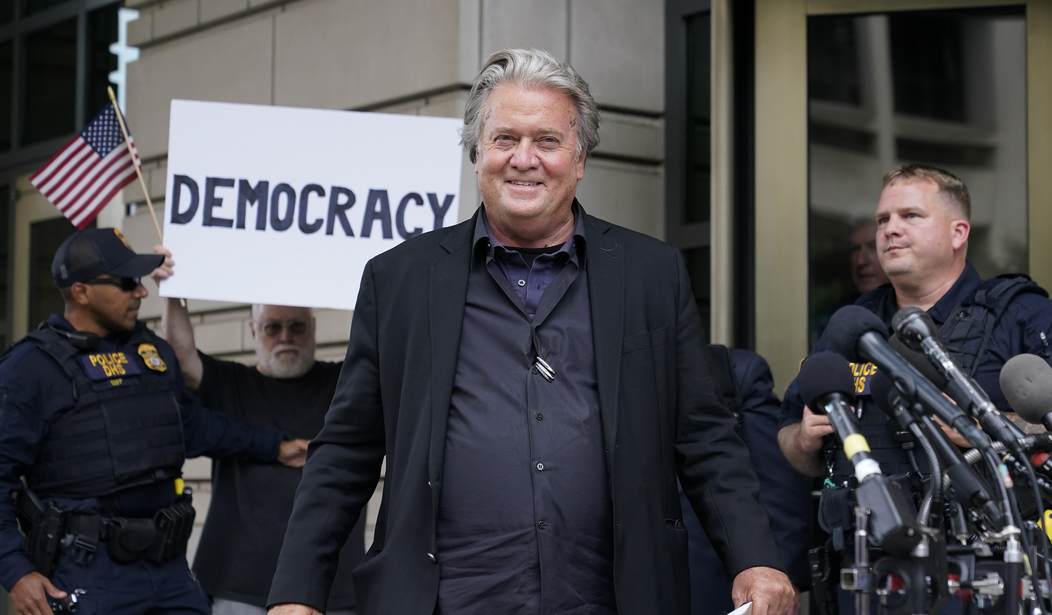
Steve Bannon was found guilty of contempt charges for defying a congressional subpoena from the House committee investigating the Jan. 6 Capitol protests.
After the jury deliberated for three hours, Bannon was convicted on two counts: one for not appearing for a deposition and the other for failing to provide documents in response to the committee's subpoena.
Following the four-day trial, he will face up to two years in federal prison, and his sentencing is scheduled for October 31.
Bannon promised to put up a fight against the "misdemeanor from hell" and go "medieval on these people," however, he decided not to testify or call on any witnesses during the trial.
Bannon's team said that he had wanted to testify. However, due to several limits on what he can and cannot say, such as issuing an "advice-of-counsel," defense led him to not take the stand.
Bannon had previously argued his testimony was protected by Trump's claim of executive privilege, but the House panel and the Justice Department said his claim was doubtful because Trump had fired Bannon from the White House in 2017, making him a private citizen when he was consulting with Trump days leading up to January 6.
Earlier this month, the DOJ said that Trump did not invoke executive privilege for material specific to Bannon. Prior to this, Bannon said he would testify to the panel claiming that Trump wrote him a letter informing him that he would waive his executive privilege.
The committee brought Bannon to court over his involvement in Trump's efforts to overturn the 2020 presidential election.
In the closing arguments, Bannon's attorney Evan Corcoran argued that the committee "rushed to judgment" because it "wanted to make an example of Steve Bannon."


Join the Conversation
VIP members get the ability to comment on articles.