





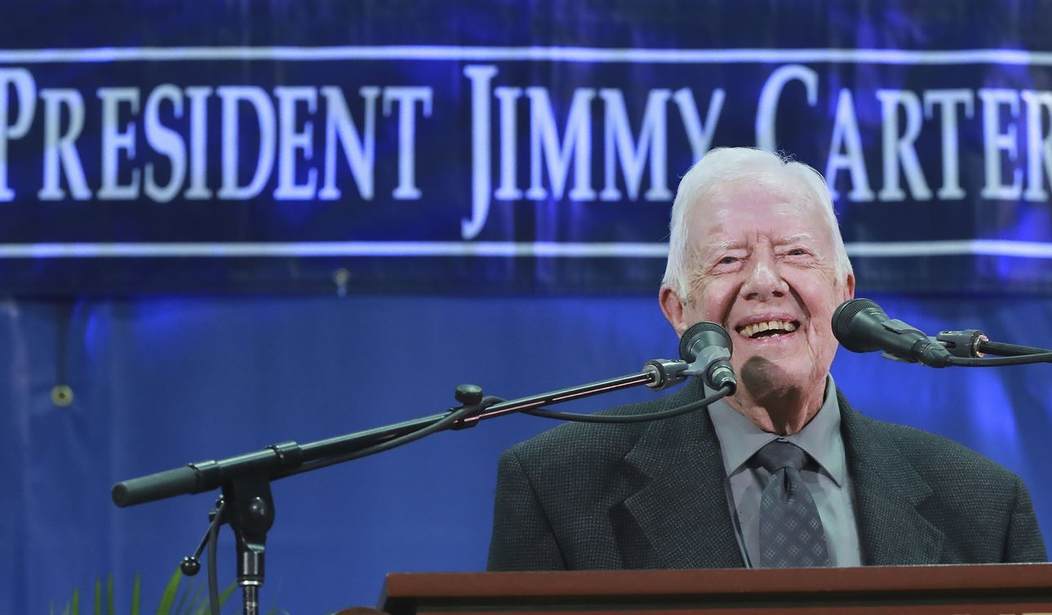
On Sunday, it was announced that Jimmy Carter, the 39th president and our nation's longest living president, had died at the age of 100. Upon news of his death, it wasn't just that touching tributes came pouring in, but those that did come, including and especially from media outlets, looked to whitewash the failures of one our nation's worst presidents.
Washington Monthly on Sunday, not long after Carter's death was announced, put out a post that featured a cartoon of Carter and President Ronald Reagan, with the latter dwarfed in comparison. "We're biased, but see it as the best assessment of Carter you'll read today," the post claimed, linking to a conversation between Carter's biographers.
Jimmy Carter's preeminent biographers, @Monthly Contributing Editor Jonathan Alter and Kai Bird discussed their works with the Monthly's Timothy Noah in 2021. We're biased, but see it as the best assessment of Carter you'll read today.https://t.co/6kZsChFOTI
— Washington Monthly (@monthly) December 29, 2024
Reagan defeated Carter in a landslide and then defeated Carter's former VP Walter Mondale in an even bigger landslide. Such BS from Washington Monthly. https://t.co/YD6NX32aCJ
— Doug Powers (@ThePowersThatBe) December 30, 2024
This is an actual article that a news outlet (Washington Monthly) published. It even says Jimmy Carter was more responsible for the fall of Soviet Union than Reagan.
— Bonchie (@bonchieredstate) December 31, 2024
Incredible. pic.twitter.com/Ub6C5YFoXL
It wasn't just the cartoon image, though. That lengthy conversation featured Reagan considerably, including with the following examples:
...Carter’s human rights policy played a huge and largely uncredited role in the collapse of the Soviet Union—more so, perhaps, than any policies enacted by his successor Ronald Reagan.
...
I devoted a whole chapter to the October Surprise. A little cautiously, with some trepidation, because it’s a conspiracy theory and it’s complicated, but I was fascinated by the story, and you decided to give two or three paragraphs to it. I don’t think we basically disagree about what may or may not have happened. But I thought it was worth a short chapter.
[Editor’s note: The October Surprise theory holds that Reagan campaign staffers conspired with Iran to delay the release of the American embassy hostages in order to damage Carter’s reelection chances.]
...
Kai Bird: It would have been a different world if he had had a second term, and we hadn’t had Ronald Reagan for two terms. That’s a great historical counterfactual.
Carter served only one term as president. Although he beat President Gerald Ford in 1976, Carter faced a significant primary challenge from then Sen. Ted Kennedy (D-MA) in 1980, and was absolutely trounced by Reagan, who went on to become our 40th president.
Reagan won in 1980 with 489 electoral votes to Carter's 49 votes, winning 44 states, while Carter won 6 plus Washington, DC. Reagan won by even more impressive margins in 1984 against Walter Mondale, who had been Carter's vice president. Reagan won 525 electoral votes and 49 states, to Mondale's 13 votes, who only won Minnesota and DC.
1980 Electoral College results:
— Ryan Saavedra (@RealSaavedra) December 30, 2024
Ronald Reagan: 489
Jimmy Carter: 49 pic.twitter.com/LlzXVZVFKC
"Allowing." https://t.co/ASqLoEJuKh pic.twitter.com/Nij3710OMz
— Stephen Green (@VodkaPundit) December 30, 2024
There was also a comparison between Carter and Reagan in a piece by Christianity Today.
The write-up was criticized by Discovery Institute's John G. West in a lengthy post shared to X, also on Sunday night.
I was going to stay silent about the passing of Jimmy Carter, but reading the Christianity Today article was too much. I wish the best for Carter’s grieving family, and Carter should be lauded for his humanitarian efforts, his efforts to bring about peace in the Middle East, and… pic.twitter.com/FvBiG1C13t
— John G. West (@JGWestDI) December 30, 2024
Since their post on Sunday afternoon, Washington Monthly has continued to post particularly favorable posts about the 39th president, though Carter's role in "human rights" isn't so rosy as they claim.
As Jeff covered earlier, Scott Jennings on CNN for Monday night offered a perfect reminder about the former president's legacy. Carter was also known for his antisemitism and trying to see Hamas recognized. Earlier on Tuesday, Jonathan Feldstein covered that legacy from such a perspective in a column for Townhall, also mentioning his own personal reactions with Carter at Emory University.

Join the Conversation
VIP members get the ability to comment on articles.