





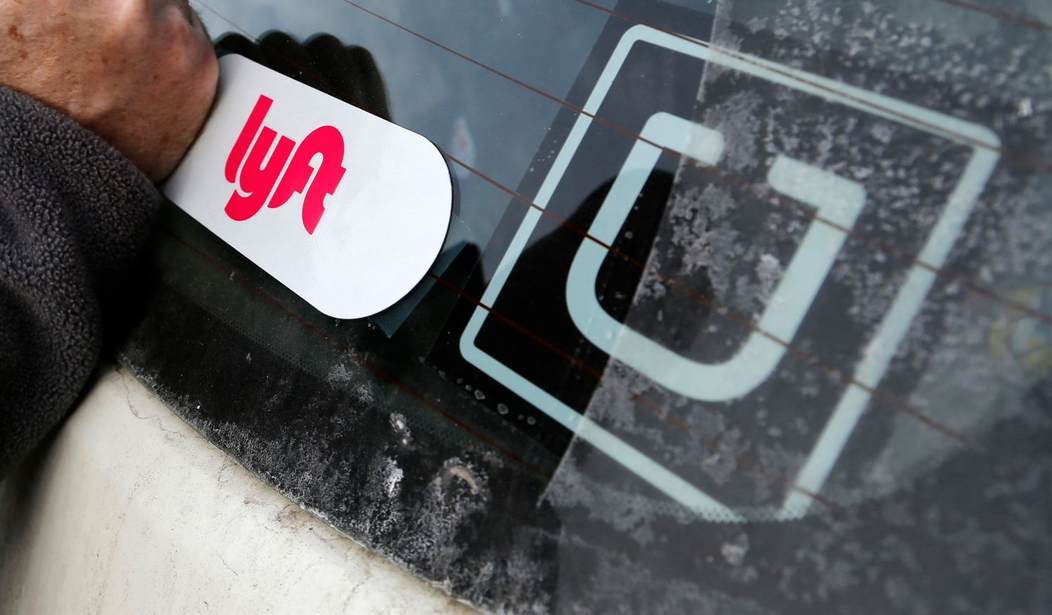
As the legislative session is set to come to a close in Minnesota, the Democratically-controlled state legislature is still attempting to regulate rideshare services like Uber and Lyft, with a statewide minimum wage of $1.27 per mile and $0.49 per minute. Uber and Lyft have criticized the proposal and threatened to leave the state as a result.
Beyond how obsessed with regulation Democratic politicians are, there are a few more points to be made here. As Spencer mentioned in March, the proposal was actually vetoed by Democratic Mayor Jacob Frey, though the city council overrode that veto. Further, Minnesota Democrats, who do have a trifecta control but only just narrowly control the state Senate and state House, are pushing such a move despite how it's failed in other Democratic areas.
Back in 2015, the Austin City Council in Texas permitted regulating the rideshare companies. Uber and Lyft pushed for a ballot proposal to let the voters decide between the city ordinance and a statewide law, with voters choosing the ordinance in 2016. The rideshare companies thus paused their operations in 2016.
Gov. Greg Abbott (R-TX) signed an executive order in May 2017, thus creating a "statewide regulatory framework for ride-hailing companies, overriding local measures that prompted businesses such as Uber and Lyft to leave Austin and other cities," prompting Uber and Lyft to return.
In 2020, California voters approved Proposition 22, which allowed Uber and Lyft to continue classifying drivers as independent drivers. The proposition was invalidated in 2021 by a California Superior Court judge. The California Supreme Court is now taking the case. Coverage from Cal Matters notes it could lead to "upending the gig economy."
It's also noteworthy that the proposition was in response to the anti-freelancer bill, Assembly Bill 5. "Prop. 22 was the industry’s response to Assembly Bill 5, a state law that codified a state Supreme Court decision that would have required the companies to classify those workers as employees," the Cal Matters report mentioned.
As part of their crusade for overregulation, state Democrats are looking to not only push extreme policies, but take jobs away and make for inhospitable business environments, as well as take away transportation options in cities where people may need them the most.
The Minnesota State Reformer, in noting how drivers are divided, also points to some serious implications, as well as how Democrats are in disarray over the matter:
The companies say they’ll pull out of Minnesota if lawmakers enact their current proposal of $1.27 per mile and 49 cents per minute when driving passengers, which is above what the state analysis estimates is necessary to guarantee drivers the Minneapolis minimum wage plus benefits after accounting for expenses.
The issue has polarized state Democrats. Many lawmakers worry that the companies’ departure would lead more than 10,000 drivers to lose income, while 1.5 million or more Minnesotans and visitors per month struggle to find rides to and from the airport, bars and sporting events as well as doctors appointments, drug stores and work shifts.
Gov. Tim Walz’s office has said he is committed to finding a solution that keeps the services active in the state, but the bill’s progressive champions don’t want to capitulate to billion-dollar Silicon Valley tech companies.
Complicating matters further, the city of Minneapolis is on track to enact similar rates on July 1, and state Democrats — especially those representing Minneapolis — are loath to preempt the city’s own minimum wage and other labor rules.
...
Both companies said the state legislation passed last year would more than double the price of the typical fare.
“How much do you think this is going to hurt people like this if all of a sudden it’s 50 to 100% more?” said [full-time driver Loren] Balazs, after dropping off a mother and son at a Petco. “What they’re trying to pass will make things worse.”
When it comes to compromises, there may not be a "solution" that Gov. Tim Walz's (D-MN) office is mentioned above hoping for. Democrats in the state rule reached a supposed compromise, but Uber still called it "disappointing" and Lyft mentioned it "would make the service unsustainable in Minnesota."
The proposed overregulation is certainly getting notice from the Republican State Leadership Committee (RSLC). "State Democrats are backing extreme liberal policies that restrict free and fair markets by trying to tell rideshare services like Uber and Lyft how to do business in their state. While state Democrats attempt to drive business out of the state, Republicans will continue to put forward policies that create a business-friendly environment and create jobs for hardworking Minnesotans," said RSLC Spokesperson Stephanie Rivera in a statement.


Join the Conversation
VIP members get the ability to comment on articles.