





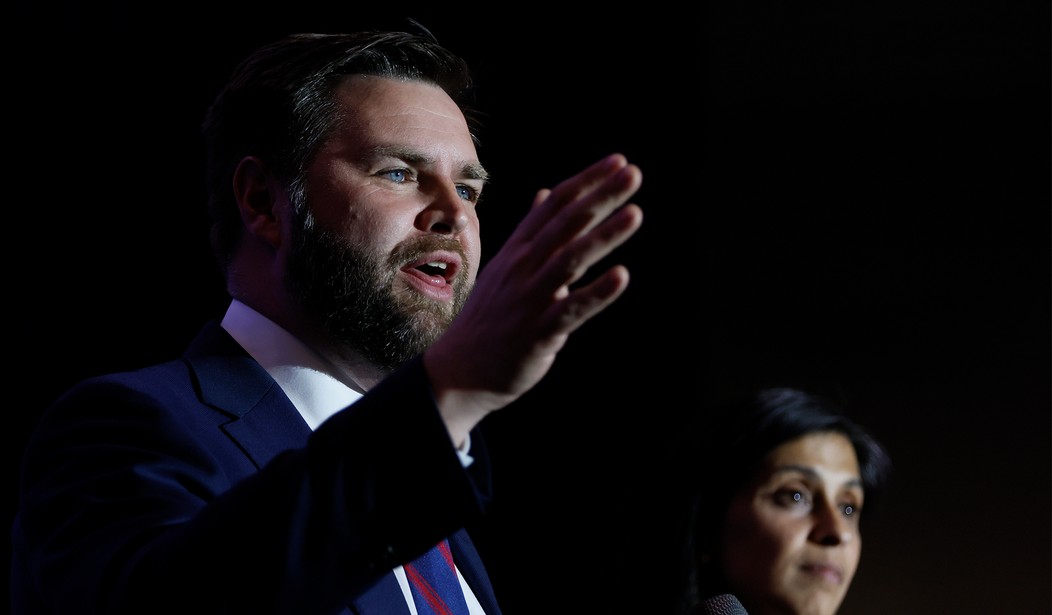
Last week, the U.S. Supreme Court effectively ended affirmative action with a series of decisions out of Harvard and the University of North Carolina (UNC). To say that the left is not pleased would be putting it politely. In case any college or university gets the idea to not comply, though, Sen. JD Vance (R-OH) is putting them on notice with a letter he sent on Thursday to the presidents of elite schools, including those in Vance's state of Ohio. Not only did Vance write to "express concern," he also called on those presidents to preserve documents after they expressed "openly defiant and potentially unlawful reaction" to the Harvard decision.
Despite the ruling being as clear as it was, Vance's letter pointed out that "within hours of the decision's pronouncement, you and your institutions expressed open hostility to the decision and seemed to announce an intention to circumvent it."
His letter includes examples from 10 university presidents, including from Princeton, Oberlin, Dartmouth, Harvard. Cornell, Kenyon, Yale, Brown, the University of Pennsylvania, and Columbia.
A Fox News report summarized some of the reactions included in Vance's letter:
"Princeton President [Christopher] Eisgruber complained that the Court’s decision was ‘unwelcome and disappointing’ and vowed to pursue ‘diversity . . . with energy, persistence, and a determination to succeed despite the restrictions imposed by the Supreme Court in its regrettable decision today,’" Vance recounted.
"Oberlin President [Twillie] Ambar felt ‘deeply saddened and concerned for the future of higher education’ when the Supreme Court’s ruling was announced," he continued. "She assured her students and faculty that, rather than dampening her enthusiasm for affirmative action policies, the decision ‘only strengthens our determination to be a welcoming place where diversity is celebrated.’"
"Harvard President [Lawrence] Bacow boasted that ‘[f]or almost a decade, Harvard has vigorously defended an admissions system’ that the Supreme Court ruled unlawful and then ‘reaffirm[ed] the fundamental principle that deep and transformative teaching, learning, and research depend upon a community comprising people of many backgrounds, perspectives and lived experiences[.]’"
Vance's letter makes note of colleagues who "have assured me that they share my concern that colleges and universities, and particularly the elite institutions to whom this letter is addressed, do not respect the Court's judgment and will covertly. defy a landmark civil rights decision with which they disagree."
Speaking of another landmark decision, Vance reminded the presidents of the painful consequences of schools refusing to abide by the Brown v. Board of Education decision from 1954. "In one infamous case" regarding reaction to that case, as Vance pointed to, "Virginia Governor Thomas B. Stanley responded to the decision... by pledging to show 'the rest of the country [that] racial integration is not going to be accepted in the South' and by vowing to organize 'massive resistance' in the Southern States. Violence and racial animosity ensued."
As the senator's letter indicates, his authority is not just limited to strong words. "The United States Senate is prepared to use its full investigative powers to uncover circumvention, covert or otherwise, of the Supreme Court’s ruling. You are advised to retain admissions documents in anticipation of future congressional investigations, including digital communications between admissions officers, any demographic or other data compiled during future admissions cycles, and other relevant materials. As you are aware, a number of federal criminal statutes regulate the destruction of records connected to federal investigations, some of which apply prior to the formal commencement of any inquiry," he pointed out.
The letter concludes by asking several questions of the university presidents to indicate compliance, including, with original emphasis:
- What procedures will your institution implement to ensure that records are retained in accordance with this letter?
- What instructions are you giving staff about their obligations to preserve records in anticipation of a potential investigation? Please inform me of the date and nature of such instructions?
- Has your staff ever been advised not to preserve records or to communicate internally in ways that could circumvent future inquiries? If so, please discuss the date and nature of such advisements.
- How will your institutions ensure that new admissions practices do not "simply establish ... the regime" that the Supreme Court has held unlawful?
- What admissions practices previously employed by your institutions will now be forbidden?
- If you have publicly committed to an interest in "diversity," how will you ensure that your commitment to that value does not entail direct or indirect race-based preferences?
Vance expects answers by July 21.
Fox News noted that they reached out to Harvard, Yale, Princeton, Dartmouth, Cornell, Brown, the University of Pennsylvania, Columbia, Oberlin College and Kenyon College about the letter. While a spokesperson for Harvard pointed to a statement that said the university "will certainly comply with the Court’s decision," no other schools had responded.
A report from Cleveland.com, however, did include a statement from Oberlin spokesperson Andrea Simakis who indicated the school is reviewing the decision. "Oberlin will comply with the law," she said in part.

Join the Conversation
VIP members get the ability to comment on articles.