





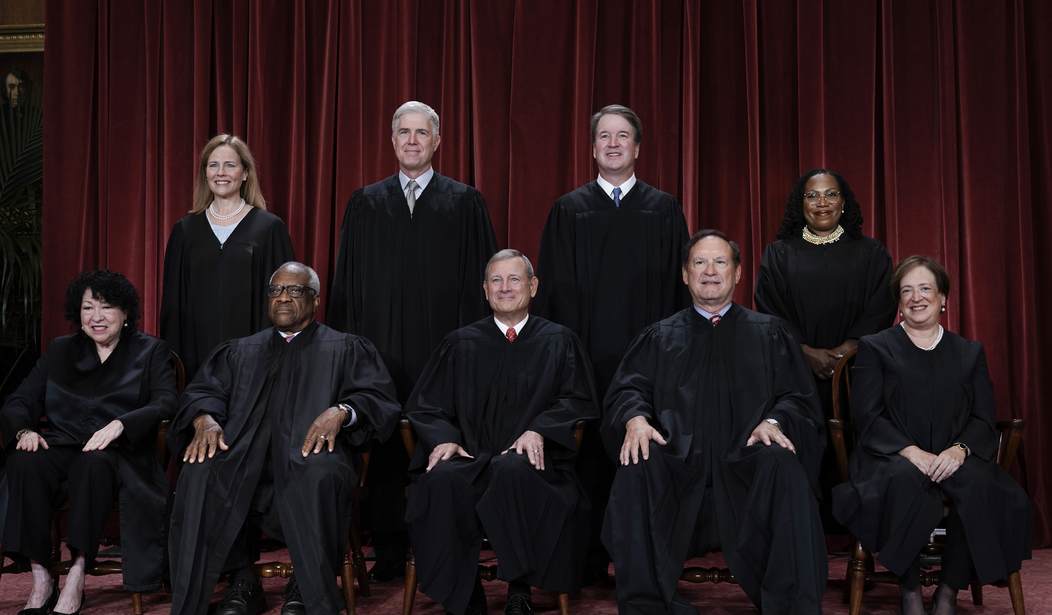
The CASA ruling has been handed down, and rogue judges and unhinged liberals are hardest hit. While it doesn’t address the issue of birthright citizenship per se, it did strike down the national injunction power that district judges have been abusing since the outset of the second Trump presidency.
SCOTUSblog set up the issue:
Whether the Supreme Court should stay the district courts' nationwide preliminary injunctions on the Trump administration’s Jan. 20 executive order ending birthright citizenship except as to the individual plaintiffs and identified members of the organizational plaintiffs or states.
And in a 6-3 ruling, the Court ruled:
Universal injunctions likely exceed the equitable authority that Congress has given to federal courts. The Court grants the Government’s applications for a partial stay of the injunctions entered below, but only to the extent that the injunctions are broader than necessary to provide complete relief to each plaintiff with standing to sue.
Trump v. Casa (birthright citizenship) is a Barrett opinion. Looks like a blunderbuss against national injunctions. This is a genuine "holy crap" decision. If you've been waiting for SCOTUS to rein in anti-Trump district courts, this one's for you (@varadmehta )
— Sean T at RCP (@SeanTrende) June 27, 2025
Katie's post on the decision is here.
🚨BREAKING: The Supreme Court rules that nationwide injunctions "likely exceed the equitable authority that Congress has given to federal courts."
— Townhall.com (@townhallcom) June 27, 2025
This is a BIG WIN for President Trump — against rogue federal judges & universal injunctions! pic.twitter.com/hqm7N1yNr2
On the one year anniversary of Trump’s debate smackdown on Biden, SCOTUS just delivered him the biggest victory he’s ever received.
— johnny maga (@_johnnymaga) June 27, 2025
District Court judges can no longer thwart his agenda with nationwide injunctions. pic.twitter.com/MPhHjeSplC
WASHINGTON (AP) — Supreme Court limits judges' power on nationwide injunctions, but fate of Trump birthright citizenship order unclear.
— Seung Min Kim (@seungminkim) June 27, 2025
Talk about a smackdown of these little judges. Judge James Boasberg is probably crying like a little girl in a closet, but let’s get back to this opinion. It was written by Amy Coney Barrett, whose opinions have been mixed, but this one is excellent. She also torched her liberal colleagues:
We will not dwell on JUSTICE JACKSON’s argument, which is at odds with more than two centuries’ worth of precedent, not to mention the Constitution itself. We observe only this: JUSTICE JACKSON decries an imperial Executive while embracing an imperial Judiciary.
No one disputes that the Executive has a duty to follow the law. But the Judiciary does not have unbridled authority to enforce this obligation—in fact, sometimes the law prohibits the Judiciary from doing so. See, e.g., Marbury v. Madison, 1 Cranch 137 (1803) (concluding that James Madison had violated the law but holding that the Court lacked jurisdiction to issue a writ of mandamus ordering him to follow it). But see post, at 15 (JACKSON, J., dissenting) (“If courts do not have the authority to require the Executive to adhere to law universally, . . . compliance with law sometimes becomes a matter of Executive prerogative”). Observing the limits on judicial authority—including, as relevant here, the boundaries of the Judiciary Act of 1789—is required by a judge’s oath to follow the law.
JUSTICE JACKSON skips over that part. Because analyzing the governing statute involves boring “legalese,” post, at 3, she seeks to answer “a far more basic question of enormous practical significance: May a federal court in the United States of America order the Executive to follow the law?” Ibid. In other words, it is unecessary to consider whether Congress has constrained the Judiciary; what matters is how the Judiciary may constrain the Executive. JUSTICE JACKSON would do well to heed her own admonition: “[E]veryone, from the President on down, is bound by law.” Ibid. That goes for judges too.
And then, there’s this footnote:
The principal dissent faults us for failing to identify a single founding era case in which this Court held that universal injunctions exceed a federal court’s equitable authority. See post, at 29 (opinion of SOTOMAYOR, J.). But this absence only bolsters our case. That this Court had no occasion to reject the universal injunction as inconsistent with traditional equity practice merely demonstrates that no party even bothered to ask for such a sweeping remedy—because no court would have entertained the request. Cf. Grupo Mexicano, 527 U. S., at 332 (“[E]quitable powers conferred by the Judiciary Act of 1789 did not include the power to create remedies previously unknown to equity jurisprudence”).
The entire conservative wing laughed at their liberal colleagues for adhering to a legal philosophy that the late Justice Antonin Scalia would routinely expose and mock as pure applesauce. As he noted, the world is your oyster if you’re a liberal jurist; you twiddle your thumbs and stare at the ceiling, wondering if the death penalty is unconstitutional today.
More of Barrett nuking Jackson from orbit: pic.twitter.com/joKaIdtr0v
— Conn Carroll (@conncarroll) June 27, 2025
What a brutal takedown by Justice Barrett.
Again, the issue of birthright citizenship wasn't tackled head-on, but gutting the national injunction powers wielded by unhinged district courts is a solid win.
The judicial coup is over.
Holy shit, this is about as brutal as I've ever seen SCOTUS be on one of their own.
— Kostas Moros (@MorosKostas) June 27, 2025
Translated: "you are so stupid that you aren't even worth responding to." pic.twitter.com/e4gDIBM6Va
— Bonchie (@bonchieredstate) June 27, 2025

Join the Conversation
VIP members get the ability to comment on articles.