





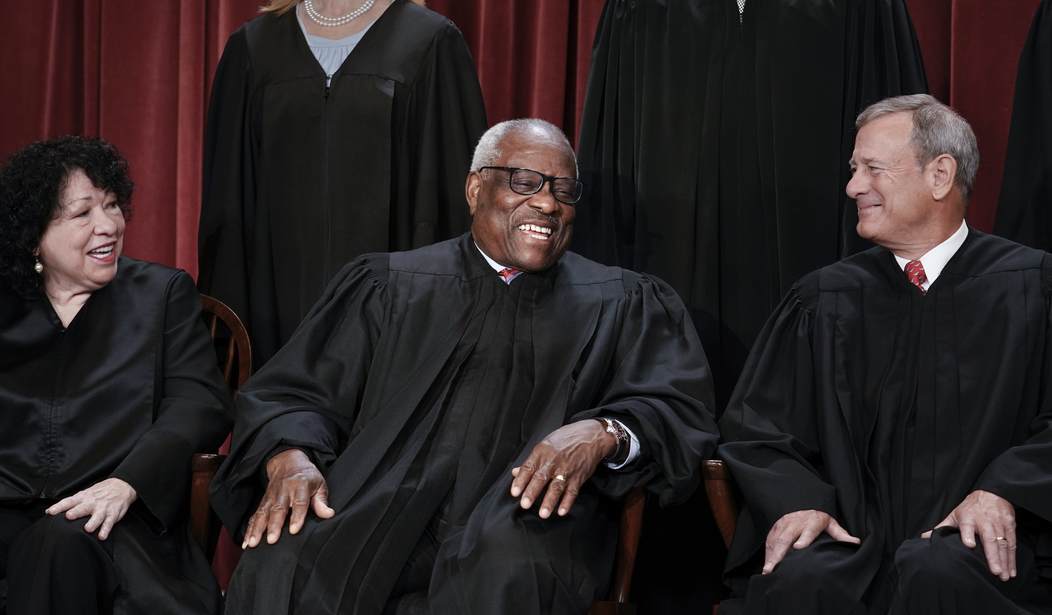
In a 6-3 decision Friday, the Supreme Court ruled President Donald Trump's efforts to end "birthright" citizenship are constitutional, overruling rogue judges issuing national injunctions. As explained by our friends at RedState, "the court has issued an opinion in CASA v. Trump, which is actually three consolidated cases involving challenges to President Donald Trump's executive order regarding birthright citizenship."
"Universal injunctions likely exceed the equitable authority that Congress has given to federal courts. The Court grants the Government's applications for a partial stay of the injunctions entered below, but only to the extent that the injunctions are broader than necessary to provide complete relief to each plaintiff with standing to sue," the decision states, authored by Justice Amy Coney Barrett.
“When a court concludes that the Executive Branch has acted unlawfully, the answer is not for the court to exceed its power, too,” she continued. “The Court today puts an end to the ‘increasingly common’ practice of federal courts issuing universal injunctions.”
🚨BREAKING: The Supreme Court rules that nationwide injunctions "likely exceed the equitable authority that Congress has given to federal courts."
— Townhall.com (@townhallcom) June 27, 2025
This is a BIG WIN for President Trump — against rogue federal judges & universal injunctions! pic.twitter.com/hqm7N1yNr2
🚨🚨🚨BREAKING: Trump scores another SCOTUS victory in Birthright Citizenship Case (NOT ON MERITS) but on whether a universal injunction is permitted. HUGELY significant in every case with universal injunctions. 1/ Reading now. Analysis to follow pic.twitter.com/VtJrjauxYl
— Margot Cleveland (@ProfMJCleveland) June 27, 2025
“GIANT WIN in the United States Supreme Court! Even the Birthright Citizenship Hoax has been, indirectly, hit hard. It had to do with the babies of slaves (same year!), not the SCAMMING of our Immigration process. Congratulations to Attorney General Pam Bondi, Solicitor General John Sauer, and the entire DOJ. News Conference at the White House, 11:30 A.M. EST,” President Trump said about the ruling on Truth Social.
In September 2022, liberal Justice Elena Kagan explained that one judge cannot derail a president's national agenda.
THE IRONY!🚨
— Townhall.com (@townhallcom) May 15, 2025
In 2022, Elena Kagan, a LIBERAL Supreme Court justice, says "It CAN'T be right that one District Judge can stop a nationwide policy in it's tracks"
OH?! You mean how District Judges have issued 17 nationwide orders stopping Trump's policies in their tracks? 🤡 pic.twitter.com/sq2J2Vulgz
Trump signed an executive order in January to "protect the meaning and value of American citizenship," purposely forcing a legal fight in order to get the interpretation of the 14th Amendment to the Supreme Court. The merits of "birthright" citizenship and the interpretation of the 14th Amendment were not conducted in this case, which was about national injunctions from judges.
From the order:
The privilege of United States citizenship is a priceless and profound gift. The Fourteenth Amendment states: “All persons born or naturalized in the United States, and subject to the jurisdiction thereof, are citizens of the United States and of the State wherein they reside.” That provision rightly repudiated the Supreme Court of the United States’s shameful decision in Dred Scott v. Sandford, 60 U.S. (19 How.) 393 (1857), which misinterpreted the Constitution as permanently excluding people of African descent from eligibility for United States citizenship solely based on their race.
But the Fourteenth Amendment has never been interpreted to extend citizenship universally to everyone born within the United States. The Fourteenth Amendment has always excluded from birthright citizenship persons who were born in the United States but not “subject to the jurisdiction thereof.” Consistent with this understanding, the Congress has further specified through legislation that “a person born in the United States, and subject to the jurisdiction thereof” is a national and citizen of the United States at birth, 8 U.S.C. 1401, generally mirroring the Fourteenth Amendment’s text.
Among the categories of individuals born in the United States and not subject to the jurisdiction thereof, the privilege of United States citizenship does not automatically extend to persons born in the United States: (1) when that person’s mother was unlawfully present in the United States and the father was not a United States citizen or lawful permanent resident at the time of said person’s birth, or (2) when that person’s mother’s presence in the United States at the time of said person’s birth was lawful but temporary (such as, but not limited to, visiting the United States under the auspices of the Visa Waiver Program or visiting on a student, work, or tourist visa) and the father was not a United States citizen or lawful permanent resident at the time of said person’s birth.
This is a breaking story, stay tuned for updates. This story has been updated with additional information.

Join the Conversation
VIP members get the ability to comment on articles.