





The death penalty is another issue where liberals and conservatives seem to be coming to a consensus regarding its implementation and the cost of this exceedingly expensive form of punishment. While the death penalty is constitutionally permissible, National Review’s Ramesh Ponnuru said, "The state has the legitimate authority to execute criminals, but it should refrain if it has other means of protecting people from them. Our government almost always does.” As for costs, in some counties, capital punishment has become a budget buster. Last summer, death row inmates in Oklahoma petitioned the Supreme Court in Glossip v. Gross, saying that the drugs used in the lethal injection process would violate their constitutional rights. The case gained national attention when one of the defendants, Charles Warner, was given a botched execution since the state used the wrong drugs. Sodium thiopental was commonly used to make sure the inmate did not feel pain during the process, which ultimately ends with potassium chloride being injected to induce cardiac arrest.
In the end, the Court ruled that the three-drug cocktail did not violate the Eighth Amendment, and that the inmates “failed to establish a likelihood of success on the merits of their claim that the use of midazolam, a sedative, as the first drug in Oklahoma’s lethal injection protocol violates the Eighth Amendment because it fails to render a person insensate to pain.” Nevertheless, the liberal wing of the court touched upon the constitutionality of the punishment, whereas Justice Scalia aptly noted, “It is impossible to hold unconstitutional that which the Constitution explicitly contemplates. The Fifth Amendment provides that ‘[n]o person shall be held to answer for a capital . . . crime, unless on a presentment or indictment of a Grand Jury,” and that no person shall be “deprived of life . . . without due process of law.’.” Then again, Scalia has also made it clear that it’s permissible to abolish the death penalty, and in some states, that’s been the case.
This week, he conceded that he wouldn’t be shocked if the Court struck down the death penalty (via AP):
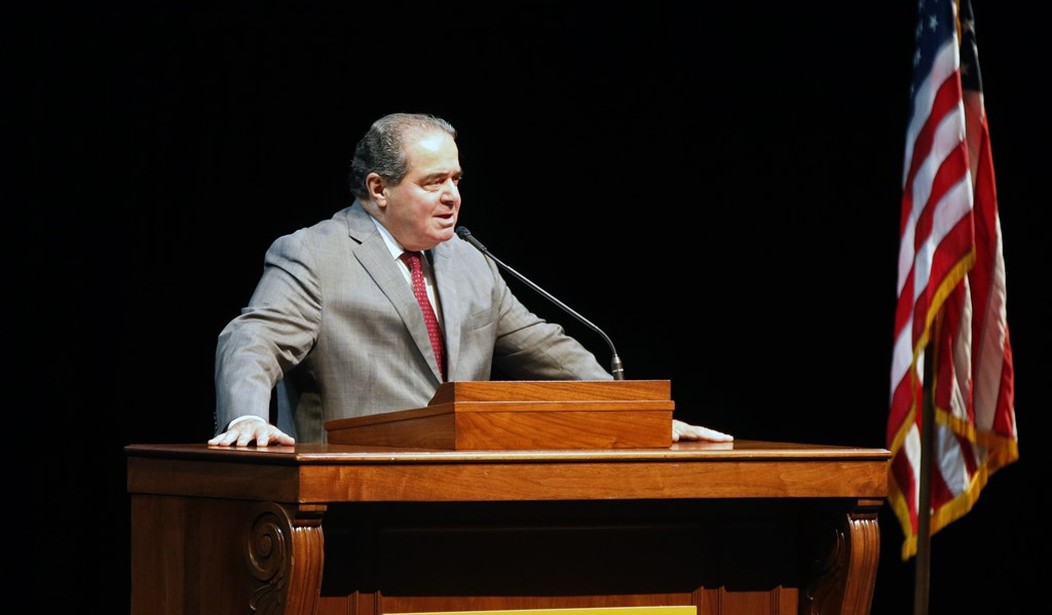
Referencing rulings to restrict capital punishment and changing sentiment within the Supreme Court, Justice Antonin Scalia said Tuesday he wouldn't be surprised if the nation's highest court invalidates the death penalty.Scalia addressed capital punishment during a University of Minnesota Law School appearance in which he also made clear retirement isn't in his near-term plans. The death penalty came up as Scalia described his judicial view that the Constitution is an "enduring" document that shouldn't be open to broad interpretation — while sharing frustration that his colleagues too readily find flexibility in it.
Scalia said death penalty decisions from the court have made it "practically impossible to impose it but we have not formally held it to be unconstitutional." Earlier in his remarks, Scalia said "it wouldn't surprise me if it did" fall, a comment that drew scattered applause in the mostly full, 2,700-seat auditorium.
He said the high court has increasingly made it difficult impose the death penalty. He said rulings have added mitigating circumstances that must be considered or made it impermissible to automatically sentence people to death for certain crimes, such as killing a police officer.
The Supreme Court this month began its latest term and has already heard one death penalty challenge out of Kansas. While that case is limited in scope it was the first high court hearing on death penalty cases since a bitter clash over lethal injection procedures exposed deep divisions among the justices last term. The court intends to consider a case from Florida that questions whether judges, rather than juries, can impose a death sentence, especially when the jury is not unanimous in recommending death.
Recommended

The silver lining is that he isn’t retiring anytime soon.







Join the conversation as a VIP Member