







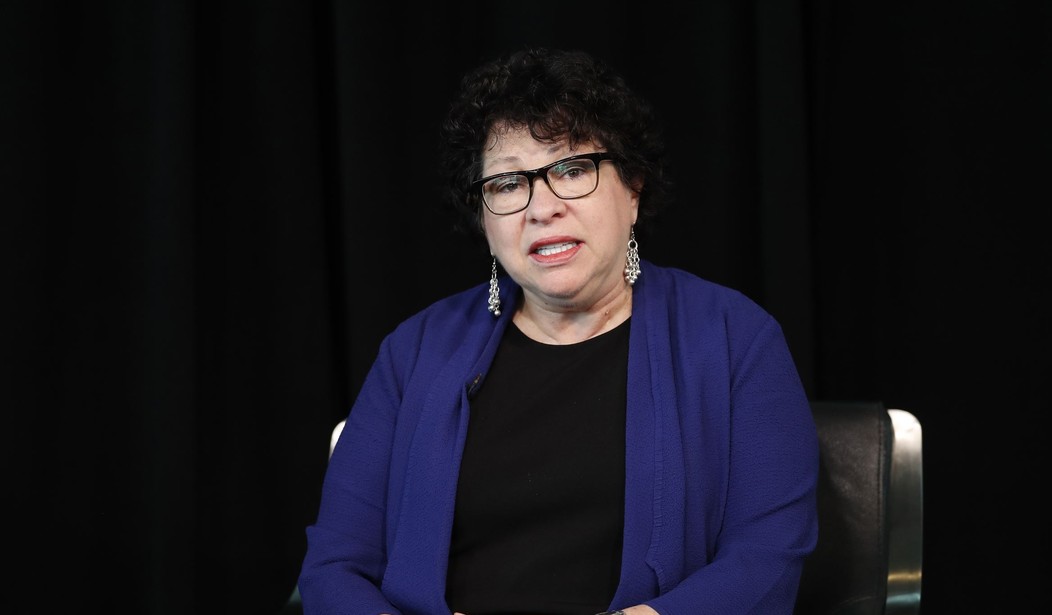
Supreme Court Justice Sonya Sotomayor described the Court’s refusal to block Texas’ “heartbeat” abortion law “catastrophic” and that she “cannot capture the totality of this harm.”
Last week, as Rebecca reported, the Supreme Court of the United States (SCOTUS) agreed to hear two cases surrounding S.B. 8, the newly-enacted Texas law that outlaws abortion after fetal heartbeat detection. The law allows citizens to pursue legal action against anyone who provides an illegal abortion or abets a woman obtaining an illegal abortion. Citizens who successfully bring lawsuits under S.B. 8 can receive up to $10,000.
Since Sept. 1, the day S.B. 8 came into effect, it has faced several legal challenges. On that day, SCOTUS ruled 5-4 allowing S.B. 8 to stay in effect after abortion providers and advocacy groups submitted a last-minute request for the Court to block it. Following the Court’s decision, President Biden promised a “whole-of-government” approach to fight the law. Days later, the Department of Justice (DOJ) announced that it would sue Texas over S.B. 8.
Once the DOJ went after S.B. 8, a short-lived temporary injunction was implemented by an Obama-appointed U.S. District Court judge. Later that same week, District Court Judge Pitman’s ruling was overruled by the Fifth Circuit Court of Appeals, who issued an administrative stay on S.B. 8. The DOJ then asked SCOTUS to block the law.
While SCOTUS has agreed to hear oral arguments for two cases surrounding the law on Nov. 1, the Court did not block the enforcement of S.B. 8. In her seven-page opinion, Sotomayor explained why she disagreed with this decision.
“Women seeking abortion care in Texas are entitled to relief from this Court now,” Sotomayor wrote. “Because of the Court’s failure to act today, that relief, if it comes, will be too late for many.” This is pointed at the fact that fetal heartbeat detection occurs at approximately six weeks, before many women know they are pregnant.
“There is no dispute that under this Court’s precedents, women have a constitutional right to seek abortion care prior to viability,” Sotomayor continued in her opinion, referring to landmark 1973 case Roe v. Wade. “There are women in Texas who became pregnant on or around the day that S. B. 8 took effect. As I write these words, some of those women do not know they are pregnant. When they find out, should they wish to exercise their constitutional right to seek abortion care, they will be unable to do so anywhere in their home State.”
Sotomayor, who was sworn in as an associate justice in 2009, was nominated by former President Obama to fill the seat left vacant by David Souter. Previously, she was nominated to serve as a U.S. District Court judge by former President George H.W. Bush in 1991 and nominated to serve on the Second Circuit Court of Appeals by President Clinton in 1997.



Join the Conversation
VIP members get the ability to comment on articles.