





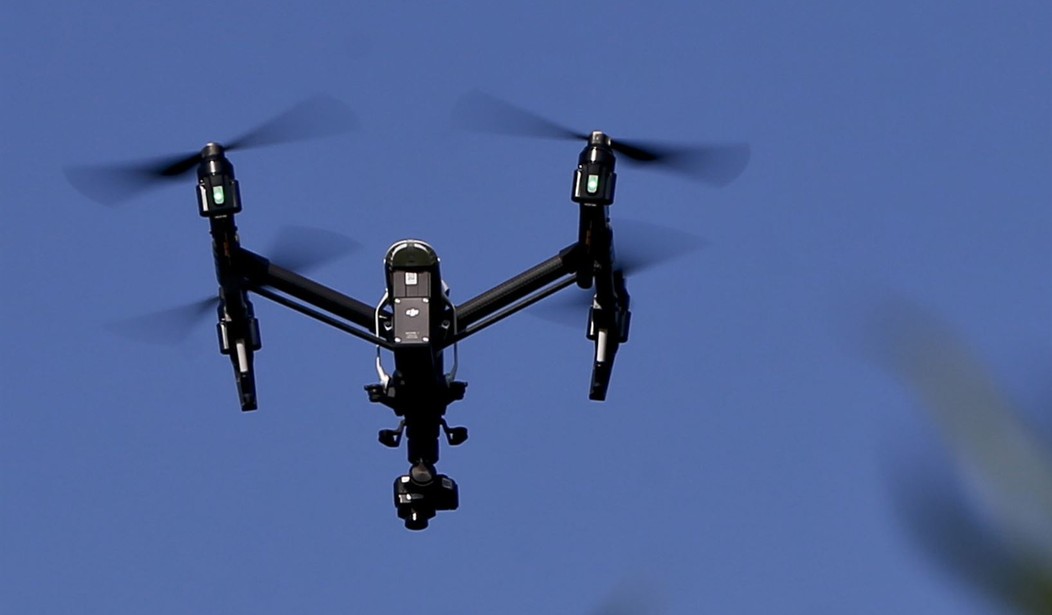
Rep. William Timmons (R-SC), chairman of the Subcommittee on Military and Foreign Affairs, and Republicans on the panel are calling on the Departments of Defense, Transportation, and Justice to provide documents detailing how the federal government is addressing the risk of drone incursions on military installations.
“Recent high-profile incursions near sensitive military facilities, power infrastructure, and public events suggest that the current framework for domestic counter-drone operations remains fragmented and, in some cases, insufficiently agile to meet evolving threats,” the lawmakers wrote in letters to the department heads.
The lawmakers highlight that in 2024 alone, there were over 350 drone incursions detected at more than 100 bases in the U.S.
During a subcommittee hearing held in April concerning this issue, a witness told the lawmakers about how the threat is being magnified by artificial intelligence-enabled technologies in drones. And the world is witnessing how drones are being used in military conflicts.
From the early days of Russia’s 2022 invasion, unmanned aerial systems (UAS) have been deployed with devastating effect by both Russian and Ukrainian forces, transforming how battles are fought and how intelligence is gathered. What began as surveillance and artillery-spotting platforms has evolved into a full-scale integration of explosive-laden loitering munitions, or "kamikaze drones," capable of precision strikes deep behind enemy lines.
One of the most notorious platforms is the Iranian-made Shahed-136, a low-cost, GPS-guided drone that Russia has used in swarms to overwhelm Ukrainian air defenses and strike civilian infrastructure, including power stations and residential areas. These drones, launched in waves, have been used to sow terror and inflict strategic damage while costing a fraction of conventional missiles. Ukraine, for its part, has responded with creative adaptations, converting consumer camera drones into improvised bombers and launching strikes on Russian trenches, vehicles, and even naval assets in the Black Sea.
Israel used drones alongside warplanes to assault top generals and key military and nuclear facilities in Operation Rising Lion this month. Iran fired back its own onslaught of drones toward Israel.
Military analysts have said Ukraine represents the first major war where drones are central to strategy, not just supporting tools. Their widespread deployment has forced a tactical rethink, prompted innovations in electronic warfare and counter-UAS systems, and prompted debate about how quickly drones may outpace manned aircraft in aerial combat. (Fox News)
“To better understand this issue, the Subcommittee is requesting documents and information concerning the federal government’s authorities and operational posture for countering unmanned aerial systems (cUAS) within the United States, with particular attention to discrepancies in how threats from unmanned verses manned aircraft are treated under current law and policy,” the lawmakers said.
Drones are surveilling American military bases, some for weeks at a time. 🛸🤔
— Oversight Committee (@GOPoversight) June 26, 2025
Chairman @RepTimmons and Oversight Republicans are seeking documents from the DOJ, DOT, and DOD to uncover who is behind these incursions and find ways to fix the broken counter-drone response system. pic.twitter.com/lLNqfbhRe2



Join the Conversation
VIP members get the ability to comment on articles.