


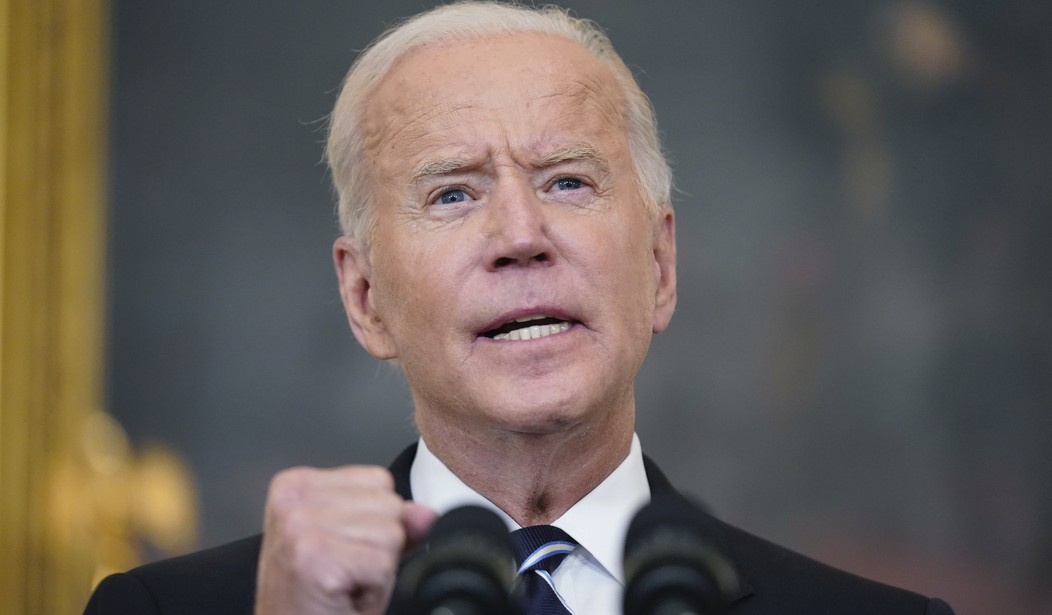
After decades of failed climate predictions, one would think the president of the United States would steer clear of making one. But this week, President Biden did just that when discussing what he claims is a global climate crisis.
While out West touring wildfire-ravaged areas, Biden tried to sell some of the climate change measures tucked into spending packages but which “appear increasingly at risk,” according to The New York Times.
“A drought or a fire doesn’t see a property line,” he said during at a stop at a federal renewable energy laboratory. “It doesn’t give a damn for which party you belong to. Disasters aren’t going to stop. That’s the nature of the climate threat. But we know what we have to do. We just need to summon the courage and the creativity to do it.”
He spoke of goals like investing in a modernized electric grid, electric busses, charging stations, and more.
“When I rejoined the Paris Climate Accord after we had been pulled out of it, the goal set when our last administration, the Obama-Biden administration, when that was set, they were set that we had more time. We don’t have the time now. The goals are different because the necessity is there. We don’t have a lot of time. We don’t have much more than 10 years for real,” he said.
President Biden on the urgency to act on climate change: "We don't have the time now. The goals are different. [...] We don't have much more than 10 years. For real." pic.twitter.com/HT4zusvdM7
— The Hill (@thehill) September 15, 2021
No matter how urgent Biden believes the “climate crisis” is, that doesn’t change the fact that such predictions and warnings have been notoriously wrong over the years.

In a 2019 column, the late Walter Williams recalled just some of them.
As reported in The New York Times (Aug. 1969) Stanford University biologist Dr. Paul Erhlich warned: "The trouble with almost all environmental problems is that by the time we have enough evidence to convince people, you're dead. We must realize that unless we're extremely lucky, everybody will disappear in a cloud of blue steam in 20 years."
In 2000, Dr. David Viner, a senior research scientist at University of East Anglia's climate research unit, predicted that in a few years winter snowfall would become "a very rare and exciting event. Children just aren't going to know what snow is." In 2004, the U.S. Pentagon warned President George W. Bush that major European cities would be beneath rising seas. Britain will be plunged into a Siberian climate by 2020. In 2008, Al Gore predicted that the polar ice cap would be gone in a mere 10 years. A U.S. Department of Energy study led by the U.S. Navy predicted the Arctic Ocean would experience an ice-free summer by 2016.
In May 2014, French Foreign Minister Laurent Fabius declared during a joint appearance with Secretary of State John Kerry that "we have 500 days to avoid climate chaos."
Peter Gunter, professor at North Texas State University, predicted in the spring 1970 issue of The Living Wilderness: "Demographers agree almost unanimously on the following grim timetable [...] By the year 2000, or conceivably sooner, South and Central America will exist under famine conditions. ... By the year 2000, thirty years from now, the entire world, with the exception of Western Europe, North America, and Australia, will be in famine."
Ecologist Kenneth Watt's 1970 prediction was, "If present trends continue, the world will be about four degrees colder for the global mean temperature in 1990, but eleven degrees colder in the year 2000." He added, "This is about twice what it would take to put us into an ice age." (Townhall)
The major difference between predictions made in the past and those of today is how much more gullible Americans are now, Williams argued, meaning we'll spend into oblivion to combat climate change. "The only result is that we'll be much poorer and less free," he said.







Join the conversation as a VIP Member