





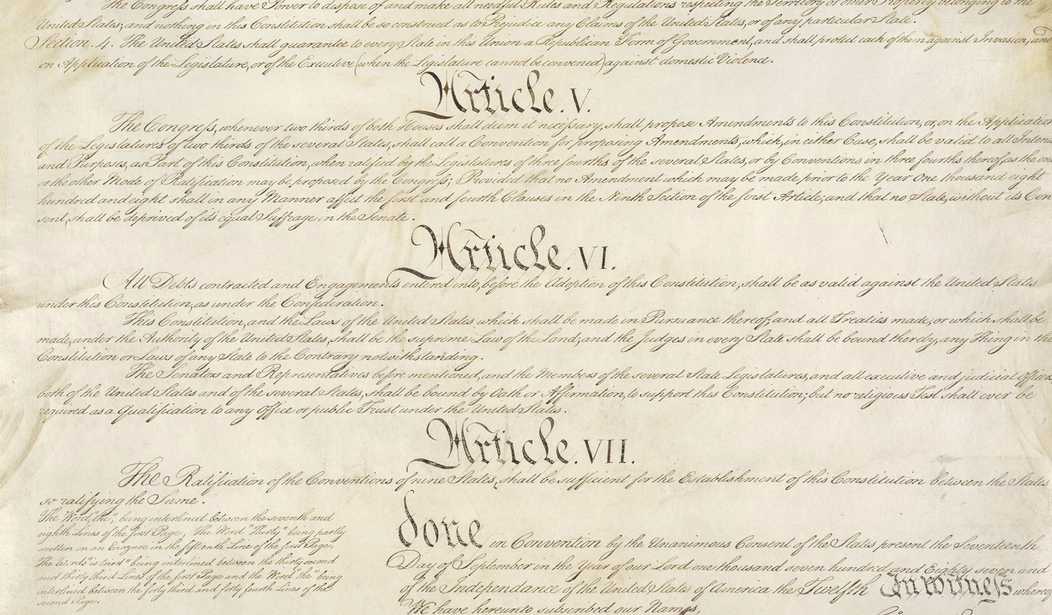
The National Archives Records Administration has placed a trigger warning all documents across its website, which includes the U.S. Constitution, Bill of Rights, and Declaration of Independence.
Viewers will now be met with a “harmful language alert" at the top of the page that links to its official statement on potentially harmful content.
“NARA’s records span the history of the United States, and it is our charge to preserve and make available these historical records,” the statement says. “As a result, some of the materials presented here may reflect outdated, biased, offensive, and possibly violent views and opinions. In addition, some of the materials may relate to violent or graphic events and are preserved for their historical significance.”
NARA provides examples of what could be considered harmful content:
- reflect racist, sexist, ableist, misogynistic/misogynoir, and xenophobic opinions and attitudes;
- be discriminatory towards or exclude diverse views on sexuality, gender, religion, and more;
- include graphic content of historical events such as violent death, medical procedures, crime, wars/terrorist acts, natural disasters and more;
- demonstrate bias and exclusion in institutional collecting and digitization policies.
When asked on Twitter why the trigger warning appeared on documents such as the Constitution, NARA said the “alert is not connected to any specific records, but appears at the top of the page while you are using the online Catalog.”
The National Archives have now put a disclaimer on their website that our historical documents may include Harmful Content.
— Lauren Boebert (@laurenboebert) September 7, 2021
They even slapped this warning on the Constitution.
We tried to tell you the Left wanted to get rid of it! pic.twitter.com/UeJtqgudMm
This alert is not connected to any specific record, but appears at the top of the page while you are using the online Catalog (https://t.co/UxHBP7pek8).
— US National Archives (@USNatArchives) September 8, 2021
Learn more about the harmful language alert: https://t.co/E3uoAKaF5J
That excuse didn't cut it for some.
You should be ashamed, but I know you aren't. Sad.
— James Fields (@Jfieldsjames) September 8, 2021
This is completely pathetic.
— Charles X Proxy™ (@Charlemagne0814) September 8, 2021
I build complex web based software systems and even I know you don’t have to have a *blanket* warning over *every* record and if your designer says that’s the only solution you need to fire that contractor.
— The Robot Watcher ?? (@TheRobotWatcher) September 9, 2021



Join the Conversation
VIP members get the ability to comment on articles.