





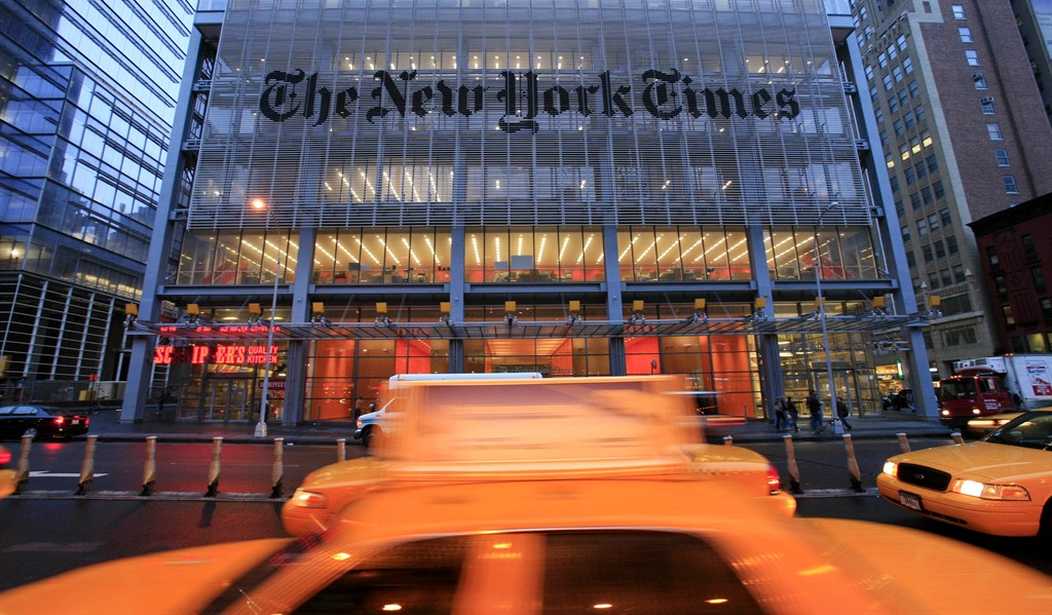
This week marks the 50th anniversary of the Apollo moon landing, but instead of celebrating one of the most remarkable achievements in history, The New York Times decided to focus on another aspect of the story: sexism.
“The Apollo program was designed by men, for men. If we do not acknowledge the gender bias of the early space program, it becomes difficult to move past it,” read the tweet promoting the article, which was titled “To Make It to the Moon, Women Have to Escape Earth’s Gender Bias.”
The Apollo program was designed by men, for men. If we do not acknowledge the gender bias of the early space program, it becomes difficult to move past it. https://t.co/Mt7rVLgAaf
— The New York Times (@nytimes) July 17, 2019
As we celebrate the 50th anniversary of the Apollo 11 moon landing, NASA has started Artemis, a program that aims “to return astronauts to the lunar surface by 2024, including the first woman and the next man.”
Although both astronauts have enormous challenges ahead, the first woman will face added hurdles simply because everything in space carries the legacy of Apollo. It was designed by men, for men.
Not deliberately for men, perhaps, but women were not allowed in the astronaut program until the late 1970s, and none flew until Sally Ride became the first American woman in space, in 1983. By this point, the space program was built around male bodies.
If we do not acknowledge the gender bias of the early space program, it becomes difficult to move past it. (NYT)
Among the issues the author discusses are the sizes of spacesuits and the cooling garments used underneath.
As one can suspect, Twitter had a field day with the story.
The @nytimes was designed by men, for men. If we do not acknowledge the gender bias of the early @nytimes, it becomes difficult to move past it. https://t.co/92rpzHGAMv
— Patricia Heaton (@PatriciaHeaton) July 17, 2019
Nicely done.
— Dr. Rob Tennant (@TennantRob) July 17, 2019
Hollywood studios were designed by men, for men....
The government was designed by men, for men...
We could do this all day and get nowhere quickly.
Very disappointing of the @nytimes
The American news media: Making sure America never makes the mistake of being proud of its accomplishments. Thank you, haters!
— Daniel Lee (@RealDanLee) July 17, 2019
I understand that a few years earlier the invasion of Normandy was also a program designed by men, for men. Was that gender bias? Can you get past that?
— John Ackermann (@johnackermann) July 17, 2019
If this were 1969, your article might be relevant. Amazing, America & the West are the most culturally evolved societies on Earth yet they're forever criticized & condemned. Seems the Left believes Whites should be held to a standard of perfection, as if we were a superior race.
— Lesbian Conservative (@lesbianoutsider) July 17, 2019
Over 60 percent of their articles are by men https://t.co/4q4enirjUx pic.twitter.com/RKpQibmfX5
— Michael Tauberg (@MichaelTauberg) July 17, 2019
@xBenJamminx pic.twitter.com/wCYFViQHmM
— TOMMY G (@TommyG) July 17, 2019


Join the Conversation
VIP members get the ability to comment on articles.