




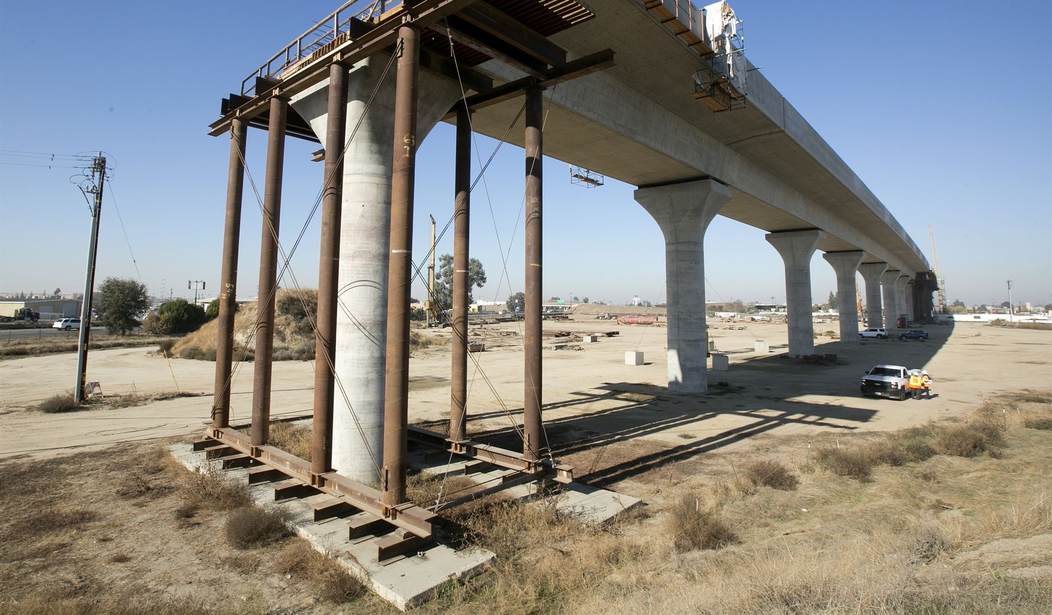
The Trump administration said they are exploring “every legal option” to get back $2.5 billion in federal funds California spent on its high-speed rail boondoggle, which Gov. Gavin Newsom announced in his first State of the State speech he is scaling back because it “would cost too much and take too long.” Additionally, the U.S. Department of Transportation said it plans to cancel $928 million in federal grants awarded to the project, which would’ve connected Los Angeles and San Francisco.
Department of Transportation and Federal Railroad Administration (FRA) Administrator Ronald Batory said in his letter making the announcement that Newsom's comments were a "significant retreat from the State's initial vision and commitment and frustrates the purpose for which federal funding was awarded.”
He further said the state “materially failed to comply with the terms” of the agreement.
The grant agreement between California and the federal government, signed in 2010, outlines several scenarios in which the federal government could take the money back. It can take the money back, for example, if the grantee fails to make "adequate progress" or "fails to complete the project or one of its tasks" or if the state doesn't meet its matching fund requirements.
If the federal government decides to take the money back, it doesn't have to wait for California to write a check. The agreement states the federal government could offset the money it would pay California for different transportation or other projects.
California hasn't yet fully matched the $2.5 billion in stimulus money. It's in the process of doing so now, using money from the 2008 bond passed by voters and revenue from the state's cap-and-trade program. It can't unlock the $929 million grant until it completes its match. (CNBC)

Newsom vowed to fight to keep the money and said the move was nothing but political retribution after the state sued the administration over the president’s declaration of a national emergency to pay for the border wall.
"This is clear political retribution by President Trump, and we won't sit idly by," Newsom said in a statement. "This is California's money, and we are going to fight for it."





Join the conversation as a VIP Member