





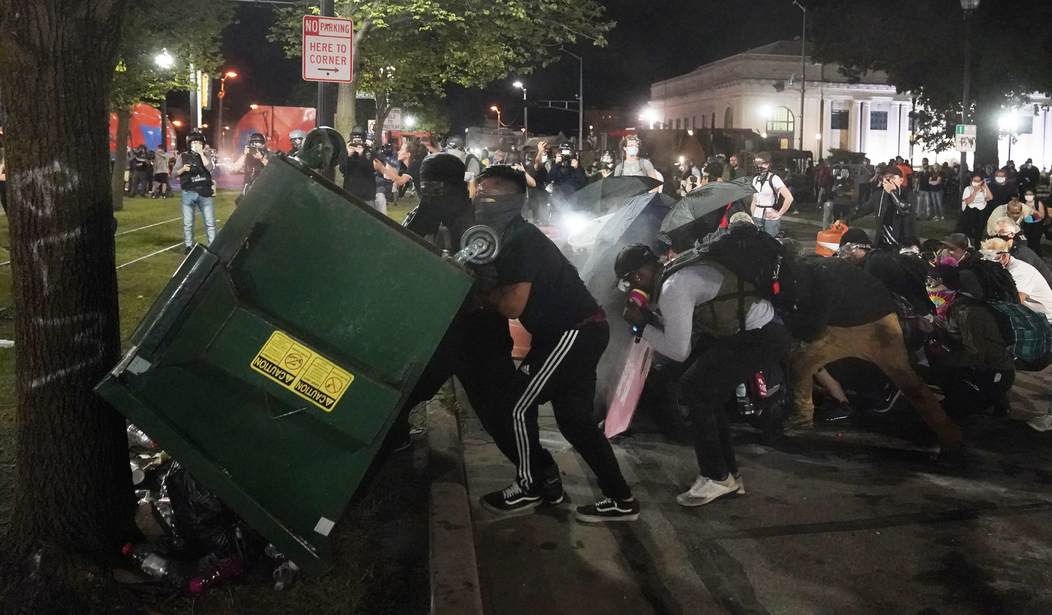
Kyle Rittenhouse's trial is set to start on November 1 and the charges range from murder to attempted murder for his role in killing two people and injuring another with an AR-15 during the Kenosha riots.
But if you've only paid attention to liberals and the mainstream media about the case, you would be left with the impression Rittenhouse shot the men during a "protest." As someone who was on the ground in Kenosha on August 24, 25, and 26 last year, this could not be further from the truth.
The reason why it is important to make the distinction is because the "protest" narrative is used to paint Rittenhouse as someone who was only there to shoot random people at the "protest" when, in reality, Kenosha was experiencing another night of riots in the aftermath of the police shooting of Jacob Blake, which both Wisconsin and federal prosecutors decline to file charges since Officer Rusten Sheskey could make a strong argument for self-defense. The multiple riots in Kenosha are the reason why armed people were in town in the first place.
Here are a few examples of "protest" being used instead of "riot":
- "Men shot by Kyle Rittenhouse during Kenosha protests can be called 'rioters,' 'looters' and 'arsonists' at trial, judge rules": CBS News
- "The three men shot by Kyle Rittenhouse during a protest against police brutality can be labeled rioters, looters or arsonists — but they shouldn't be called victims, the Wisconsin judge in Rittenhouse's murder trial ruled this week": NBC News
- "An Illinois man was justified in shooting three people during a protest over police brutality in Wisconsin last year because the men confronted him and two of them tried to wrestle his gun away, a use-of-force expert called by the defense testified at a pretrial hearing Tuesday": Associated Press
- "One year after Kenosha protest shootings, Kyle Rittenhouse's case has a long way to go": Milwaukee Journal Sentinel reposted by USA Today
- "After dark, the crowd streamed away from the courthouse, where the police were firing tear gas and rubber bullets. As armored vehicles herded the protesters toward the mechanic shop, one of them said, 'We in Call of Duty!": The New Yorker
- "Kyle Rittenhouse pleads not guilty in fatal Kenosha protest shootings": PBS News
- "Kyle Rittenhouse shot and killed two protesters with a rifle at these protests": The Recount
The riot that occurred on the night of August 25 started out in much the same way the night before. People gathered in front of the Kenosha County Courthouse, which now had a fence around it because rioters had attacked the building and police officers for two nights in a row. It did not take long for people to start shaking the fence in order to tear it down. Law enforcement and the National Guard came out of the Courthouse to stop the rioters. The rioters responded by throwing rocks, bottles, and fireworks at police and National Guardsmen.
Rioters are now throwing projectiles at police and the National Guardsmen outside the Kenosha County Courthouse. pic.twitter.com/uYubsBGX0i
— Julio Rosas (@Julio_Rosas11) August 26, 2020
Since it was past curfew, police used armored trucks and tear gas to push everyone out of the park across the street from the courthouse since they refused to stop attacking law enforcement. Even after the crowd was pushed out of the park, they continued to throw objects at the armored trucks as they were pushed further down the street. Some of the rioters even started to damage buildings they passed by.
Police and rioters continue to battle with each other in the streets of Kenosha. pic.twitter.com/NeMzglNQLt
— Julio Rosas (@Julio_Rosas11) August 26, 2020
What it’s like to be by the armored police vehicles in Kenosha: pic.twitter.com/8JJgbdenst
— Julio Rosas (@Julio_Rosas11) August 26, 2020
It's because of this tactic by law enforcement, this is how the crowd of rioters was pushed into the group of armed civilians who were guarding businesses and properties against further damage since they were heavily targeted in the two nights before. This is where I recorded the two sides getting into arguments with each other and even getting Joseph Rosenbaum, the first person killed by Rittenhouse, on-camera taunting the armed civilians, yelling, "Shoot me, n***a!" The crowd of rioters lit a dumpster on fire and tried to roll it down the street towards the police trucks but it was put out by someone on the armed civilian side. The shootings took place shortly after the verbal back and forth between the two sides.
More confrontations between rioters and armed citizens. pic.twitter.com/sAVe1G9xEc
— Julio Rosas (@Julio_Rosas11) August 26, 2020
Now that it is confirmed Joseph Rosenbaum was one of the people shot and killed by alleged gunman Kyle Rittenhouse in Kenosha, I filmed him earlier in the night taunting the armed civilians, saying, "Shoot me, n***a." pic.twitter.com/Nn2encm78Y
— Julio Rosas (@Julio_Rosas11) August 27, 2020
I was up the street when Rittenhouse first shot Rosenbaum, but I recorded the second part of the shootings when Anthony Huber and Gaige Grosskreutz attacked him after falling down.
??????: Multiple gunshots are fired after people chased a guy with a rifle. Rifle dude tripped and fell. He fired his gun at a guy who jumped on top of him. pic.twitter.com/BfV244MMnc
— Julio Rosas (@Julio_Rosas11) August 26, 2020
While Kenosha had peaceful protests before and after August 25, I can say unequivocally the shootings that took place that fateful night happened during a riot. If the media can't be trusted to correctly label the environment in which the high-profile incident took place, how can they be trusted to get the facts and nuance of the shooting right?
Join the Conversation
VIP members get the ability to comment on articles.