





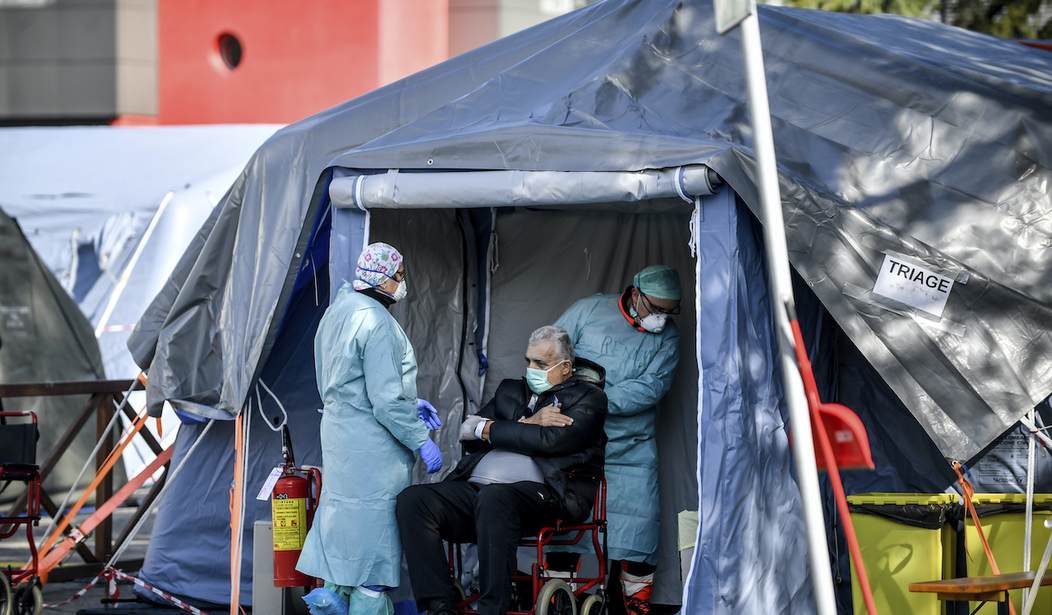
An adviser to Italy's minister of health, Professor Walter Ricciardi, said the coronavirus death rate in Italy may be higher than in other countries not only because of demographics -- Italy has the second oldest population in the world -- but also because of the way Italy records deaths of those who have tested positive for the coronavirus.
"The way in which we code deaths in our country is very generous in the sense that all the people who die in hospitals with the coronavirus are deemed to be dying of the coronavirus," Prof. Riccardi told The Telegraph.
"On re-evaluation by the National Institute of Health, only 12 percent of death certificates have shown a direct causality from coronavirus, while 88 percent of patients who have died have at least one pre-morbidity - many had two or three," the professor explains.
The professor is not alone, as others say it's way too early to know the true mortality rate so long as the number of mild cases in the country remains unknown.
Italy's older population may also explain the large number of deaths being attributed to the coronavirus.
"The age of our patients in hospitals is substantially older - the median is 67, while in China it was 46," the professor says. "So essentially the age distribution of our patients is squeezed to an older age and this is substantial in increasing the lethality."
A study in the Journal of the American Medical Association found that 87 percent of the deaths in Italy attributed to the coronavirus and 40 percent of known infections have been people 70 years of age or older.
The coronavirus obviously poses a threat to the health and well-being of people all around the world, but it's probably a good idea to balance the panic and all the dire forecasts with a little bit of critical thinking.
The Centre for Evidence-Based Medicine points out that 10 weeks after the first international alert for the H1N1 influenza, the overall case fatality rate as of Jul. 16, 2009 varied 0.1% to 5.1%. In 2019, the WHO reported the H1N1 influenza had a much lower fatality rate of 0.02%.
As of Sunday, the number of reported deaths in Italy attributed to the coronavirus is 4,825. But there are reasons to be hopeful that Italy's coronavirus death rate may not be as high as the current reports indicate.



Join the Conversation
VIP members get the ability to comment on articles.