





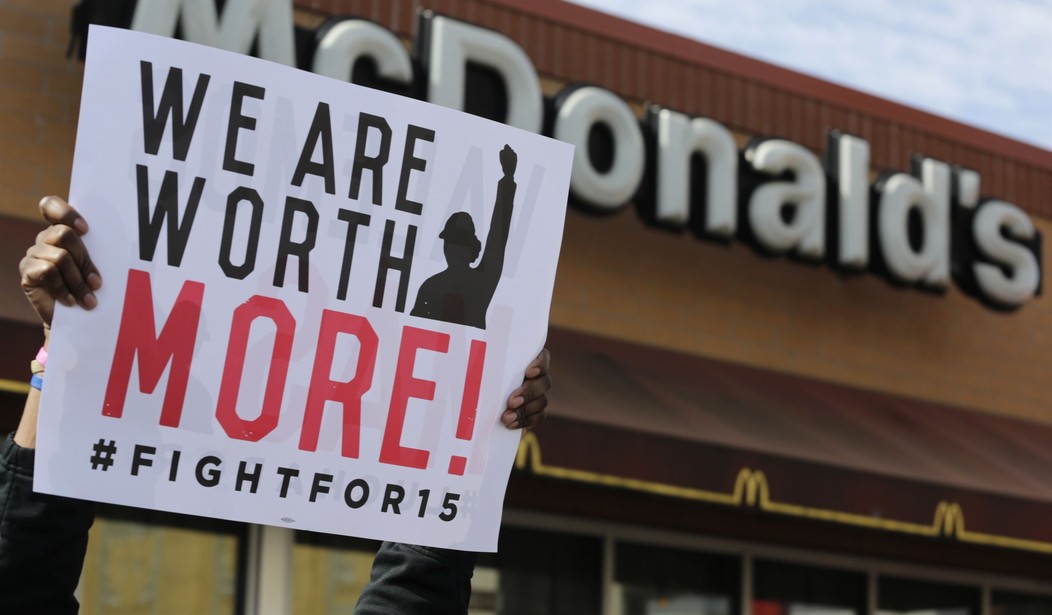
Some day, Democrats will learn that minimum wage laws do not help workers. They only make things more expensive, while leading to reduced hours, fewer jobs, and shuttered businesses. California enacted a $20/hour minimum wage law, and Los Angeles is pushing a $30/hour minimum wage for hospitality workers in the run up to the 2028 Olympic Games, and both have had disastrous economic effects already.
In the Twin Cities, a $15/hour minimum wage is having the same effect.
Higher pay, fewer jobs: The real cost of a $15 minimum wage in the Twin Cities https://t.co/aBcXCbOaWS
— The Minnesota Star Tribune (@StarTribune) May 11, 2026
Here's more (emphasis added):
When the Minneapolis City Council approved a controversial $15 minimum wage in 2017, no one knew what would happen next.
Workers and business owners made dueling predictions of boom or bust that would result from the citywide wage hike. Cities with similar policies were still phasing in the $15 minimum, so it was impossible to say who was right.
Nearly a decade later, businesses in Minneapolis and St. Paul — which passed its own similar law in 2018 — say they’re stretched thinner than ever, and both cities have lost thousands of jobs.
Pressure on the hospitality industry is particularly acute. Restaurants and other leisure-related businesses say shrinking margins have left them less able to weather economic shocks, such as the federal immigration crackdown that forced many to temporarily close this winter.
The Federal Reserve Bank of Minneapolis, which has studied the effects of the $15 minimum wage in Minneapolis since 2018, recently reported minimum wage policies have resulted in higher hourly pay but fewer available hours and positions. That has meant lower earnings: Between 2017 and 2021, the average decline in wage earnings across all industries was 1% in Minneapolis and about 2% in St. Paul. The research controlled for the effects of the COVID-19 pandemic and unrest after George Floyd’s murder in 2020.
We all knew exactly what would happen. Because we have years of minimum wage hikes that demonstrate the same pattern.
You retards actually start with this when millions of conservatives told you exactly what would happen. pic.twitter.com/29kQ3bngZn
— Wisco_Knight Returns (@Wisco__Knight) May 11, 2026
They really tried to do that.
Wow, the thing that every intelligent person warned would happen actually happened.
— Frajer Crane (@vtmiah) May 12, 2026
It's almost like the business owners knew what they were talking about.
Gee. Who could have predicted that? LOL.
— Just Me (@VehementMaybe) May 11, 2026
REPUBLICANS predicted that.
And everyone else with a brain.
Why didn’t anyone warn us?!!
— Michael Holmstrom (@MichaelH_MN) May 11, 2026
Oh wait, we did. https://t.co/6Eiz0mneAf
We did, and we were called all sorts of names for it.
Who could have possibly seen this coming? https://t.co/Zc85muKTRx
— Mark Hemingway (@Heminator) May 11, 2026
Everyone.
This happened in WA as well. It really hit the small services things like hiring for yard work or babysitting too, even though a lot of that isn’t all that formal. It’s been rough. https://t.co/M4vVqzBg63
— Elan (@engele) May 11, 2026
Democrats want to make everyone poorer, so for them, this is a feature and not a bug.
Unexpectedly! https://t.co/FXq5ZIt0Pf
— Omri Ceren (@omriceren) May 12, 2026
Unexpectedly. It took almost a decade and a study to "prove" what anyone who passed fifth grade math could have explained to Minnesota legislators.
Editor’s Note: Thanks to President Trump’s leadership and bold policies, America’s economy is back on track.
Help us continue to report on the president’s economic successes and combat the lies of the Democrats. Join Townhall VIP and use promo code FIGHT to receive 60% off your membership.
Join the Conversation
VIP members get the ability to comment on articles.