





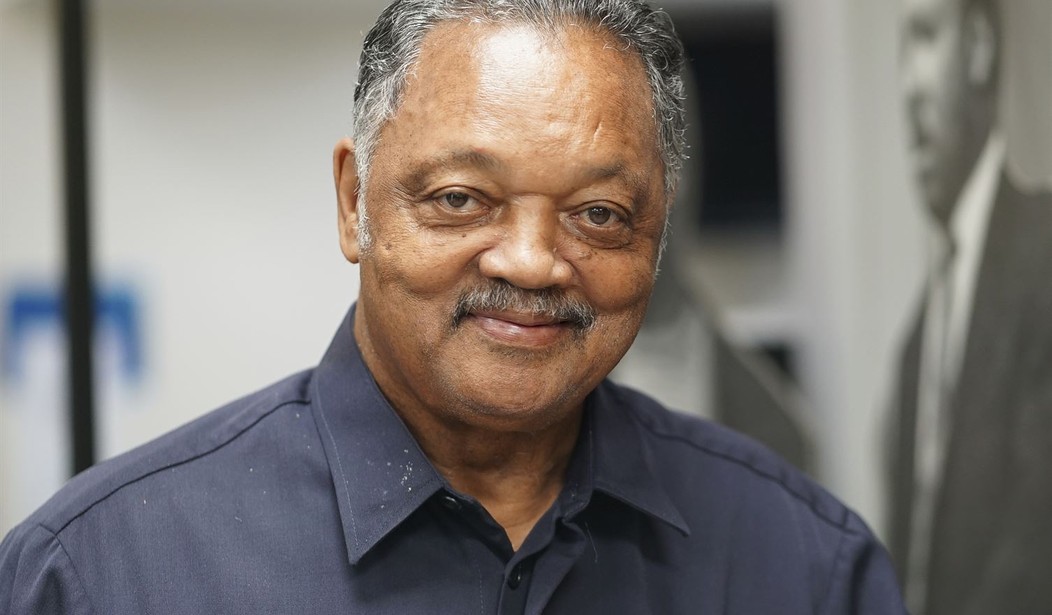
Rev. Jesse Jackson, civil rights activist and founder of the Rainbow PUSH Coalition, has died. He was 84 years old.
JUST IN - U.S. civil rights activist Jesse Jackson dies aged 84. pic.twitter.com/MrQxetdOTp
— Disclose.tv (@disclosetv) February 17, 2026
The Rev. Jesse Jackson, the civil rights leader, Baptist minister and pioneering politician who launched two bids for the U.S. presidency, died on Tuesday morning at the age of 84, his family said in a statement.
"Our father was a servant leader -- not only to our family, but to the oppressed, the voiceless, and the overlooked around the world," the family statement said.
"We shared him with the world, and in return, the world became part of our extended family. His unwavering belief in justice, equality, and love uplifted millions, and we ask you to honor his memory by continuing the fight for the values he lived by," it added.
Jackson was hospitalized late last year with complications related to Progressive Supranuclear Palsy (PSP), a degenerative neurological condition that Jackson was diagnosed with a decade ago. On Sunday, November 16, CBS News reported Jackson was on "some form of life support" at a Chicago hospital.
The Rev. Jesse Jackson is on a form of life support, sources told CBS News. https://t.co/ptwkNZf5pC
— CBS News (@CBSNews) November 16, 2025
Family later issued a correction, saying Jackson was stable and not on life support.
The family of Reverend Jesse L. Jackson, Sr., says he is in stable condition and is breathing without the assistance of machines. And the family clarifies that he is not on life support. https://t.co/g8P5C2h6i0
— FOX 5 DC (@fox5dc) November 17, 2025
In a statement issued at the time, the family said, "The family is grateful for the dedicated medical team at Northwestern Memorial Hospital, where Reverend Jackson is receiving appropriate treatment. The Jackson family extends heartfelt appreciation for the many prayers and kind messages offered during this time," the family said in a statement."
Jackson was born Jesse Lewis Burns in Greenville, South Carolina to Helen Burns, who was a 16-year-old high school student and father Noah Robinson. Robinson was Burns' neighbor. A year after Jackson was born, his mother married Charles Jackson, and he adopted Jesse, hence the change in his surname.
Rev. Jesse Jackson has died at the age of 84.
— Sassafrass84 (@Sassafrass_84) February 17, 2026
Jackson was hospitalized on Nov. 12 following a lengthy battle with the progressive neuromuscular disease progressive supranuclear palsy, a condition similar to Parkinson's disease.
RIP. pic.twitter.com/eZyQOh1caz
Jackson attended the segregated Sterling High School in Greenville, where he was near the top of his class, a solid athlete, and class president. After high school, he attended the University of Illinois, rejecting a contract from a minor league professional baseball team. After two semesters, Jackson transferred to North Carolina A&T in Greensboro, saying racial prejudice at the University of Illinois kept him from playing on the football team and participating in other extracurricular activities. Jackson played quarterback at A&T and was once again elected student body president.
In 1964, Jackson graduated with a Bachelor's degree in Sociology and attended the Chicago Theological Seminary. He dropped out in 1966, just short of earning his Master's degree, to focus on the civil rights movement. He was ordained a minister in 1968 and awarded a Master of Divinity by the Chicago Theological Seminary in 2000, based on his prior classwork and activism.
Jackson worked closely with Rev. Martin Luther King, Jr., starting in 1965 with the Selma marches. Soon, Jackson was working through the Southern Christian Leadership Conference (SCLC), and Jackson would later expand the organization in Chicago.
🚨BREAKING: Jesse Jackson, civil rights leader, dead at 84. pic.twitter.com/CC2YH0rS8u
— Autism Capital 🧩 (@AutismCapital) February 17, 2026
Following King's assassination in 1968, which led to some disputes with King's aides, including Jackson's claim that King died in his arms. Ten years later, Jackson met with James Earl Ray and later said others were involved in King's assassination.
In 1971, Jackson began operations at People United to Save Humanity (Operation PUSH), a name later changed to People United to Serve Humanity. In 1978, Jackson called for a closer relationship between the Black community and the Republican Party, saying, "Black people need the Republican Party to compete for us so we can have real alternatives."
Jackson resigned his post at Operation PUSH in 1984 and formed the Rainbow Coalition to run for president. Jackson ran for president again in 1988, and his campaign was hindered in part by Operation PUSH's financial difficulties. Operation PUSH and the Rainbow Coalition merged in 1996.
Thank you Rev. Jesse Jackson. Take your rest. pic.twitter.com/T1PzbpTQc8
— Renee Larson-Endsley (@iamreneejai) February 17, 2026
In 1991, Jackson went to Iraq to secure the release of foreign nationals. At least 20 Americans and several British citizens were released. He had a similar experience in the 1980s, when he traveled to Syria to free Navy Lt. Robert Goodman, an American pilot who was being held by the Syrian government. It was this that served as a springboard for his 1984 campaign. He also traveled to Kenya and Belgrade during the Clinton administration.
He remained politically active throughout the 2000s and 2010s.
Jackson married Jacqueline Brown in 1962, and had five children, Santita, Jesse Jr., Jonathan, Yusef, and Jacqueline. In 2001, Jackson's affair with a staffer named Karin Stanford was revealed. The pair had a child, Ashley Jackson, in 1999, and Jackson was paying $4,000 a month in child support.
In 2017, Jackson was diagnosed with Parkinson's disease, a diagnosis that was changed to PSP in April, 2025.
The Reverend Jesse Jackson has died at 84 years of age. An ordained minister, a civil rights activist, a politician, son, husband, and father of 6. He was an American original. Rest In Peace. pic.twitter.com/gDLmQRhTWA
— The Panic (@ThePanic16) February 17, 2026
Jackson's career was not without controversy. In 1984, he was criticized by the Jewish community for calling New York City Jews "Hymies" and New York City "Hymietown." He also had a close relationship with Nation of Islam leader Louis Farrakhan, whose antisemitic statements cast a pall on Jackson. After President Jimmy Carter fired U.N. Ambassador Andrew Young for meeting with the Palestinian Liberation Organization (PLO), Jackson and others began endorsing a Palestinian state.
Rev. Jesse L. Jackson Sr., 84, has died, his family confirms to me. He was a civil rights hero, American political pioneer, husband and father. May he rest in peace.
— Abby D. Phillip (@abbydphillip) February 17, 2026
Jackson is survived by his wife Jacqueline and his six children.


Join the Conversation
VIP members get the ability to comment on articles.