







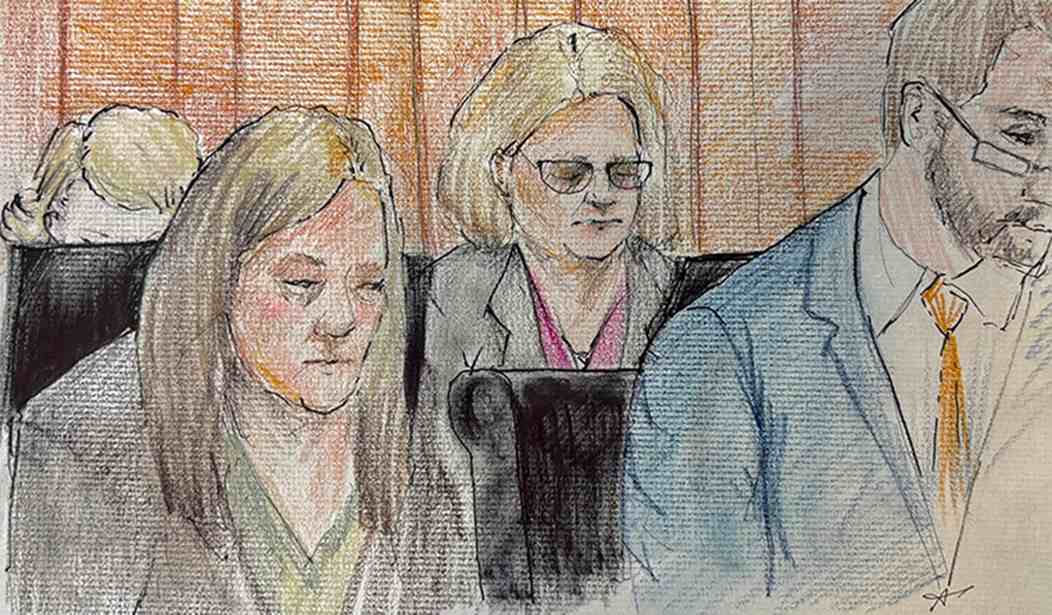
The government rested its case against disgraced Milwaukee County Judge Hannah Dugan today, bringing day three of her trial to an early end.
The day's testimony began with Milwaukee County District Court Administrator Stephanie Garbo testifying. Garbo told the court that Chief Judge Carl Ashley called her and that he believed ICE agents were coming to Dugan's court that day, April 18. Garbo stated that she observed two men sitting on a bench (ICE agents) and that Chief Judge Ashley did not ask Her to interact with them, check whether they had a warrant, or bring them to his office.
Later, Garbo said Judge Cervera, who testified yesterday, and an agent came to Judge Ashley's office, and Garbo arranged a phone call between the agent and Ashley.
Garbo said Judge Ashly was discussing a draft policy regarding ICE at the courthouse with the agent. Garbo also stated that she believed the policy was still a draft and that no policy was in place on April 18. She described the conversation between the agent and Ashley as "professional" and confirmed the courthouse's public hallways were available for arrests.
The next witness was Chief Judge Carl Ashley. Ashley stated that he issued a press release regarding ICE at the courthouse on April 6 and "expressed concerns that he took seriously." Ashley noted that his personal disagreement with federal policies or laws would not authorize him to interfere with a lawful arrest in a public area, and that he did not tell ICE that they could not conduct arrests in a public hallway.
Ashley also provided a copy of his draft policy, which addressed language for court employees to use if ICE tried to access a non-public area: "I do not consent, but because I have no other choice at this time, I will not interfere with your order."
This is a similar policy to that of San Francisco County, California, and Ashley stated that the policy explicitly permits ICE to conduct operations in public areas.
Jurors were given a binder of documents that Ashley reviewed for the court, including his April 6 press release. That press release also said ICE could have a "chilling effect on access to justice" and cause people to "perceive courthouses as unsafe due to fear of detention."
Ashley also wrote that "courts must remain free from the threats of immigration enforcement."
Following Judge Ashley, the government called District Attorney Melissa Buss. She was assigned to Dugan's courtroom on April 18, including for the Flores-Ruiz case, which was scheduled for a pre-trial conference at 8:30 am.
Victims in the Flores-Ruiz case were present, and Buss testified that, in such cases, she prefers that they be called on the record.
When a clerk mentioned ICE was present at the courthouse, Buss said Dugan got up and went into her chambers, and that she saw Dugan motion to Flores-Ruiz and his attorney to come to the jury door. Flores-Ruiz and his attorney went through the jury door. Buss said that the door leads to Dugan's chambers and a hallway, which has another doorway and access to a stairwell.
Buss stated that Dugan decides which cases to call and when, and that Dugan did not call Flores-Ruiz's case. Buss learned later that the case was called off the record. She was also not informed of Flores-Ruiz's next court date and, therefore, was unable to update the victims.
After a short break, Buss said she sent an email to Flores-Ruiz's attorney containing an offer letter for a deferred prosecution agreement, which could have resulted in reduced charges or dismissal.
Buss told the court she believes judges have the power to control what happens in their courtrooms, including where people exit.
Dugan's court clerk, Alan Freed, was the next witness. Freed told the court he was assigned to Dugan's courtroom on April 18. He testified that he heard "one or more" public defenders mention ICE was in the building, and that he was "upset" and "a little bit outraged" by this news.
Freed testified that he advised Dugan that there were ICE agents in the hallway, that he didn't call the chief judge because Dugan told him not to, and that Dugan then went into her chambers. He later heard from another attorney that Dugan was in the hallway confronting the agents.
Freed said Dugan and a man walked past him, and Freed said he called the man a "fascist."
He then stated that Dugan called Flores-Ruiz's case "right away" and instructed Flores-Ruiz's attorney to obtain a court date "off the record." He said someone "from Dugan's direction" on the stand told Flores-Ruiz's attorney to leave the courtroom and come back, and Freed said he couldn't recall ever hearing a judge tell an attorney to leave and come back without a client.
Court ajourned after the government rested its case against Judge Hannah Dugan this afternoon.
— Spectrum News 1 Wisconsin (@SpectrumNews1WI) December 17, 2025
Dugan leaves the Milwaukee County Courthouse; her trial will resume tomorrow.
Here are the major takeaways from today's proceedings: https://t.co/r5fc2ebYgm pic.twitter.com/1V4DbGNxAV
The prosecution played audio from Dugan's courtroom, in which she was heard saying "down the stairs," and Freed said another court employee offered to "show them" (Flores-Ruiz and his attorney). Freed said he heard Dugan reply, "I'll do it...I'll get the heat." The other employee said she'd rather get in trouble.
Freed was shown video footage of Dugan, Flores-Ruiz, and his attorney at the jury door, and that, out of the thousands of cases he has worked, it was the first time he'd seen a criminal defendant go through the jury door.
He also testified that Flores-Ruiz's case was advanced over another case after the court learned that ICE was in the public hallway. Freed said it is permissible to call a case with victims off the record, and that Dugan heard nine such cases off the record that day.
Freed said he knew ICE had an administrative warrant to arrest Flores-Ruiz, but was unsure when he learned of it.
Brittney Ewing, a former District Attorney's Office victim-witness advocate, was on duty on April 18 and met with the victims in the Flores-Ruiz case that morning. She stated that when Flores-Ruiz entered the courtroom, the victims appeared "uncomfortable."
Ewing said she'd never seen a defendant go through the jury door, but still expected his case to be called. Another court employee informed her that the case had been adjourned. When she explained this to the victims, they were "upset" and "confused."
The next witness was Mercedes de la Rosa, the public defense attorney for Flores-Ruiz. She stated that she was made aware that ICE was in the building by another public defender. She told the court that Dugan instructed her to leave and return for a later court date.
De la Rosa said she walked through the jury door and into a hallway, and that she'd never been in that area before. Dugan gestured for her to go to the end of the public hallway, but she "felt scared" and "freaked out," calling the situation "unusual." She said she and Flores-Ruiz went back into the public hallway, where Flores-Ruiz left the building and was apprehended by ICE.
The prosecution called Walter Piel, a private practice criminal defense attorney. Piel told the court that he'd appeared before Dugan more than 50 times in his career and that Dugan had told him she'd call his case first on April 18, as Piel had another case in Dane County later that morning.
Piel stated that Dugan left the court and later returned from the area behind him, the public hallway, while in her judicial robes. She asked Piel to step back and called another case.
He also stated he'd never had Dugan ask him to take a client out and return to get a date. He also witnessed Dugan standing near the jury door, and a man and a woman approached her. Dugan told someone to "come," and the woman told Piel she was sorry.
That woman was Mercedes de la Rosa, Flores-Ruiz's public defender.
Piel testified that Dugan asked him if there were victims in his case, and that it was typical for a judge to ask such a question.
In his 31-year career, Piel said he'd never seen a criminal defendant enter the jury room, and that he'd seen numerous courthouse arrests.
The final witness of the day was Joan Butz, a Milwaukee County court reporter. She stated that it makes a difference for her work whether a case is on or off the record. She also testified that it "pisses her off" that ICE was in the hallway.
She realized Dugan was not in the courtroom and testified that she saw Dugan return through the public door while in her judicial robes.
Butz told the court she heard Dugan instruct Flores-Ruiz's attorney to go out and come back for a date, and that she'd never heard Dugan do that with any other attorney.
Butz stated that she'd show Flores-Ruiz and his attorney the stairs and that she and Dugan were concerned that, if Flores-Ruiz and his attorney went through the "wrong door," he'd encounter ICE agents.
Butz told the court that Dugan led Flores-Ruiz and his attorney down the hallway.
After Butz's testimony, the prosecution rested its case. Defense Attorney Steven Biskupic said the defense will call four witnesses on Thursday. Dugan will not testify.
Presiding U.S. District Judge Lynn Adelman told the jury they'd get the case "before too long" and said the trial is "making good progress."
Closing argument is scheduled for tomorrow afternoon, and the trial will resume tomorrow morning.
Editor’s Note: Democrat politicians and their radical supporters will do everything they can to interfere with and threaten ICE agents enforcing our immigration laws.
Help us hold these leftists accountable and expose their obstruction. Join Townhall VIP and use promo code FIGHT to get 60% off your membership.



Join the Conversation
VIP members get the ability to comment on articles.