


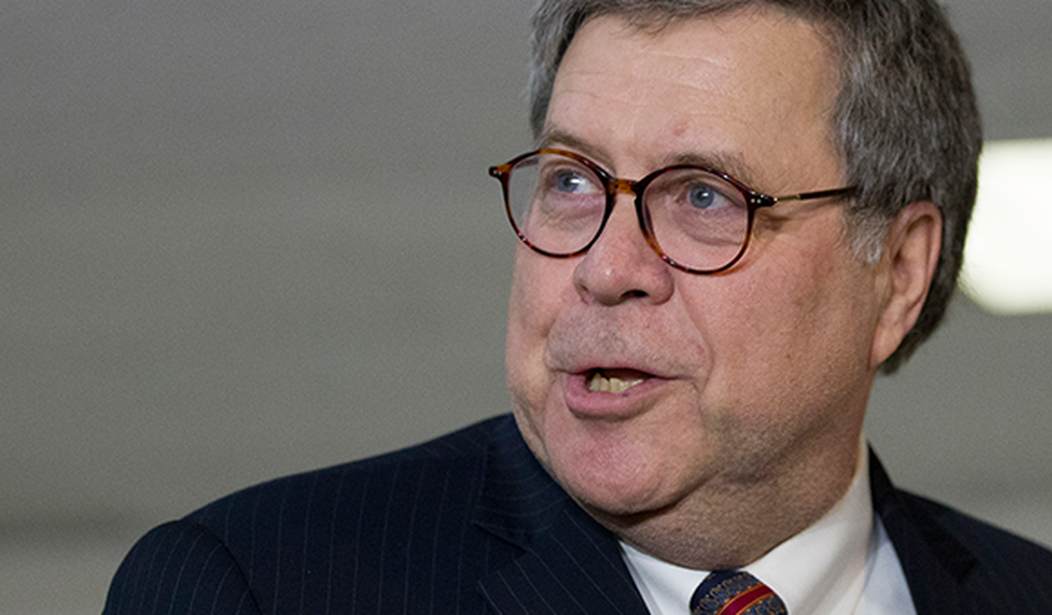
Attorney General William Barr's full written statement about the conclusion of Special Counsel Robert Mueller's investigation into Russian collusion was released on Tuesday.
One of the points Barr is expected to hammer during Wednesday's Committee testimony is the fact that he kept his promise to make Mueller's report as public as can be.
"When I appeared before this Committee just a few months ago for my confirmation hearing, Senators asked for two commitments concerning the Special Counsel's investigation: first, that I would allow the Special Counsel to finish his investigation without interference; and second, that I would release his report to Congress and to the American public. I believe that the record speaks for itself," the statement said.
Barr is also expected to defend the redactions that were included in the released report, saying as much information as possible was released to the public.
"As I explained in my letter of April 18, 2019, the redactions in the public report fall into four categories: (1) grand-jury information, the disclosure of which is prohibited by Federal Rule of Criminal Procedure 6(e); (2) investigative techniques, which reflect material identified by the intelligence and law enforcement communities as potentially compromising sensitive sources, methods, or techniques, as well as information that could harm ongoing intelligence or law enforcement activities; (3) information that, if released, could harm ongoing law enforcement matters, including charged cases where court rules and orders bar public disclosure by the parties of case information; and (4) information that would unduly infringe upon the personal privacy and reputitional interests of peripheral third parties, which includes deliberation about decisions not to recommend for such parties," the statement said. "I have also made available to a bipartisan group of leaders in Congress, including Chairman Graham and Ranking Member Feinstein, a minimally redacted version that includes everything other than the grand-jury material, which by law cannot be disclosed."
Recommended
According to Barr's statement, an analyst said less than eight percent of the public report was redacted. The minimally redacted version Judiciary Committee leaders had access to had less than two percent redacted.
In addition to working with Mueller's team, the DOJ also consulted with members of the intelligence community and prosecutors to determine what information would harm ongoing investigations if released.
The report was made available to President Donald Trump's legal team, which "allowed them to advise the President on executive privilege, consistent with long-standing Executive Branch practice." Trump never did execute executive privilege though.
After Mueller sent the full report to Barr, the Attorney General "determined that it was in the public interest for the Department to announce the investigation's bottom-line conclusions – that is, the determination whether a provable crime has been committed or not."
Barr decided to release the full report, instead of piece-by-piece, so Congress and the American people could draw their own conclusions.
The Attorney General was tasked with determined with whether or not a crime was committed and that the DOJ could prove, beyond a reasonable doubt, that it did take place.
"The role of the federal prosecutor and the purpose of a criminal investigation are well-defined. Federal prosecutors work with grand juries to collect evidence do determine whether a crime has been committed. Once a prosecutor has exhausted his investigation into the facts of a case, he or she faces a binary choice: either to commence or to decline prosecution," the statement said. "To commence prosecution, the prosecutor must apply the principles of the federal prosecution, and conclude both that the conduct at issue constitutes a federal offense and that the admissible evidence would probably be sufficient to obtain and sustain a guilty verdict by an unbiased trier of fact. These principles govern the conduct of all prosecution by the Department and are codified in the Justice Manual."
"The appointment of a Special Counsel and the investigation of the conduct of the President of the United States does not change the rules," the statement said.
Barr hammers home the point that, as a prosecutor, he has to feel that he could convince a jury, beyond a reasonable doubt, that a crime did in fact take place, which he felt did not happen.
Read the full letter:
Here’s AG Barr’s full written statement for his testimony to the Senate Judiciary Cmte tomorrow. pic.twitter.com/Sl3Y5cOlrg
— Peter Alexander (@PeterAlexander) May 1, 2019






Join the conversation as a VIP Member