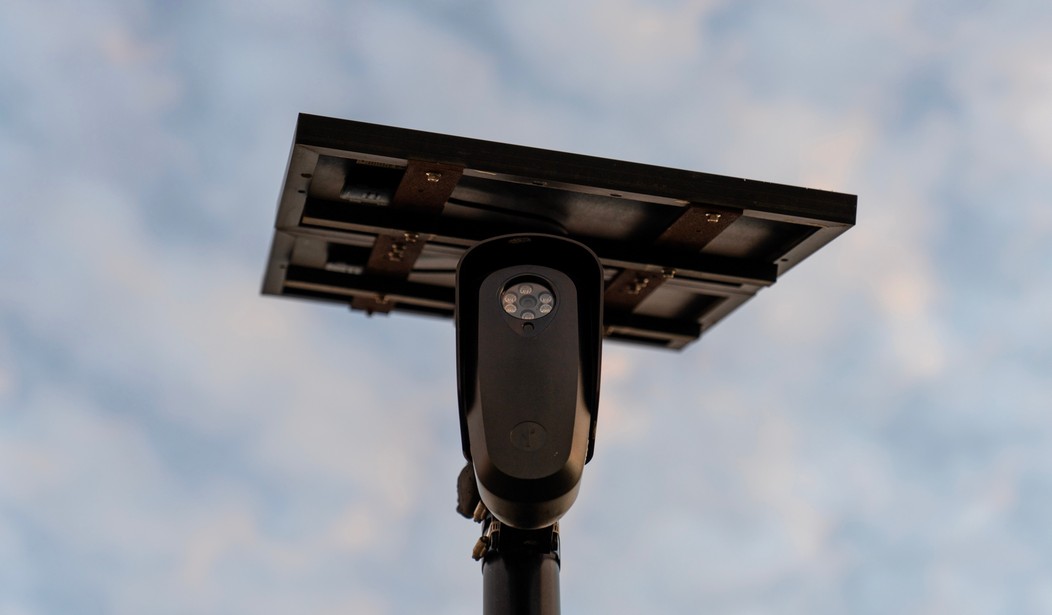

A federal judge granted a woman’s motion to suppress evidence obtained using Flock Safety cameras after she was caught with a large amount of methamphetamine in her vehicle.
Melisa Susan Kyle was driving through East Tulsa in May when she was pulled over by a Tulsa County deputy sheriff who worked as a Drug Enforcement Administration (DEA) task force officer.
The deputy saw that Kyle was driving a rental car with California plates on Interstate 44. He ran the plate through Flock and Vehicle Manager, another license plate surveillance system. The search returned over 50 records of the vehicle moving across several states over a month.
He stopped Kyle for following another vehicle too closely and questioned her about her trips. She refused to allow a search, at which point the officer used a K-9 unit. The officer found more than 44,000 grams of methamphetamine and about $7,000 in cash.
“This is a type of indiscriminate mass surveillance,” Judge Hill wrote. “It is a tool that collects information about all vehicles that pass by any network-connected camera at all times, and it serves up the information to law enforcement on demand.” 🤔 https://t.co/qoCvPrx1Ah
— DeFlock (@therealDeFlock) October 8, 2026
Kyle was charged on May 19 with possession with intent to distribute. However, U.S. District Judge Sara E. Hill granted Kyle’s motion to suppress, holding that the deputy’s warrantless search violated the Fourth Amendment because it was done without probable cause. The judge concluded that each piece of evidence must be thrown out as fruit of the poisonous tree. She also noted that the deputy had no reasonable suspicion to extend the traffic stop.
Judge Hill argued that public road travel is not a blank check for a month of stored surveillance camera hits. “The Court acknowledges that people, in at least a broad sense, do not have a reasonable expectation of privacy in their movements on a public roadway,” she noted.
But she further stated that surveillance technology “appears to be approaching a dragnet-style of law enforcement.”
“This is a type of indiscriminate mass surveillance,” the judge continued. “It is not targeted on a single individual, as in Carpenter. It is a tool that collects information about all vehicles that pass by any network-connected camera at all times, and it serves up the information to law enforcement on demand.”
New: We got body camera footage of the Flock search and traffic stop a judge ruled unconstitutional and "indiscriminate mass surveillance" https://t.co/2jzfymymIO
— Jason Koebler (@jason_koebler) October 8, 2026
The judge explained, “The Court finds that because the ALPR systems Alaniz used to search Kyle’s historical location information intruded on her reasonable expectation of privacy in the whole of her physical movements, it was a search under the Fourth Amendment.”
Based on the information in the record, the only reason Alaniz conducted that search was because he saw her license plate was from California. That search was not supported by probable cause, and it was done without a warrant in violation of Kyle’s Fourth Amendment rights.
However, other courts have ruled differently in similar cases. This is part of a national debate over how law enforcement should be allowed to use data collected from license plate readers. Supporters argue that they are necessary tools to apprehend criminals. However, critics point out that these systems constitute a form of mass surveillance allowing officers to conduct searches without warrants.