
It should give Republicans pause when a socialist endorses what has become a centerpiece of their economic thinking. At the very least, it is worth asking what that agreement reveals.
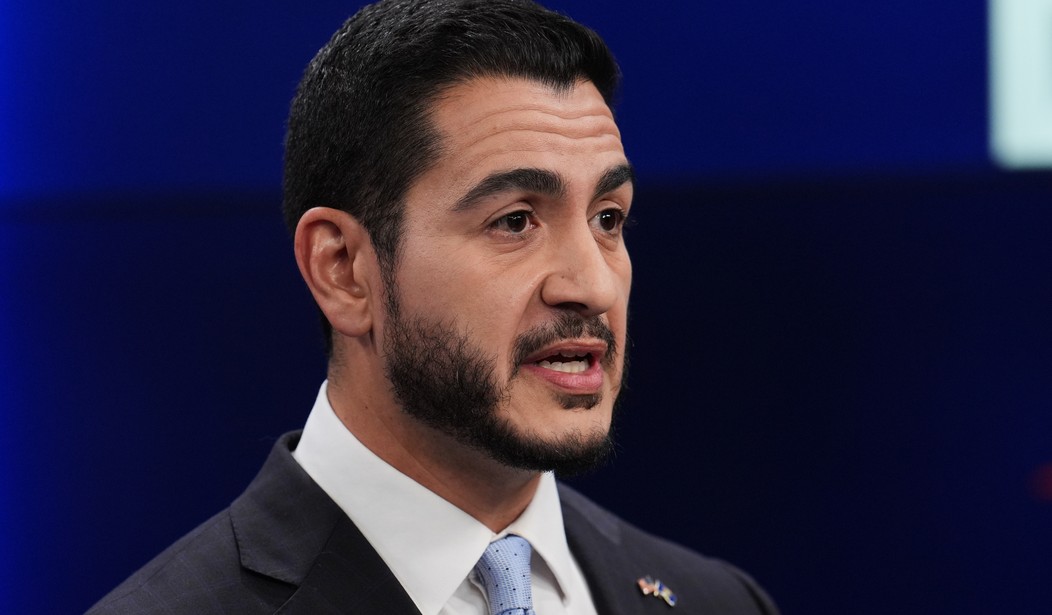
In an interview on Friday, Michigan Senate candidate Abdul El-Sayed, who has drawn criticism as a socialist for his support of higher taxes on the wealthy, Medicare for All, and his broader hostility toward capitalism, came out against free trade. And, while he criticized the Trump administration’s handling of its tariff war, he endorsed what he called “smart tariff policies” in order to protect American jobs and expand the country’s industrial base.
Some conservatives may find that reassuring, that even one of the most progressive Democrats can recognize the merits of their approach. But there seems to be a less comforting explanation, that perhaps El-Sayed has not moved toward the Right’s economic thinking so much as the right has moved toward his. Away from free markets and toward the heavy hand of government intervention.
Abdul El-Sayed: I think the era of free trade has sold us short. We need to be thinking about smart tariff policies, not these ridiculous policies that we've got with the trade war with Canada. Smart tariff policies that are protecting our jobs, growing more jobs, and then releasing our industrial might on the rest of the world.
— Clash Report (@clashreport) October 23, 2026
"I think the era of free trade has sold us short," El-Sayed said. "So we need to be thinking about smart tariff policies, not these ridiculous policies that we've got with trade war with Canada, but smart tariff policies that are protecting our jobs, growing more jobs, and then releasing our industrial might on the rest of the world."
Over the past several years, Republicans have increasingly declared that free trade has delivered little beyond a hollowed-out industrial base, lost jobs, and prosperity that never reached ordinary Americans. In that telling, manufacturing losses are the entire story, while jobs, growth, and gains in purchasing power elsewhere barely count. Tariffs, protectionism, and heavy industrial subsidies have become the preferred remedies, with government intervention sold as the cure for a supposedly failed free market.
While manufacturing may have been hollowed out in some communities, the claim that free trade has, by and large, failed America does not follow. It rests on counting losses and ignoring gains. There have certainly been problems with trade, but the vast majority stem from poor government policy, poorly negotiated trade agreements, or weak foreign policy, not free trade itself. The answer is more free trade, not less.
The idea that free trade has failed also means ignoring that the massive resurgence of manufacturing in the United States has occurred not in sectors protected by tariffs, but in those tied to the country’s AI boom which itself is driven by the sufficiently under-regulated market that the sector now enjoys.
The industries powering recent US manufacturing expansion—computers/electronics and aerospace—are those facing the lowest tariffs, says Cato’s @scottlincicome. The least-protected industries are growing the fastest. https://t.co/v2Kld2PmrJ https://t.co/xURIOUmjgB
— Cato Institute (@CatoInstitute) September 1, 2026
More broadly speaking, free trade in general has lowered prices for American families, reduced costs for American manufacturers, and opened foreign markets to American businesses.
Over the past roughly 40 years, inflation-adjusted U.S. economic output has nearly tripled, output per person has roughly doubled, median household income has risen 39 percent, and median weekly earnings have increased 20 percent. Household wealth has roughly quadrupled after inflation, prime-age employment has climbed near record highs, and involuntary part-time work has fallen 14 percent despite a 44 percent population increase. Meanwhile, the poverty rate has dropped from 14 percent to 10.2 percent.
Free trade helped to build that prosperity.
Anyone claiming America could have achieved those gains, or even greater ones, without it should explain how economic isolationism or autarky would have produced a richer, stronger country. Better yet, point to a nation that sustained global economic dominance with either of those economic policies.
El-Sayed has not suddenly recognized the wisdom of Republican economic policy. He is applying his socialist worldview to global economics. He is promising to protect workers and shield specially chosen American companies through what amounts to blatant crony capitalism, treating the American economy as a government jobs program rather than an engine of prosperity.
Anti-free-trade Republicans have joined him in that belief. They are free to defend that position, but they should be honest about the direction they are moving. This is not a socialist embracing reason. It is Republicans moving leftward toward government intervention as acceptable economic policy.