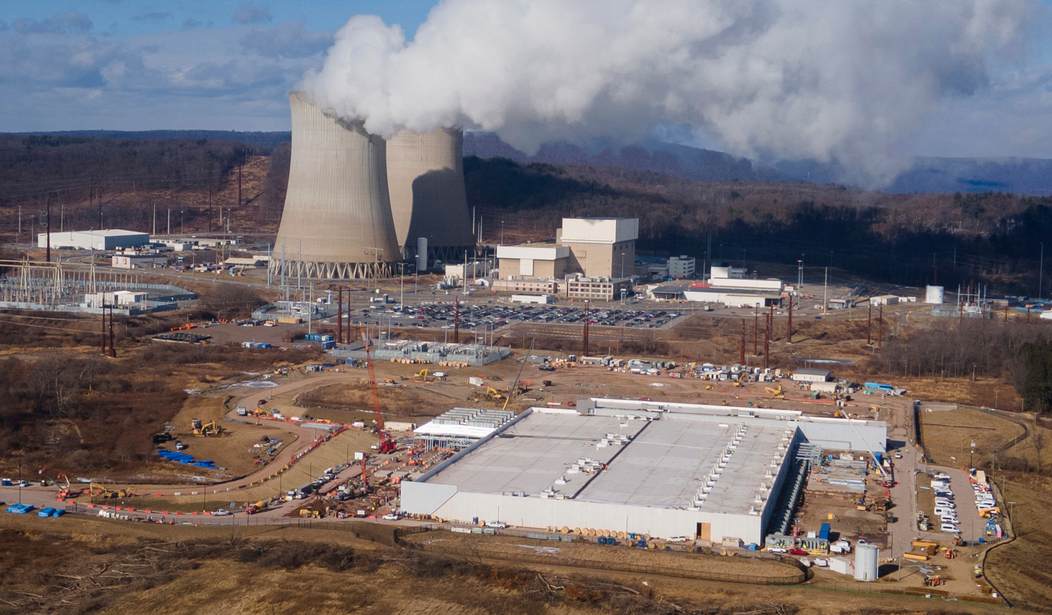

The debate over data centers may seem like just another issue of the day. In reality, it strikes at the heart of a growing economic revolt in American politics, one that could make socialism not merely acceptable, but normal.
Three-quarters of Americans oppose the construction of data centers, including more than 60 percent of Republicans. That bipartisan consensus is driven by a range of concerns, with each carrying different weight for different people: environmental impact, utility prices, land use, and the fear that Big Tech is imposing its will on local communities.
But beneath each of those objections lies the same uniting factor: a collapsing belief in free markets.
The first sign of this mindset is the quiet embrace of the fixed-pie fallacy: the idea that water, land, power, and opportunity are fixed quantities, and that if a data center uses some, ordinary Americans must necessarily go without.
Take water. Critics talk as if America is about to run dry because servers need cooling. And yet governments allow staggering quantities to disappear through leaking pipes, neglected infrastructure, and incompetent water management. The free market response to that government failure should be to build better systems, not to impose moratoriums on data-center construction based on exaggerated claims about AI water use.
The land argument is even stranger. Since when is America running out of land? Data centers occupy a fraction of the space required by many other commercial and industrial developments, while often generating unusually large property-tax revenues per square-foot. What, exactly, do critics imagine this land would otherwise become, and why should a productive private investment be presumed to be a misuse of it? American innovation has always made things smaller, cheaper, and more efficient. Computers that once filled rooms now fit in pockets; factories and farms now produce more with less land and labor than they did decades ago. There is no reason to assume data centers are exempt from that same trend.
The utility-price argument may be the clearest example of the fixed-pie fallacy. Critics assume that if data centers use more electricity, families must pay more for less. But the evidence so far points in the opposite direction. More demand is not a crisis; it is a reason to build America's energy infrastructure. Something people who believe in a free market would suggest. Large data-center customers give utilities the incentive, and financial basis, to expand generation, transmission, and grid capacity. The answer is to make those companies pay their share of the buildout, not to cripple growth.
The jobs argument is no better. Critics sneer that data centers do not employ enough people permanently, as if every building must double as a factory floor or a government jobs program. They create construction work, local spending, tax revenue, and the computing capacity that lets technology firms, manufacturers, and businesses across the economy grow. We do not condemn power plants, warehouses, or highways because they fail to employ enough people per square foot. Data centers are infrastructure. Treating them as worthless unless they are packed with workers is a remarkably efficient way to guarantee that nothing ever gets built.
And then there is one of the debate’s more sinister claims: that Big Tech is somehow imposing its will on helpless local communities. That is a familiar left-wing story, even though it seems to pervade the right just as much now, that private businesses are inherently evil, too powerful to restrain, and capable of getting whatever they want without consequence.
A free-market view is less melodramatic and more useful: this is an incentives problem. When politicians make it profitable for companies to chase subsidies, favorable zoning, and regulatory carve-outs, companies will do exactly that. The solution is to reduce the political favors that make influence-peddling worthwhile and restore genuine competition, not flood the industry with new regulations that invite lobbyists and special-interest groups to compete for even more favors on behalf of their preferred tech companies.
It is also worth remembering that demand for data centers does not come from nowhere. Americans may say they do not want a facility nearby, but they use the cloud services, streaming platforms, online shopping, AI tools, financial systems, and communications networks that require those facilities every day. Companies are not investing hundreds of billions of dollars to satisfy a poll response; they are responding to actual demand. The market is a more reliable measure of what people value than their stated preference for all of the benefits of modern computing. And yet, people struggle to acknowledge that the market often reveals more about what they actually want than what they say they want.
This is how socialism infects America. As a matter of fact, this is why it already has. People no longer trust what the free market teaches, that prosperity grows out of millions of individual choices, voluntary exchange, competition, risk, and innovation rather than the commands of politicians. They see the messiness of a free economy and demand someone take control of it.
Conservatives and independents may call themselves anti-socialist, but their policy preferences increasingly point in the other direction as they regularly support more restrictions on private investment, more political control over development, and more government power to decide what gets built, where it gets built, and who is allowed to benefit. That is not a belief in free markets, it is the normalization of a government-managed economy.
And that is where the data-center fight leads. It is no longer just a debate about servers, land, water, or power bills; it is a test of whether Americans still believe that a free market can build prosperity better than political vetoes and government rationing.
The market must win here. If every new facility can be strangled by fear, moratoriums, and the assumption that growth is a threat, America will not merely lose ground in the AI race, it will lose something more fundamental: its faith in a free market.