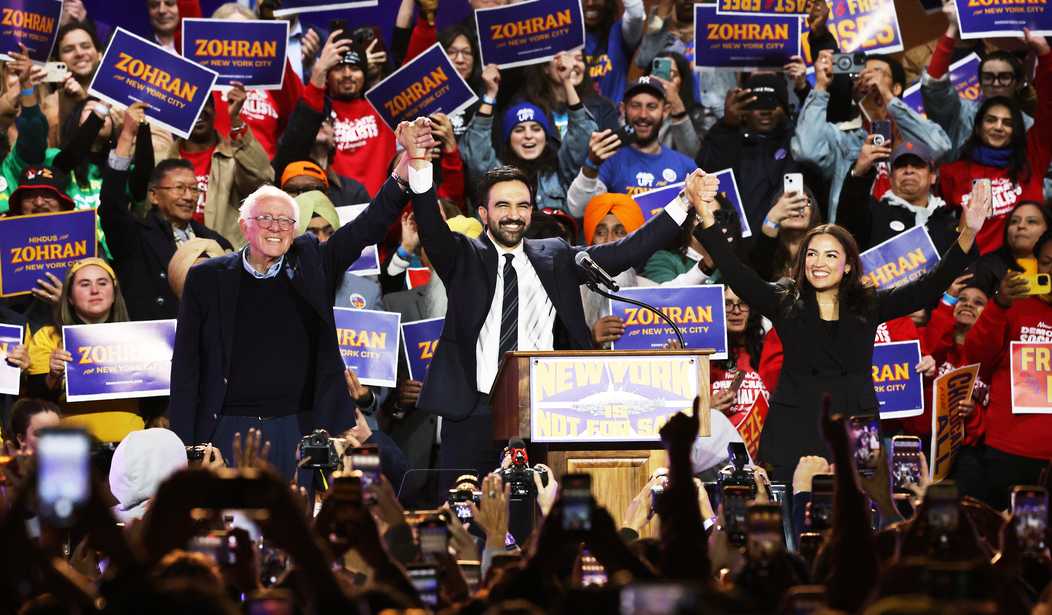

Americans hear it day after day, year after year: capitalism, the economics of a free market, has failed the United States.
The left invokes so-called “late-stage capitalism.” Socialists point to unequal wealth distribution and the failure of every American to obtain certain necessities, such as housing, higher education, and healthcare. Even some on the right have joined the cacophony of complaints, blaming capitalism for the lack of artwork and intentional design in modern buildings, its supposed failure to prevent offshoring, and the perceived greed of technology companies.
Yet, the solution to these problems actually requires a shift toward laissez-faire capitalism. That becomes abundantly clear once we recognize that the government and political leaders have spent decades blaming the free market for the failures of socialism, and for failures of their own making.
But is the United States truly a free market?
The late economist, Walter E. Williams cast doubt on that assumption, writing in 2006, that: “Three-fifths to two-thirds of the federal budget consists of taking property from one American and giving it to another."
This pattern, where government focuses more on redistribution than wealth creation, is abundantly clear in nearly every corner of American life. We have a progressive income tax that, by definition, takes more from those who earn more than those who earn less. More than half of the federal budget goes toward entitlement programs, which are almost single-handedly driving the national debt. Government accounts for nearly 20 percent of all consumption and investment in the economy.
Washington props up entire industries through subsidies and government contracts, has grown accustomed to bailing out failing businesses, and has consistently pursued central planning since the 1930s. Even the Federal Register, a useful indicator of the scale of federal regulatory and administrative activity, expanded from 2,620 pages in 1936 to a record 106,109 pages in 2024, more than a fortyfold increase.
Beyond the broad ways government plays a larger role in the economy than many assume, it is also responsible for some of America’s most serious failures: from the Great Depression and the 2008 financial crisis, to making offshoring more profitable than manufacturing at home; from green-energy policies that hamstring businesses, to subsidies that drive up healthcare and higher-education costs; and from zoning laws that actively keep housing prices high.
It sounds like, then, that we may not be as much of a free market as we think.
The United States remains, technically, a mixed economy, but the closer we look at what government actually does, the clearer it becomes which direction the country leans, and where that trend line is headed.
That raises a more important question: Are America’s economic troubles the result of markets, or of the absence of them? The answer seems pretty clear.
There is still much to be thankful for in this country. But as regulations continue to pile up across housing, education, and healthcare, the sense of economic struggle has continued to pervade the American public. That is why Republicans should take up the mantle of returning power to the invisible hand of the free market, especially as socialism gains ground among Democrats and the broader electorate.
Restoring genuine freedom to the economy could solve more problems than most people imagine, and offer a new vision of America, one unencumbered by the heavy hand of government. It could accelerate innovation, create greater wealth, and lower prices. It could also help solve the immigration crisis, contribute to repairing the moral fabric of American society, and restore the conditions for prosperity across the country.
And to everyone who insists it wouldn't work: How could they know? It has never truly been tried.