
At the heart of the United States' economic troubles lies a single issue: a lack of accountability.
For years, politicians have blamed the free market wherever business seems to fail. Healthcare. Housing. Higher education. Banking. The assumption is always the same: the market failed. But what if the opposite is true? What if these industries stopped behaving as they were supposed the moment government insulated them from the consequences of failure?
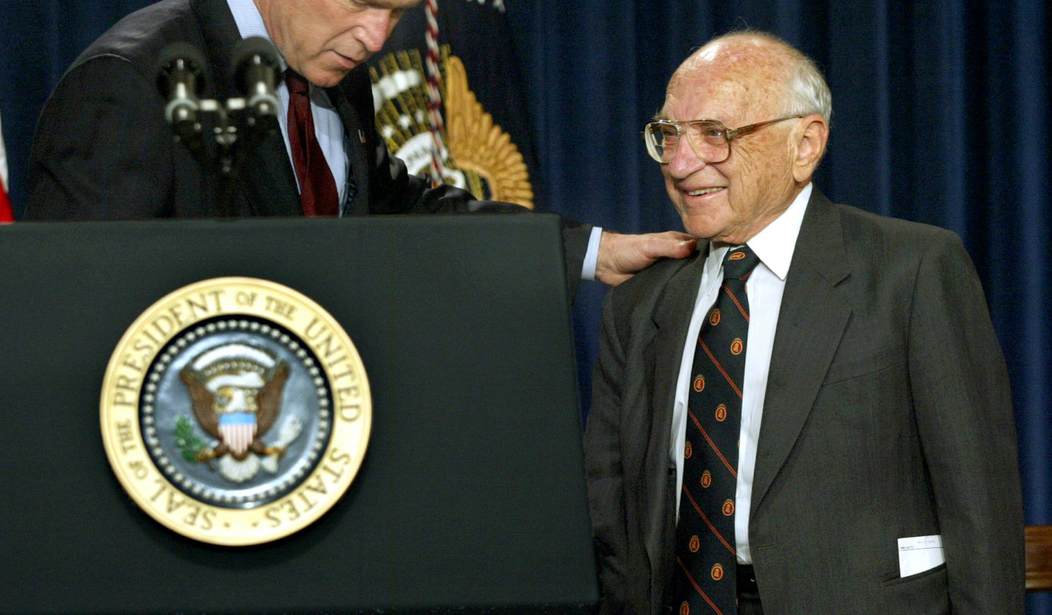
As political figures across the right seek to cast Milton Friedman into the depths of history, it's worth revisiting several of his insights, because they often provide exactly the clarity our current problems are missing, and they show, again and again, that the failure was never one of private enterprise. It has always been one of our government.
Friedman spent much of his career making a point that sounds almost too simple to matter. A free market, he argued, is fundamentally a profit and loss system, and the loss half of that equation is doing just as much work as the profit half, arguably more. Profit rewards a company for serving customers well. Loss is what happens when it doesn't, and that loss is the mechanism that forces the business into correction. Without the real threat of loss, a company has no reason to fix what it's doing wrong, because nothing is actually making it pay for the mistake.
Milton Friedman on why losses are just as important as profits:
— Milton Friedman Quotes (@MiltonFriedmanW) August 5, 2026
“A free-enterprise system is a profit-and-loss system, and never forget the loss part.
If you have a system in which losses are eliminated, you will eliminate the heart of a free-enterprise system, which is to… pic.twitter.com/XnMBuW2PjB
"A free enterprise system is a profit and loss system, and never forget the loss part," Friedman said. "If you have a system in which losses are eliminated, you will eliminate the heart of a free enterprise system, which is to make people responsible for their own actions and to provide a system under which they are induced to use their resources effectively, under which if they engage in bad ventures they get out."
"That's the fundamental difference between the market and government."
How does this play out in America's most pressing economic issues?
Take Zohran Mamdani's city-run grocery store. What happens when a store doesn't run on profit or loss? It doesn't have to provide goods people actually want. It has to provide what Mamdani wants, entirely protected from any consequence customers might otherwise impose.
Or take healthcare. Government subsidy accounts for roughly 40 percent of the industry's revenue, which means the incentive shifts accordingly: satisfy the government's requirements, not the patient's needs.
Or take the government's newfound appetite for equity stakes in companies like Intel. The moment Washington becomes a shareholder, it also becomes a guarantor, with every incentive to protect its investment from the loss that would otherwise force correction.
Or take the 2008 financial crisis, caused in large part by government pressure on Fannie Mae and Freddie Mac to underwrite subprime mortgages, backed by the implicit assumption that Washington would absorb the losses if it ever went wrong.
Or take higher education, where universities increasingly chase federal loan dollars and regulatory approval, not the interests of the students those loans are supposed to serve.
And yet the blame for these failures consistently lands on the middleman, the private enterprise simply following the incentives government built for it, exactly as any rational actor would. The people who never get blamed, even though they're the ones who deserve it, are the ones in Washington who built the incentives in the first place.
This is exactly why socialism is on the rise. Accountability is nowhere to be found, people are angry, and they're hunting for change, any change, because they need results and they needed them yesterday. Even Republicans have started reaching for the same diagnosis the socialists did.
While that diagnosis is understandable, it is also completely wrong. Every failure on this list, a city-run grocery store, the healthcare industry, the financial sector in 2008, were not market failures. They are accountability failures that began the moment government decided a company no longer had to earn its customers or profit to survive.
Friedman's whole point was that markets are the only economic system that punishes failure automatically. Take that punishment away, replace it with a government check, a bailout, a subsidy, a guarantee, and you make sure that businesses primary priority is pleasing government, not you.