





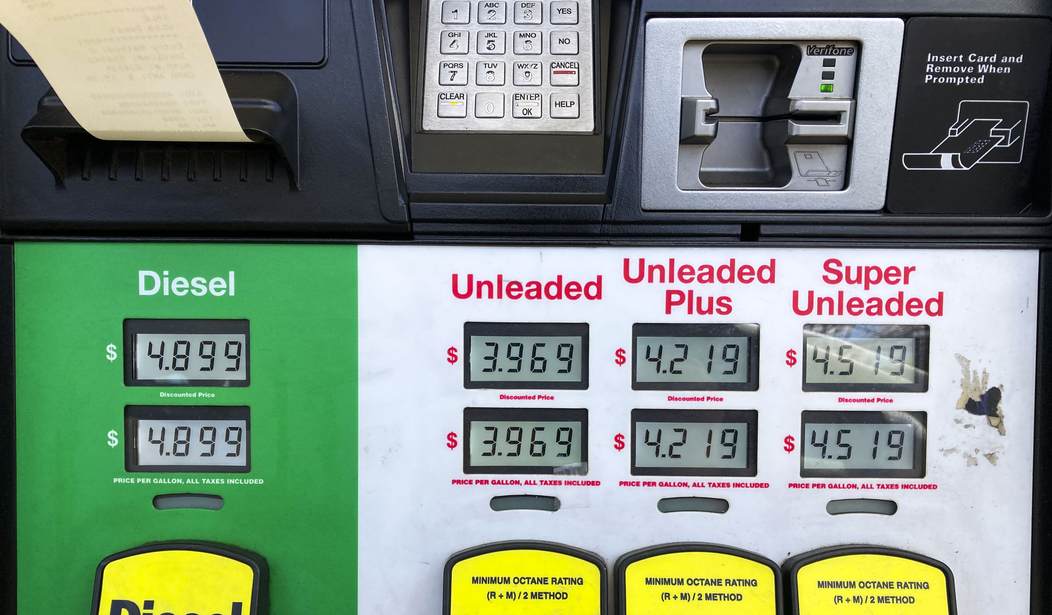
Beijing just discovered it cannot fight, or even wait, without American permission. While China rations its future, the United States is securing the world’s oil on its own terms.
The numbers are brutal and unforgiving. China imports between 11 million and 12.5 million barrels of crude every single day. Between 40 and 50 percent of that supply must thread the narrow needle of the Strait of Hormuz. Total consumption, including refined products, runs 15 million barrels daily. Even after years of frantic stockpiling, Beijing’s combined strategic and commercial reserves sit at roughly 1.1 to 1.4 billion barrels, 90 to 120 days of cover at current burn rates.
Ninety days. Coincidentally, or maybe not, that's the exact timeframe a U.S. President has via a War Powers Resolution before Congress must approve an extension.
That clock started ticking on February 28 when strikes on Iran turned the Strait into contested waters. Public trackers show no formal blockade, but that doesn't matter as the insurance market collapsed, carriers have fled, and tanker traffic has halted. Days later in the Mediterranean, a Russian liquefied natural gas (LNG) carrier mysteriously exploded and sank from an unknown assailant. Today, LNG shipping rates have surged more than 40 percent, with spot Atlantic fixtures quoted above $200,000 per day. Energy markets are pricing in prolonged chaos.
China’s response is telling. Refiners have been ordered to prioritize domestic supply. Domestic diesel and gasoline prices have spiked; Brent crude has breached $100 a barrel in Asian trading. Beijing has realized its vulnerability: we are one sustained disruption away from factory shutdowns, truck queues, and civilian rationing, and they are panicking.
Now turn to Washington.
The United States under President Trump is now the world’s largest oil producer. We don't need Hormuz. Two days after the Iran strikes, President Trump announced a new full maritime political-risk insurance through the U.S. International Development Finance Corporation for all Gulf energy shipments, backed by US Navy protection. This week, Secretary of the Interior Doug Burgum stood shoulder-to-shoulder with Venezuela’s acting president in Caracas, live on camera, announcing the rapid reopening of Venezuelan fields and minerals to American investment. Trump followed up within hours: “Oil will be flowing again—fast.” The power play is obvious. While China stares at empty tanks in three months, America is adding new supply lines in real time.
Even Chinese analysts are admitting the obvious. In the South China Morning Post and state-linked think-tank papers this week, experts who spent years peddling the “American decline” narrative are suddenly changing their tune. One widely circulated analysis put it bluntly:
“America’s war-making capability depends entirely on its will to deploy such power.” The implication is devastating for Beijing. The United States does not lack the ships, the fuel, the technology, or the capability. It lacked the willingness, and President Trump has made that willingness quite clear.
This is the asymmetry the post-pandemic world is only now waking up to. China built the largest navy on paper and the largest strategic petroleum reserve in Asia, yet it remains one chokepoint away from economic paralysis. America sits atop North America’s energy super-basin, a willing partner in Venezuela’s revival, and a Navy that can ensure and escort global trade AND project power.
The 90-day window is no coincidence. It is the exact duration Beijing can endure before its economy begins to seize. It is also the exact duration the United States can sustain military operations in the Gulf without asking permission from anyone. That alignment is not an accident; it is the cold arithmetic of power meeting will.
Markets already understand. Global supply chains are repricing. European and Asian manufacturers that depend on Chinese parts are quietly dusting off contingency plans. Shipping costs are climbing. The longer the Strait remains contested, the higher the price Beijing will pay in lost growth, lost exports, and lost prestige.
China is learning the hard lesson that stockpiles and pipelines cannot substitute for sea-lane security backed by overwhelming naval power and domestic energy abundance. President Trump did not forget it. Now the rest of the world is watching the proof unfold in real time: energy independence is power. It is the ultimate strategic multiplier, the force that amplifies economic strength, military reach, and national sovereignty all at once. But none of it matters without the will to use it.
The coming weeks will reveal whether the Strait reopens quickly or becomes a protracted test of endurance. Either way, the verdict is already forming in Beijing’s war rooms and on trading floors from Singapore to New York. China’s energy vulnerability has been laid bare. America’s energy dominance and the will to use it has just been reaffirmed.
The 90-day clock is running. Only one side is comfortable with where the hands are pointing.
Editor's Note: For decades, former presidents have been all talk and no action. Now, Donald Trump is eliminating the threat from Iran once and for all.
Help us report the truth about the Trump administration’s decisive actions to keep Americans safe and bring peace to the world. Join Townhall VIP and use promo code FIGHT to get 60% off your VIP membership.

Join the Conversation
VIP members get the ability to comment on articles.