







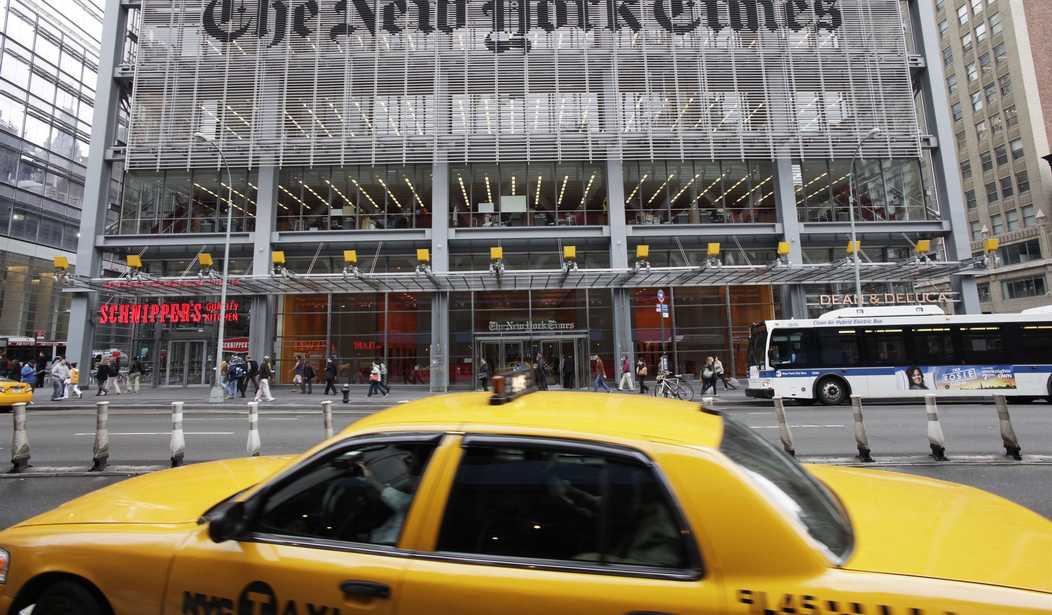
New York Times Supreme Court reporter Adam Liptak recently sounded the alarm with a headline that read, "The Supreme Court's Increasingly Dim View of the News Media." Naturally, he was upset that some conservative judges aren't fond of the 1964 New York Times v. Sullivan decision, which makes it nearly impossible for public figures to sue media outlets for libel, since the mind-reading standard of "actual malice" must be established.
Liptak began by complaining about Judge Laurence H. Silberman, who's not on the Supreme Court but the U.S. Court of Appeals for the District of Columbia Circuit. In a recent dissent, Silberman wrote, "Two of the three most influential papers (at least historically), The New York Times and The Washington Post, are virtually Democratic Party broadsheets."
"Nearly all television -- network and cable -- is a Democratic Party trumpet," Silberman wrote. "Even the government-supported National Public Radio follows along."
The writer thinks this is an unfair criticism, rather than a fact that is proven daily. The Times front page on April 22 had this headline on top: "U.S. to Scrutinize How Minneapolis Handles Policing: Inquiry Signals That White House Aims to Combat Abuses Nationwide." Below was the headline "Republicans Sharpen Penalties For Protesters in Flurry of Bills."
This is fish-in-a-barrel stuff.
Liptak also cited Justice Clarence Thomas, noting "the media often seeks 'to titillate rather than to educate and inform.'" If you consider the role NPR and the "Democratic Party broadsheets" played in Anita Hill's titillating (and still-unproven) charges of sexual harassment against Thomas during his Supreme Court confirmation hearings (battle) in 1991, you might understand his skeptical viewpoint.
A new article in the North Carolina Law Review inspired Liptak's lament. Professors Ronnell Andersen Jones and Sonja West reviewed all references to the press in Supreme Court opinions going back to 1784 and found "a marked and previously undocumented uptick in negative depictions of the press by the U.S. Supreme Court."
The pinned tweet on West's Twitter account reads, "The press is supposed to be the government's 'opposition party.' That's kinda the whole point." But the media are never the "opposition party" when Democrats are in power.
Jones and West dug out the Pentagon Papers and noted that then-Justice Hugo Black wrote, "The New York Times, The Washington Post and other newspapers should be commended for serving the purpose that the founding fathers saw so clearly."
But decades later, Liptak referenced the Citizens United decision, claiming that then-Justice Anthony Kennedy cited "the decline of print and broadcast media" and the "sound bites, talking points and scripted messages that dominate the 24-hour news cycle."
This quotation is distorted. Kennedy was objecting to the idea that media corporations had more freedom to speak than a nonprofit group such as Citizens United. Right before that passage, he insisted, "Our Nation's speech dynamic is changing, and informative voices should not have to circumvent onerous restrictions to exercise their First Amendment rights."
Notice the error here: Even mild and obvious press critiques are somehow comparable to an "increasingly dim view" on freedom of the press. Favoring the free expression of conservatives -- Citizens United made a documentary criticizing Hillary Clinton in 2008 -- is somehow against the media.
Once again, we see that the liberal media and their academic defenders are great at dishing out criticism and remarkably horrible at taking it. Mock them and you endanger the First Amendment. Accuse them and you're accusing democracy itself. Freedom of speech is for liberal elites, not for conservative rabble.
They imply the most disturbing and unacceptable exercise of free speech is to denounce the media as Democratic propagandists. So, who is really championing the First Amendment?
Join the Conversation
VIP members get the ability to comment on articles.