





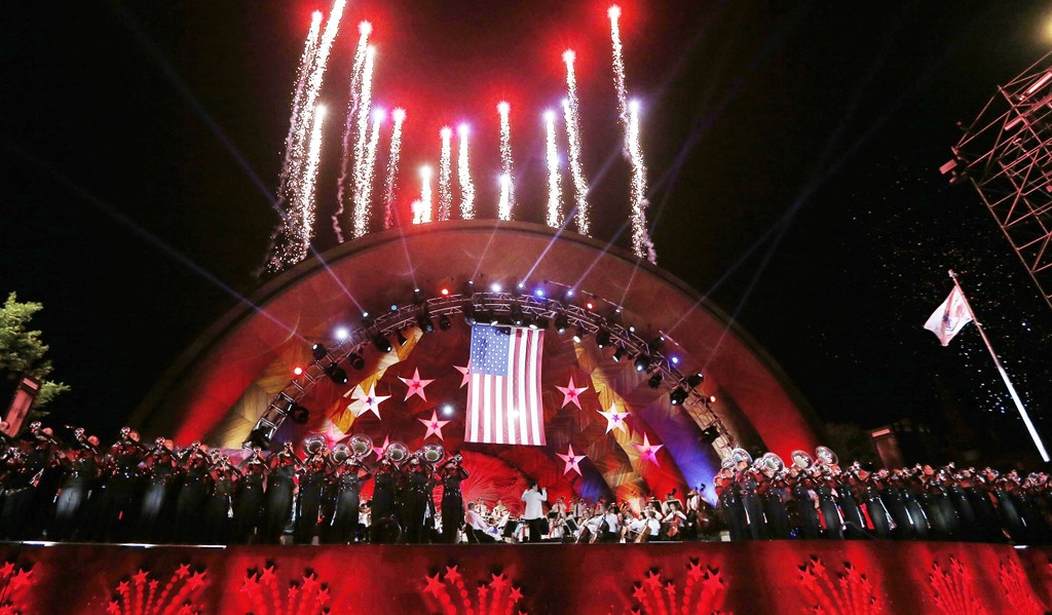
There was a time when the Fourth of July meant something more than a three-day weekend. Speeches, writings and commemorative ceremonies reminded us of the origins and greatness of America. No matter where in the world our ancestors came from, we today are almost invariably better off because they came to America.
Independence Day signified much more than one country announcing its independence from another on July 4, 1776. It represented a new form of government -- freer and more accountable to its own people than the monarchies common around the world for centuries.
What happened in America did not stay in America. The example of freedom inspired other peoples in other lands. As a famous poem put it, it was America's "embattled farmers," fighting for their own freedom and independence, who "fired the shot heard round the world."
There was no question then that the United States was "exceptional," however much the smug elites of today -- including our President -- try to dismiss the idea. Because self-government on such a large scale was a unique experiment, the founders of the American republic were very much aware that it had its dangers. Thomas Jefferson warned that "eternal vigilance" was the price of liberty. Even generations later, Abraham Lincoln expressed his fervent hope that "government of the people, by the people and for the people shall not perish from the earth." The survival of freedom was not something he took for granted.
Today, too many Americans take freedom for granted, as just another entitlement, something that does not require them to take any personal responsibility.
It is painful to watch people on the streets -- or on college campuses -- being interviewed by TV reporters who ask them elementary questions about the people and institutions that run the country, and see how uninformed they are. And how unconcerned about their own gross ignorance.
People like that are the natural prey of political demagogues, of which there has never been a shortage. We see the consequences in ever expanding arbitrary powers of government. Just last week, a U.S. Attorney threatened prosecution of anyone who made "inflammatory" statements about Muslim boys accused of raping a 5-year-old girl.
Surely that Justice Department official knew that the courts were not likely to violate people's right to free speech. But the real threat was to drag people through expensive and time-consuming legal processes that could disrupt their lives completely.
Such high-handed use of government powers has become increasingly common during the Obama administration. But an apathetic and uninformed public voted him a second term.
That is not the "eternal vigilance" required to preserve freedom. It is the widespread apathy and gullibility which accepts the coming of tyranny on the instalment plan.
Earlier generations of Americans fought and died to preserve freedom. Today's generation cannot spare time from their selfies and twitters to think about such things. Neither the past nor the future seems to weigh on their minds.
A generation that owes so much to the past acts as if they owe nothing to anybody. Their idea of freedom is exemption from laws or obligations.
What many conceive of as freedom today is much more like anarchy: Who are the police to tell them what they cannot do?
But anarchy does not mean freedom. It means that people "become the slaves of ruffians." What was said in 19th century Britain remains painfully true in too many crime-ridden neighborhoods in 21st century America.
The orgy of anti-police rhetoric in the wake of riots in Ferguson, Missouri and in Baltimore has already been followed by a sudden surge in violence, including murders, as police pull back or get pulled back. Innocent people have paid with their lives for such self-indulgences by demagogues and the media.
Freedom is not free. It requires, at a minimum, maturity and a sense of the realities of life. No society of human beings has ever been perfect. But we need only think of whatever person we love most and ask: Is that person perfect?
Is a country that is not perfect nevertheless deserving of our respect, our gratitude or our love? The Fourth of July is a good day to ponder that question.


Join the Conversation
VIP members get the ability to comment on articles.