





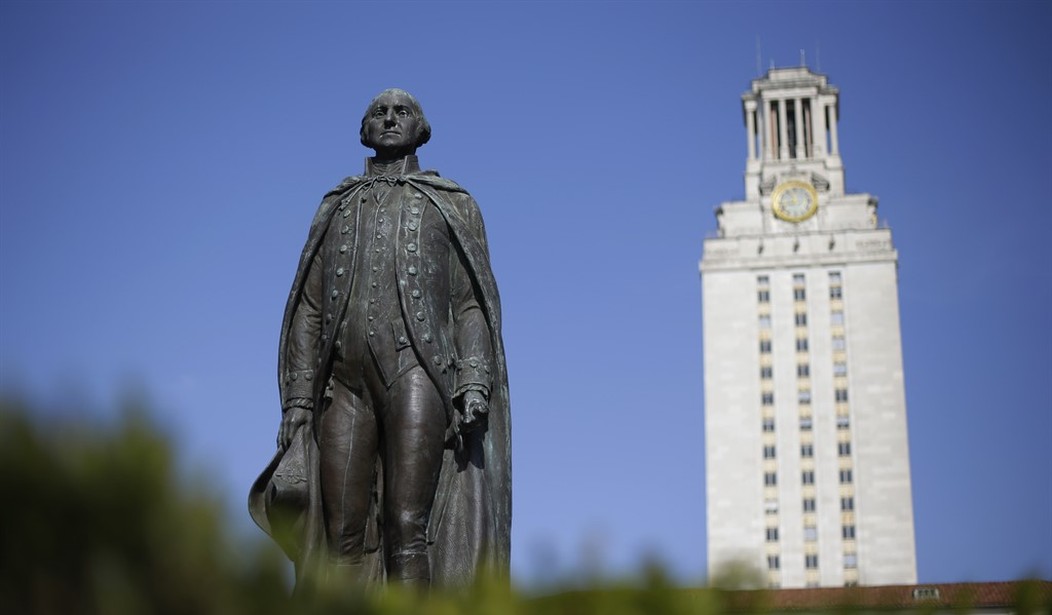
In 1790, George Washington wrote to the Hebrew Congregation in Newport, Rhode Island, to present his vision for America as a country where “bigotry finds no sanction” and “persecution no assistance.” He celebrated a nation where all citizens, including the “Children of the Stock of Abraham,” could dwell securely under their own “vine and fig tree,” free from fear. His words were a covenant, rejecting mere toleration and affirming natural rights for all.
Yet, in 2025, this covenant lies in tatters as a surge of anti-Semitism on college campuses defies the principles our first president championed. The Trump administration’s threats to defund hatred-tolerating universities are an attempt to uphold Washington’s vision.
The Anti-Defamation League’s (ADL) April report exposes the crisis: 9,354 anti-Semitic incidents nationwide in 2024, up 5 percent from 2023 and a staggering 893 percent over a decade. College campuses, too often the heart of this bigotry, saw an 84 percent spike, with 1,694 campus incidents. Vandalism and assaults surged, and half of monitored anti-Israel protests carried protest messaging—chants, signs, and speeches vilifying Jews.
This is not democratic discourse, but rather harassment and violence, fostering a climate where Jewish students live in fear, far from the safety Washington promised. The ADL’s Jonathan Greenblatt correctly calls this a “horrifying level of antisemitism,” a betrayal of the “enlarged and liberal policy” Washington urged.
Washington’s letter declares that a just government guarantees “liberty of conscience and immunities of citizenship,” asking only that citizens uphold this freedom. Too many universities’ failure to curb anti-Semitism—seen in cases like a professor demanding Jews apologize for “oppression”—marks a fatal dereliction of this duty. Too many campuses, meant to foster enlightenment, have become hotbeds of prejudice, targeting Jewish students for their identity, not their actions. This utterly contradicts Washington’s insistence that no persecution should befall anyone for who they are, undermining the “great and happy people” he believed America could be.
The Trump administration’s response to these horrors—revoking $210 million from Princeton and threatening further Princeton defunding—aims to restore Washington’s—and America’s—ideals. Critics, like Princeton’s president Christopher L. Eisgruber, who try to hide behind academic freedom, misrepresent the issue. Academic freedom does not shield hatred; it requires accountability to ensure open inquiry, not fear.
When institutions fail to protect Jewish students, allowing bigotry to fester, they forfeit public funding.
Defunding is not censorship, but a refusal to subsidize environments that defy America’s founding principles. Princeton may continue to coddle Jew-hatred, but it cannot continue to demand that taxpayers subsidize it.
Washington’s letter also calls on citizens to support a government that upholds equality as a citizen duty. The ADL’s Oren Segal reinforces this, urging “good people” to confront anti-Semitism. Yet, too many universities remain silent or complicit, tolerating protests laced with anti-Semitic venom or faculty rhetoric scapegoating Jews. This inaction frays the societal compact Washington both described and cherished, in which mutual respect drives peace and prosperity.
The Trump administration’s actions assert that the government will not stand by while institutions neglect their duty to protect all their students, faculty, and staff. By targeting funding, the president seeks to force universities to align with the “just administration” Washington deemed indispensable to national greatness.
Critics may claim such defunding risks overreach and/or stifles dissent. But Washington’s words clarify that liberty is not a license to harm. The government’s role is to protect rights, not fund spaces where they are violated. The 700 percent rise in anti-Semitic incidents reported by Hillel International and the 3,000 percent surge in tips to StopAntiSemitism cry out for urgent action, for these are not isolated acts but a systemic failure requiring systemic remedies.
Defunding delivers a clear message: universities must uphold every student’s safety and dignity or face consequences.
Washington dreamed of a nation where “none shall make . . . [anyone] afraid.” Today, Jewish students on campuses live in fear, their belonging eroded by irrational, unchecked hatred.
The Trump administration’s defunding threats are not punitive but restorative, realigning higher education with America’s covenant of equality and liberty. To honor his vision, we must demand that our institutions reflect the America he foresaw—one where bigotry finds no foothold, and every citizen thrives in safety and freedom.
Thomas Lindsay, Ph.D., is the Higher Education Policy Director for Next Generation Texas. He has more than two decades’ experience in education management and instruction, including service as a dean, provost, and college president.

Join the Conversation
VIP members get the ability to comment on articles.