







The trip that former President Ronald Reagan took to Europe in June of 1987 culminated in one of the greatest speeches of the last century -- but its first major moment was a visit to the Vatican.
On June 3, 1987, Reagan and first lady Nancy Reagan flew to Venice, Italy. Shortly before midnight, they arrived at the Villa Condulmer, where they would stay for several days.
"Finished evening with old John Wayne movie," Reagan wrote the next day in his diary.
The day after that, he delivered a television address broadcast in Western Europe by the U.S. Information Agency on its WORLDNET satellite television channels.
"Next week I'll be addressing the people of West Berlin," Reagan said. "I will stand in front of the wall that runs like an open wound through the heart of Europe, the wall that represents all that is most hostile to our democratic values of freedom and human rights. A regime that so fears its own people it must imprison them behind a wall is a regime that will always be a source of tension in Europe. It will always be at odds with free people everywhere."
Then, on June 6, Reagan and the first lady flew to the Vatican, where the president met with St. John Paul II, the pope whose native Poland -- like East Germany -- was then occupied by the atheistic communist regime of the Soviet Union.
"Nancy went on a separate tour while Bishop (Dino) Monduzzi took me to the papal library where I met the Pope," Reagan recorded in his diary. "We talked for an hour -- an interesting hour. I filled him in as best I could on Nicaragua & Gen. Sec. (Mikhail) Gorbachev."
According to the Los Angeles Times, former White House press secretary Marlin Fitzwater quoted the president as saying, of his meeting with the pope, "Most of our discussions were on U.S.-Soviet relations and on General Secretary (Mikhail S.) Gorbachev."
Reagan then returned to Venice, where he attended that year's G7 summit along with the leaders of Canada, France, West Germany, Italy, Japan and the United Kingdom.
On June 12, 1987, he flew to Germany to speak in front of the Berlin Wall.
"Then it was on to the Brandenburg gate where I addressed tens & tens of thousands of people -- stretching as far as I could see," Reagan wrote. "I got a tremendous reception -- interrupted 28 times by cheers."
In this speech, Reagan drew attention to the symbolic importance of a television tower on the other side of the wall.
"Perhaps this gets to the root of the matter, to the most fundamental distinction of all between East and West," said Reagan. "The totalitarian world produces backwardness because it does such violence to the spirit, thwarting the human impulse to create, to enjoy, to worship. The totalitarian world finds even symbols of love and worship an affront. Years ago, before the East Germans began rebuilding their churches, they erected a secular structure: the television tower at Alexander Platz. Virtually ever since, the authorities have been working to correct what they view as the tower's one major flaw, treating the glass sphere at the top with paints and chemicals of every kind. Yet even today when the sun strikes that sphere -- that sphere that towers over all Berlin -- the light makes the sign of the cross. There in Berlin, like the city itself, symbols of love, symbols of worship, cannot be suppressed.
"As I looked out a moment ago from the Reichstag, that embodiment of German unity, I noticed words crudely spray-painted upon the wall, perhaps by a young Berliner, 'This wall will fall. Beliefs become reality.'
"Yes, across Europe, this wall will fall. For it cannot withstand faith; it cannot withstand truth. The wall cannot withstand freedom."
"General Secretary Gorbachev," Reagan said at another point in the speech, "if you seek peace, if you seek prosperity for the Soviet Union and Eastern Europe, if you seek liberalization: Come here to this gate! Mr. Gorbachev, open this gate! Mr. Gorbachev, tear down this wall!"
Twenty-nine months later, the wall came down.
United by the values Reagan articulated at the Brandenburg Gate, the United States and its NATO allies defeated Soviet communism.
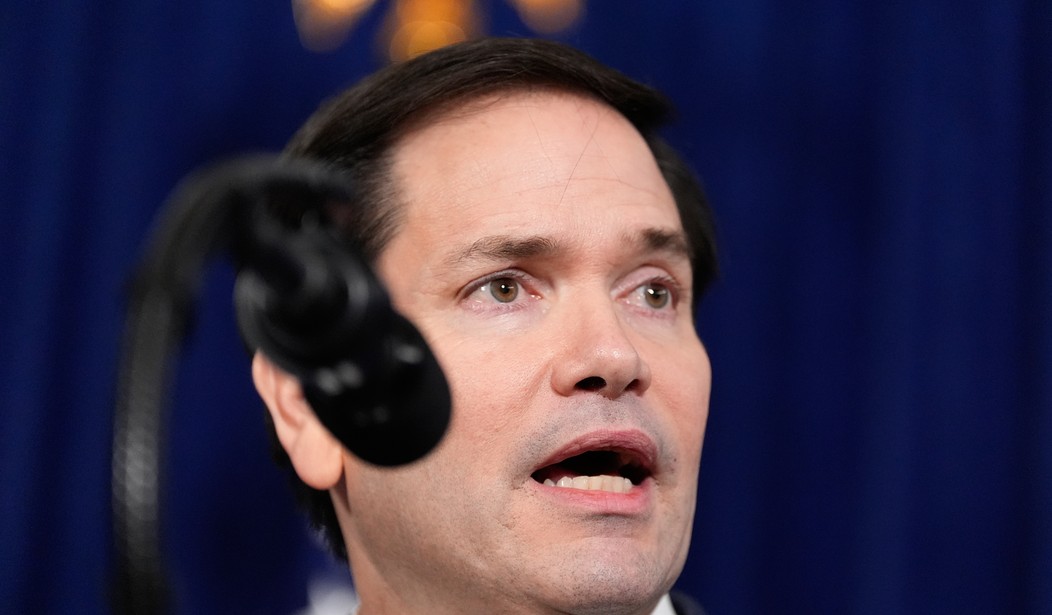
Secretary of State Marco Rubio spoke last week at the Munich Security Conference, were he directed his message to America's European allies and spoke in the spirit of Reagan.
He noted that the first Munich Security Conference convened in 1963. "At the time of that first gathering, Soviet communism was on the march," Rubio said. "Thousands of years of Western civilization hung in the balance. At that time, victory was far from certain. But we were driven by a common purpose. We were unified not just by what we were fighting against; we were unified by what we were fighting for. And together, Europe and America prevailed and a continent was rebuilt. Our people prospered. In time, the East and West blocs were reunited. A civilization was once again made whole.
"That infamous wall that had cleaved this nation into two came down, and with it an evil empire, and the East and West became one again."
"For the United States and Europe, we belong together," he said later in the speech. "America was founded 250 years ago, but the roots began here on this continent long before. The men who settled and built the nation of my birth arrived on our shores carrying the memories and the traditions and the Christian faith of their ancestors as a sacred inheritance, an unbreakable link between the old world and the new.
"We are part of one civilization -- Western civilization. We are bound to one another by the deepest bonds that nations could share, forged by centuries of shared history, Christian faith, culture, heritage, language, ancestry, and the sacrifices our forefathers made together for the common civilization to which we have fallen heir."
"It was here in Europe where the ideas that planted the seeds of liberty that changed the world were born," said Rubio.
"And this is the place where the vaulted ceilings of the Sistine Chapel and the towering spires of the great cathedral in Cologne, they testify not just to the greatness of our past or to a faith in God that inspired these marvels," he said. "They foreshadow the wonders that await us in our future."
Which is why this generation owes future generations the same liberty we have inherited rooted in these same unchanging values.
Editor’s Note: Do you enjoy Townhall’s conservative reporting that takes on the radical left and woke media? Support our work so that we can continue to bring you the truth.
Join Townhall VIP and use promo code FIGHT to receive 60% off your membership.


Join the Conversation
VIP members get the ability to comment on articles.