





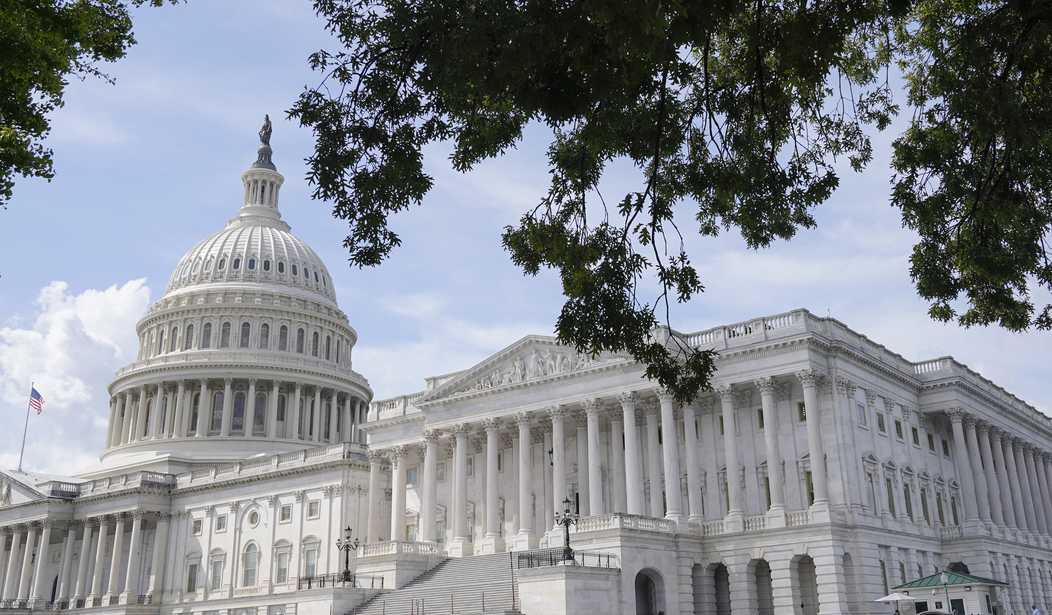
With the November election approaching, much attention is focused on the presidential contest -- but at least as significant are the contests that will determine who controls Congress.
That is because Congress controls federal taxing and spending.
"The Congress shall have power to lay and collect taxes, duties, imposts and excises, to pay the debts and provide for the common defence and general welfare of the United States," says the Constitution.
"No money shall be drawn from the Treasury, but in consequence of appropriations made by law," it says.
In his Commentaries on the Constitution of the United States, published in 1833 and quoted on The Founders' Constitution website, Justice Joseph Story did an excellent job explaining the purpose of this provision.
"The object is apparent upon the slightest examination," wrote Story. "As all the taxes raised from the people, as well as the revenues arising from other sources, are to be applied to the discharge of the expenses, and debts, and other engagements of the government, it is highly proper, that congress should possess the power to decide, how and when any money should be applied for these purposes.
"If it were otherwise, the executive would possess an unbounded power over the public purse of the nation; and might apply all its monied resources at his pleasure," he wrote.
"In arbitrary governments the prince levies what money he pleases from his subjects, disposes of it, as he thinks proper, and is beyond responsibility or reproof," Story wrote. "It is wise to interpose, in a republic, every restraint, by which the public treasure, the common fund of all, should be applied, with unshrinking honesty to such objects, as legitimately belong to the common defence, and the general welfare."
How has Congress handled this responsibility in recent decades?
In 1994, when Congress faced the midterm election in President Bill Clinton's first term, Republicans were competing with a Democratic Party that had won control of the House in every election since 1954. In late September 1994, then-House Minority Whip Newt Gingrich led Republican House members and candidates in making what they called their "Contract With America."
"The contract is a list of tried-and-true GOP agenda items, including welfare reform, tax cuts, term limits and a balanced budget amendment to the Constitution -- a list calculated to have maximum voter appeal," reported the Associated Press.
It did. Republicans won control of both the House and Senate that year.
On Jan. 26, 1995, House Republicans brought up the proposed constitutional amendment that would require a balanced budget.
This proposed amendment, said its official summary, "Prohibits total outlays from exceeding total receipts for a fiscal year, unless three-fifths of the members of each House of Congress provide by law for a specific excess of outlays over receipts by a roll call vote."
It also: "Sets a permanent limit on the amount of the public debt. Prohibits an increase in such amount unless approved by a three-fifths majority in each House by roll call vote."
And: "Directs the President to submit a balanced budget."
Then-House Majority Leader Dick Armey gave a floor speech explaining why this amendment was needed.
"Each and every one of our children today is endowed with $18,300 of federal national debt," said Armey.
"This moment," he said, "stands at a time where, if we do nothing, we must face the even more frightening possibility that by the time of their young adulthood, they will have even worse of that indebtedness, and their children, too, will share it."
Armey was right -- and large majorities in both houses of Congress agreed with him.
The House voted 300 to 132 that day to approve the Balanced Budget Amendment. The 228 Republicans who voted for it were joined by 72 Democrats -- giving it the necessary two-thirds vote to move forward.
So, it went to the Senate -- where on March 2, 1995, one Republican defector stopped it from being sent to the states for ratification. That was Sen. Mark Hatfield of Oregon, who, according to his biography on the Senate website, "cast the lone Republican 'nay' vote on a GOP-supported Balanced Budget Amendment, which ultimately fell one vote short of passage."
On that day when Hatfield blocked the Balanced Budget Amendment, the federal debt was $4,851,006,718,917.40, according to the Treasury Department's "Debt to the Penny" webpage. As of Oct. 18 of this year, it was $35,769,732,147,503.35.
That is a greater-than-sevenfold increase in less than 30 years.
According to the 2020 Census, there were 73,106,000 individuals in the United States under the age of 18. The $35,769,732,147,503.35 in federal debt equals approximately $489,286 per each one of these young Americans.
Under the Biden-Harris administration -- working with a Congress in which Republicans controlled the House and Democrats the Senate -- the federal government spent $6,751,552,000,000 in fiscal year 2024, according to the Monthly Treasury Statement for September. At the same time, it collected $4,918,736,000,000 in taxes and ran a deficit of $1,832,816,000,000.
The $6,751,552,000,000 the federal government spent in fiscal 2024 was up $2,304,941,000,000 -- or 51.8% -- from the $4,446,611,000,000 it spent in the pre-COVID year of fiscal 2019.
What comes next? "For the 2025-2034 period, CBO now projects that if current laws generally remained unchanged, the cumulative deficit would be $22.1 trillion," said a Congressional Budget Office report released in June.
America needs a Congress that will stop this.

Join the Conversation
VIP members get the ability to comment on articles.