





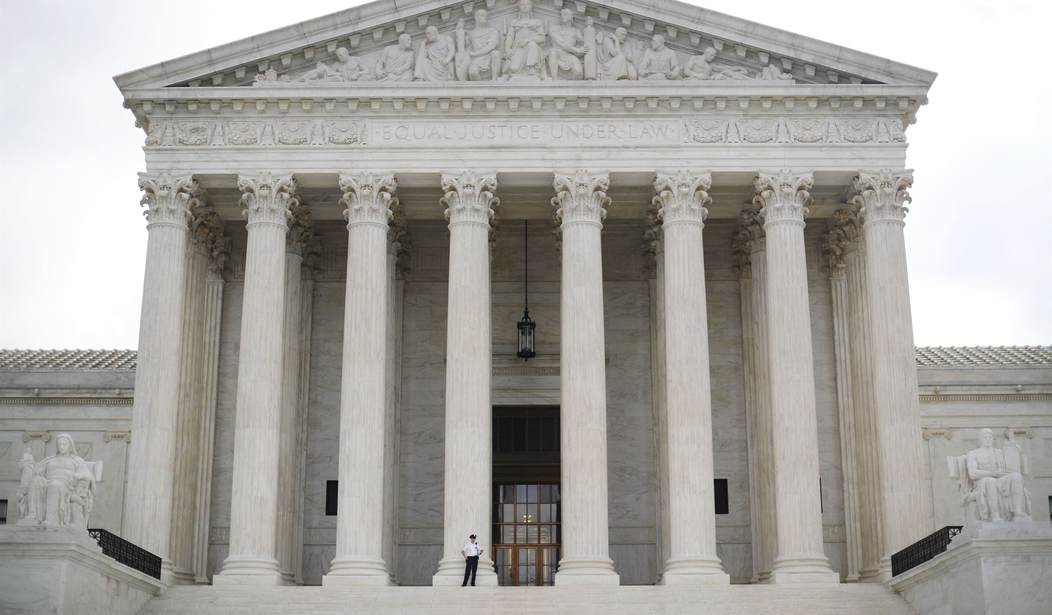
Judging by the argument that one lawyer made to Justice Neil Gorsuch, Tuesday must have been an interesting day in the restrooms at the U.S. Supreme Court.
"There are transgender lawyers in this courtroom today," attorney David Cole told Gorsuch.
"Of course, there are," said Gorsuch.
Cole was in the court to represent a biological male who decided in 2013 that he "identified" as a female -- and who then fought a family-owned Michigan-based funeral home all the way to the Supreme Court because it fired him as a funeral director when he indicated that he intended to start dressing as a female at work.
"As I was saying," Cole said a few moments later, according to the transcript of the oral argument in the case, "there are transgender male lawyers in this courtroom following the male dress code and going to the men's room and ... the Court's dress code and sex-segregated restrooms have not fallen."
"Transgender people follow the rule that's associated with their gender identity," Cole told the court. "It's not disruptive."
Specifically at issue in the court on Tuesday was whether the funeral home violated Title VII of the Civil Rights Act of 1964 by insisting that a biologically male funeral director would need to dress according to the funeral home's male dress code while he was at work.
Title VII says: "It shall be an unlawful employment practice for an employer ... to fail or refuse to hire or to discharge any individual, or otherwise discriminate against any individual with respect to his compensation, terms, conditions, or privileges of employment, because of such individual's race, color, religion, sex, or national origin."
In the funeral home case, the court must now decide what the word "sex" means legally when it describes an "individual's ... sex."
Are human beings male and female? Or are there additional sexes?
In this same case, the U.S. Court of Appeals for the 6th Circuit decided that an individual's sex is whatever the individual says it is.
A person's sex, in that court's vision, is neither static nor binary.
"By the same token, discrimination 'because of sex' inherently includes discrimination against employees because of a change in their sex," Judge Karen Nelson Moore, who was appointed by former President Bill Clinton, wrote in the opinion handed down by that court.
She elaborated in a footnote, comparing discrimination against "transgender, intersex, or sexually indeterminate" people to religious discrimination -- because, in her view, people can decide to change their sex, just as they can decide to change their religion.
"Moreover, discrimination because of a person's transgender, intersex, or sexually indeterminate status is no less actionable than discrimination because of a person's identification with two religions, an unorthodox religion, or no religion at all," wrote this judge. "And 'religious identity' can be just as fluid, variable, and difficult to define as 'gender identity'; after all, both have 'a deeply personal, internal genesis that lacks a fixed external referent.'"
Is there truly no "fixed external referent" that would indicate to a medical doctor -- or even just a modestly intelligent person -- that a particular individual happens to be male or female?
In the Supreme Court on Tuesday, Justice Samuel Alito accurately noted that this case about the meaning of "sex" will open the door to other cases.
"Let me move beyond the bathroom to another example," Alito said. "And it is not before us, but it will be coming. So a transgender woman is not permitted to compete on a woman's college sports team. Is that discrimination on the basis of sex in violation of Title IX?"
Title IX prohibits discrimination "on the basis of sex" in education programs that receive federal funding.
If five Supreme Court justices decide in the funeral home case that a person's sex under Title VII is whatever the person says it is, the same logic applied to Title IX would mean that a high school boy could simply declare himself a female and then play on the girl's basketball team.
But the ultimate issue here is not bathrooms or basketball courts. It is truth.
A person's sex is an objective and unchangeable fact. To claim otherwise is simply a lie.
Terence P. Jeffrey is the editor in chief of CNSnews.com.


Join the Conversation
VIP members get the ability to comment on articles.