





Three months after President Franklin Roosevelt named Robert Jackson attorney general, Jackson addressed a gathering of U.S. attorneys.
He issued a worthwhile warning.
"With the law books filled with a great assortment of crimes, a prosecutor stands a fair chance of finding at least a technical violation of some act on the part of almost anyone," Jackson said in a speech delivered April 1, 1940.
"In such a case," he said, "it is not a question of discovering the commission of a crime and then looking for the man who committed it, it is a question of picking the man and then searching the law books, or putting investigators to work, to pin some offense on him."
Sound familiar?
"It is in this realm -- in which the prosecutor picks some person whom he dislikes or desires to embarrass, or selects some group of unpopular persons and then looks for an offense, that the greatest danger of abuse of prosecuting power lies," Jackson said.
Remember: This speech was delivered 78 years ago -- by a Democrat.
"It is here that law enforcement becomes personal, and the real crime becomes that of being unpopular with the predominant or governing group, being attached to the wrong political views, or being personally obnoxious to or in the way of the prosecutor himself," Jackson said.
A year later, FDR named Jackson to the Supreme Court. Almost five decades after that, then-Justice Antonin Scalia quoted Jackson's speech in his lone dissent on Morrison v. Olson.
The issue there was whether the independent counsel provisions in the Ethics in Government Act of 1978 were constitutional.
Scalia said no.
The Appointments Clause was key to this case. It says the president "shall nominate, and by and with the Advice and Consent of the Senate, shall appoint Ambassadors, other public Ministers and Consuls, Judges of the supreme Court, and all other Officers of the United States, whose Appointments are not herein otherwise provided for, and which shall be established by Law: but the Congress may by Law vest the Appointment of such inferior Officers, as they think proper, in the President alone, in the Court of Law, or in the Heads of Departments."
Thus, the question of whether an officer of the federal government needs to be appointed by the president and confirmed by the Senate turns on whether the individual is an "inferior officer" or what the court now calls a "principal officer."
The Ethics in Government Act required an independent counsel to be appointed by a three-judge panel.
That would be constitutional only if an independent counsel were an "inferior officer."
The majority in Morrison concluded this was the case. Scalia obliterated their argument.
He noted, for example, that the majority said, "Admittedly, the Act delegates to the appellant (the) 'full power and independent authority to exercise all investigative and prosecutorial functions and powers of the Department of Justice."
"Once all of this is 'admitted,'" Scalia concluded, "it seems to me impossible to maintain that appellant's authority is so 'limited' as to render her an inferior officer."
He further argued that the independent counsel statute violated the Constitution's separation of legislative, judicial and executive powers.
"Governmental investigation and prosecution of crimes is a quintessentially executive function," he concluded.
So what is the remedy if a president or executive officer engages in corrupt or criminal activity?
"The checks against any branch's abuse of its exclusive powers are twofold," said Scalia. "First, retaliation by one of the other branch's use of its exclusive powers: Congress, for example, can impeach the executive who willfully fails to enforce the laws; the executive can decline to prosecute under unconstitutional statutes; and courts can dismiss malicious prosecutions. Second, and ultimately, there is the political check that the people will replace those in the political branches ... who are guilty of abuse."
In 1999, Congress let the independent counsel law expire and the Justice Department issued regulations allowing the attorney general to name a special counsel. Under those regulations, as reported by the Congressional Research Service, a special counsel "shall exercise, within the scope of his or her jurisdiction, the full power and independent authority to exercise all investigative and prosecutorial functions of any United States Attorney."
But U.S. attorneys are principal officers who must be nominated by the president and confirmed by the Senate.
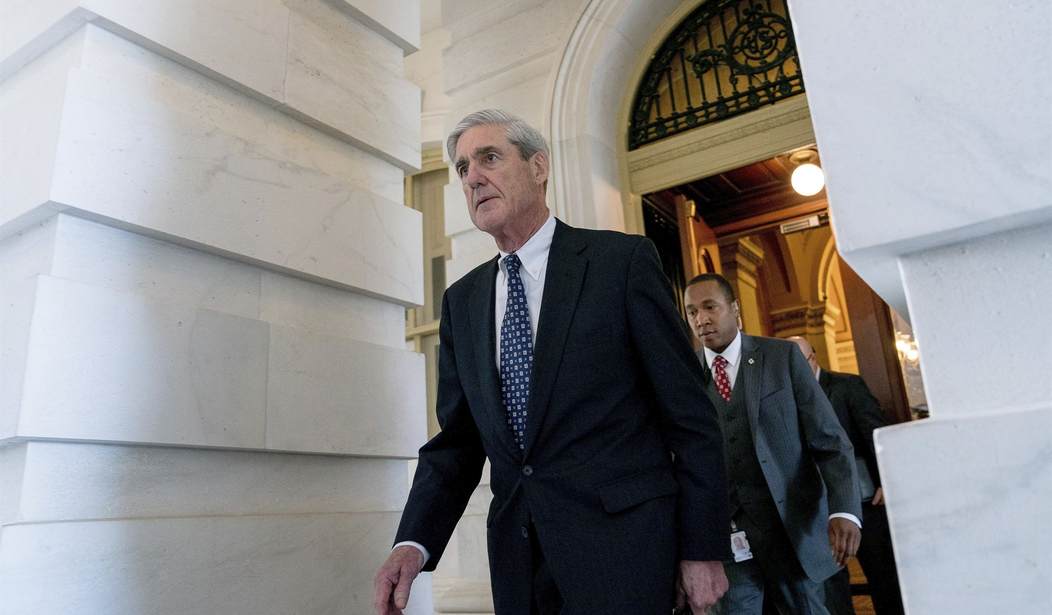
In the Wall Street Journal, Northwestern Law School professor Steven Calabresi, who clerked for Scalia, argued that special counsel Robert Mueller's "investigation has crossed a constitutional line" that even the majority drew in Morrison v. Olson.
"Only a principal officer, such as a U.S. attorney, can behave the way Mr. Mueller is behaving," wrote Calabresi. "Mr. Mueller is much more powerful today than any of the 96 U.S. attorneys."
Yet Mueller was not appointed by the president and confirmed by the Senate.
Calabresi concluded that those targeted by Mueller "should challenge the constitutionality of his actions on Appointments Clause grounds."
Mark Levin, who served with Calabresi in former President Ronald Reagan's Justice Department, agrees.
"Every defendant, suspect and witness, in this matter," Levin said on his website, "should challenge the Mueller appointment" as a violation of the Appointments Clause.

Join the Conversation
VIP members get the ability to comment on articles.