







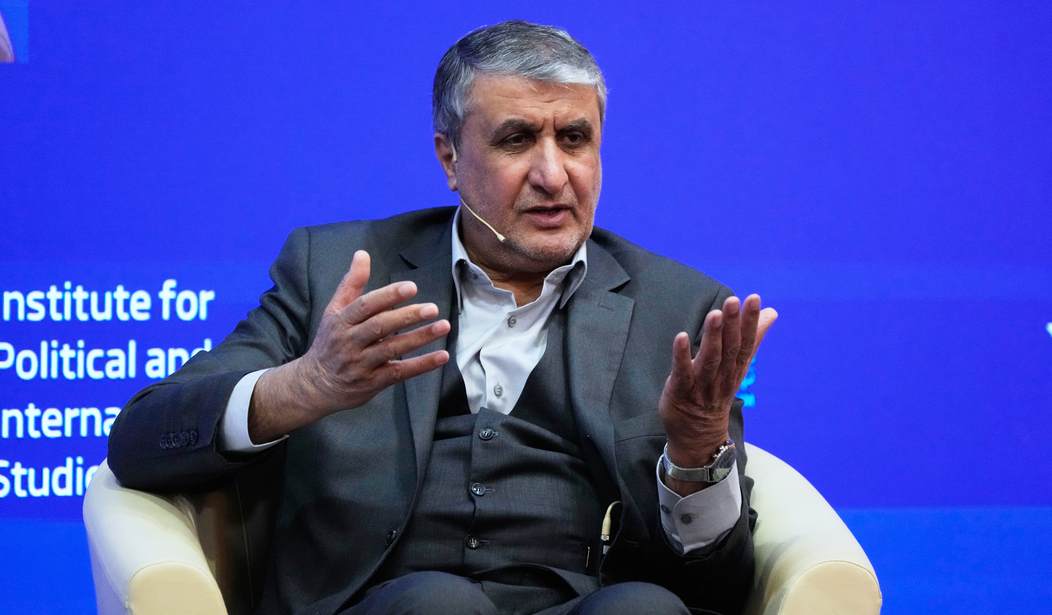
The latest remarks by Iran's atomic energy chief, Mohammad Eslami, that "no country can deprive Iran of its right to nuclear enrichment," are as predictable as they are disingenuous. Tehran has long cloaked its nuclear weapons ambitions in the language of sovereign rights and peaceful technology. Eslami insists that enrichment lies at the heart of any nuclear program and that Iran is merely exercising its lawful rights under the Non-Proliferation Treaty. On paper, that argument appears superficially sound. In reality, however, Iran's nuclear file is riddled with concealment, clandestine facilities, and years of obfuscation before international inspectors.
Rafael Grossi, the director-general of the International Atomic Energy Authority (IAEA), said last year that he was apprehensive over the theocratic regime's growing stock of enriched uranium. He disclosed: "They have amassed enough nuclear material for several nuclear weapons — not one at this point." Grossi claimed the mullahs have accumulated 400 kilograms of uranium enriched to 60 percent purity, a hair's breadth away from the 90 percent weapons-grade purity required for building a nuclear bomb. Uranium required for civilian power production is only enriched to 3.74 percent.
The backdrop to Eslami's comments is the second round of Oman-mediated talks between Tehran and Washington in Geneva. These discussions follow the dramatic collapse of earlier negotiations during the brief but intense Iran-Israel conflict in June, when the United States joined Israel in striking Iranian nuclear facilities. Now, once again, diplomacy teeters on the edge while threats of force hang in the air. President Donald Trump has resumed his characteristic mix of pressure and unpredictability, warning of possible military action and deploying a formidable naval presence to the region. The dispatch of major carrier strike groups to the Gulf is not mere theatre. It is a calculated signal that Washington's patience is finite. Yet Tehran has responded in kind, staging naval exercises in the Strait of Hormuz and conducting joint drills with Russia in the Sea of Oman and northern Indian Ocean. The choreography of confrontation continues.
Amid this tense stand-off, reports have emerged of a possible Iranian proposal: a three-year suspension of enrichment in exchange for lucrative economic arrangements that could appeal to a transactional White House. Such a deal, if it exists, would be a masterclass in regime survival tactics. It would buy time, relieve pressure, unlock funds, and preserve the core infrastructure of Iran's nuclear program intact. This would be a grave error. A temporary suspension is not dismantlement. It is not transparency. It is not accountability. It is merely a pause, one that Tehran could exploit to consolidate gains elsewhere. The centrifuges would not be destroyed. The scientific know-how would not vanish. The ballistic missile program, already a source of deep alarm across the Middle East, would continue its steady advance. And the regime's sponsorship of proxy militias, from Lebanon to Yemen, would remain untouched.
Washington has repeatedly called for zero enrichment, alongside curbs on ballistic missiles and an end to Iran's support for militant groups. Israel, understandably, insists that these elements be integral to any agreement. Yet Tehran has consistently sought to narrow the talks to enrichment alone, compartmentalizing its destabilizing activities as separate and non-negotiable. To accept a limited, time-bound suspension would be to validate that strategy. In any case, the mullahs cannot be trusted. They have continually cheated in the past.
Worse still, it would betray the long-suffering people of Iran. For decades, ordinary Iranians have borne the brunt of sanctions, economic mismanagement, and repression. Waves of protest, from students to women to workers to Bazaar merchants, have been met with brutality. Billions of dollars released under previous agreements did not trickle down to struggling families. Instead, they flowed into the coffers of the Revolutionary Guards, funding foreign adventures and domestic repression.
There is a cruel irony in the regime's invocation of national rights. The same authorities who claim an inalienable right to nuclear technology deny their own citizens the most basic civil and political rights. Elections are stage-managed. Dissent is criminalized. Women are policed for their attire. Ethnic and religious minorities face systemic discrimination. The leadership's definition of sovereignty serves only itself. Those who argue for a pragmatic deal contend that any freeze is better than none, that a three-year breathing space could lower tensions and avert war. The desire to avoid conflict is understandable. Military confrontation would be catastrophic, not only for Iran but for the wider region and global energy markets. The Strait of Hormuz remains a strategic chokepoint through which a significant share of the world's oil passes. Even the threat of closure rattles economies.
Yet history cautions against wishful thinking. Previous agreements have demonstrated Tehran's skill in playing for time. Sunset clauses approach with alarming speed. Verification mechanisms erode under political pressure. Meanwhile, the regime adapts, recalibrates, and advances. A sustainable solution must therefore meet several non-negotiable criteria. First, enrichment beyond minimal civilian levels must cease permanently, not temporarily. Excess centrifuges should be dismantled and removed, not mothballed. Second, intrusive, anytime-anywhere inspections must be guaranteed, with clear consequences for non-compliance. Third, ballistic missile development and the transfer of advanced weaponry to proxy groups must be integral to the framework, not relegated to a future discussion that never materializes.
The temptation to strike a headline-grabbing bargain will be strong. A dramatic announcement, framed as a triumph of deal-making, may appear attractive in the heat of an election cycle. But geopolitics is not a real estate transaction. The stakes are immeasurably higher. Tehran's leaders are adept at reading their counterparts. They understand the allure of economic opportunity. They calculate that a suspension dressed up as compromise might suffice to ease pressure while preserving strategic depth. To succumb to such a ruse would not only embolden the regime but signal to allies and adversaries alike that persistence in defiance ultimately pays.
The Iranian people deserve more than another flawed accord that entrenches their oppressors. They deserve a future free from both nuclear brinkmanship and any form of authoritarian rule that will come about through regime change by the Iranian people themselves and the organized, structured resistance inside the country. Any agreement that falls short of dismantling the machinery of proliferation and aggression will simply postpone, not prevent, the next crisis. The world must not confuse delay with resolution. A three-year pause is not peace. It is a countdown.
Struan Stevenson was president of the European Parliament's Delegation for Relations with Iraq (2009-14) and chairman of the Friends of a Free Iran Intergroup (2004-14), the Coordinator of the Campaign for Iran Change (CiC). He was a member of the European Parliament (MEP) representing Scotland (1999-2014). He is an author and international lecturer on the Middle East.
Editor’s Note: Do you enjoy Townhall’s conservative reporting that takes on the radical left and woke media? Support our work so that we can continue to bring you the truth.
Join Townhall VIP and use promo code FIGHT to receive 60% off your membership.
Join the Conversation
VIP members get the ability to comment on articles.