







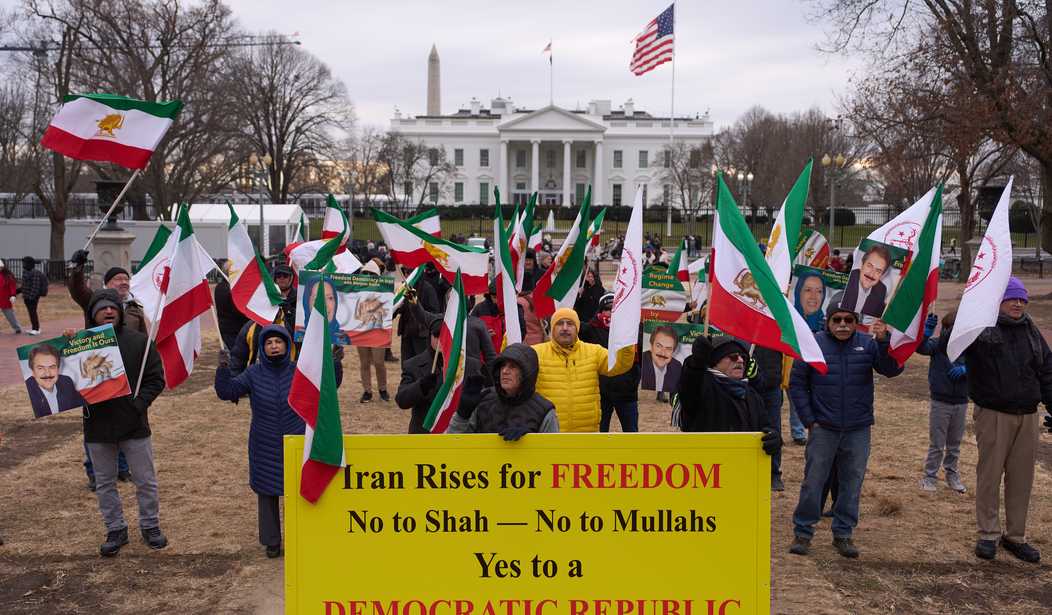
Iran is once again at a historic crossroads. As the country enters a new year, it does so not with celebration but with fire on the streets, rage in the bazaars, and defiance on university campuses. What began in late December as an economic protest in Tehran's Grand Bazaar has metastasized into a nationwide political uprising that now openly questions the survival of the clerical regime itself.
With inflation officially hovering around a staggering 52 percent, the Iranian economy is in freefall. The rial has collapsed, wages have been pulverized, and poverty has become the defining condition of daily life for millions. But to frame the current unrest merely as a cost-of-living crisis is to profoundly misunderstand what is unfolding. This is not simply an economic protest. It is a revolt against dictatorship in all its forms.
From Tehran to Shiraz, Isfahan to Kermanshah, Rasht to Khorramabad, the chants ringing through the streets tell their own unmistakable story. "Death to the dictator," "Death to Khamenei," "This year is the year of blood, Khamenei will be overthrown," and perhaps most telling of all, "Neither Shah nor Supreme Leader. Democracy and equality." These are not the slogans of a population seeking reform. They are the slogans of a people demanding an end to tyranny.
The regime's own media has inadvertently confirmed this reality. Fars News Agency, closely aligned with the Revolutionary Guards, admitted that the protests were being driven by organized groups chanting explicitly political slogans calling for the overthrow of the system. In a telling acknowledgement, it pointed to the influence of opposition leader Maryam Rajavi and the National Council of Resistance of Iran (NCRI), conceding that economic grievances were being transformed into a direct challenge to clerical rule.
This admission is crucial. The regime has long tried to portray dissent as sporadic, leaderless, or foreign-inspired. Yet the pattern is now undeniable. Resistance Units affiliated with the People's Mujahedin of Iran (PMOI) have played a decisive role in spreading protests, linking disparate demonstrations, and reinforcing a unifying message: down with the dictator, freedom for Iran.
The response of President Masoud Pezeshkian has been eerily familiar. Calling for dialogue, he urged officials to "listen to the legitimate demands of the protesters." It was a moment that evoked a chilling historical echo. In November 1978, a beleaguered Shah Mohammad Reza Pahlavi addressed the nation, claiming he had "heard the voice of your revolution" and promising reform. Three months later, he was gone. History, it seems, is repeating itself, first as tragedy, then as warning.
Faced with a determined and politically conscious uprising, the regime has reverted to its most cynical tactics: infiltration, disinformation, and psychological warfare. Plainclothes IRGC and Basij agents have been deployed to infiltrate protests, deliberately chanting slogans in favour of Reza Pahlavi, the Shah's son, in a transparent attempt to hijack the narrative. The objective is not to restore the monarchy, but to poison the well, to fracture unity by suggesting the only alternative to the mullahs is a return to the past.
Iranians have not fallen for it. Again and again, protesters have responded with chants rejecting both dictatorships, chanting "Death to the oppressor, be it the Shah or the Supreme Leader." In several cases, infiltrators have been exposed, filmed, and identified as regime agents. In Mashhad, such provocateurs were unmasked at the funeral of a dissident lawyer, only to later join security forces, arresting mourners. Their Basij identification cards told the real story.
Alongside physical repression, an information war is being waged with increasing sophistication. Doctored videos, deepfake audio, and recycled footage have flooded social media, falsely claiming that crowds are chanting pro-monarchy slogans. Careful analysis has exposed mismatched acoustics, lip-sync errors, and artificially clean soundtracks. In one case, footage from Sharif University dating back to 2022 was repurposed with fabricated audio to push a restorationist narrative.
This is not accidental. It is a deliberate strategy, amplified by satellite channels funded by remnants of the old regime and regional actors with their own agendas. The aim is to shift the axis of conflict away from "people versus regime" and toward a manufactured "battle of alternatives." It is a classic divide-and-rule scenario, updated for the digital age.
Meanwhile, repression on the ground has intensified. Universities have emerged as key battlegrounds. Students, particularly young women, have been at the forefront of resistance, prompting nighttime raids on dormitories, mass arrests, and the closure of campuses. In Fasa, protesters stormed the governor's office, only to be met with live fire and helicopters. In Lordegan, security forces killed at least two demonstrators. Even the regime admits casualties among its own Basij forces, a sign that fear is beginning to change sides.
All of this raises an unavoidable question: can this regime survive? It is bankrupt, economically, morally, and politically. Inflation at 52 percent is not a statistic; it is a sentence of despair for ordinary families. Decades of corruption, executions, repression, and regional adventurism have hollowed out the state. What remains is a brittle apparatus of force, desperately clinging to power through violence and lies.
Yet the streets are speaking with remarkable clarity. The dominant slogans are not nostalgic, not sectarian, not ambiguous. They are future-oriented, democratic, and resolutely anti-dictatorial. Neither Shah nor Supreme Leader. Only liberty and equality. The world must not be fooled by the regime's theatrics or its manufactured narratives. This uprising is real, resilient, and politically defined. Every fake video, every planted agent, every bullet fired into a crowd is evidence not of strength, but of fear.
Iran's rulers should remember the lesson of 1979. When a regime loses legitimacy, no amount of repression can save it. The Iranian people have risen before. They are rising again. And this time, they are determined to finish the job.
Struan Stevenson is the Coordinator of the Campaign for Iran Change (CiC). He was a member of the European Parliament representing Scotland (1999-2014), president of the Parliament's Delegation for Relations with Iraq (2009-14), and chairman of the Friends of a Free Iran Intergroup (2004-14). He is an author and international lecturer on the Middle East.

Join the Conversation
VIP members get the ability to comment on articles.