





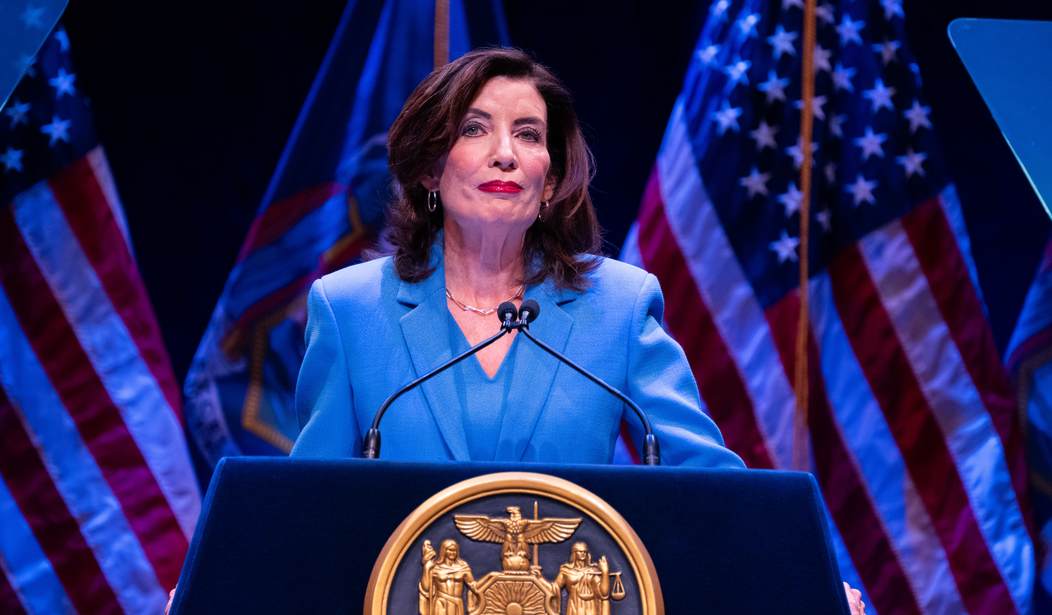
Back in April, New York Gov. Kathy Hochul described her proposal to ban local law enforcement agencies statewide from participating in the Department of Homeland Security’s 287(g) as “drawing a line in the sand.”
Appearing last Friday on MS NOW’s Morning Joe, Hochul was asked whether she could block local participation in the program. She replied: “I just banned it. It is against the law now in the State of New York to have these agreements.”
The 287(g) program gives trained state and local law enforcement officers authority to perform certain federal immigration enforcement functions under federal supervision. Depending on the agreement, officers can identify immigration violations among people who are already in custody, serve federal administrative warrants, or exercise immigration authority during their regular duties.
Not everyone in New York agrees with Hochul’s ban.
The state ordered 12 local law enforcement agencies to end their 287(g) partnerships by August 25. That same day, 15 county sheriffs filed suit challenging the ban.
Rensselaer County Sheriff Kyle Bourgault, whose office has had a 287(g) agreement since 2018, says the agreement allows deputies to determine whether someone arrested locally is wanted on other charges. “Access to that information is crucial in ensuring criminals and fugitives are brought to justice,” Bourgault said.
His office refused to terminate the agreement, prompting New York Attorney General Letitia James to sue the sheriff’s office.
Governors in other blue states are drawing their own lines in the sand against 287(g), creating friction with local sheriffs who want to keep their partnerships.
Earlier this year, New Mexico Gov. Michelle Lujan Grisham signed the Immigrant Safety Act, which “bans the use of state land for immigration detention and prohibits local police from entering into 287(g) federal agreements allowing them to perform immigration duties.”
Two New Mexico counties continued operating their agreements after the law went into effect, prompting the state’s attorney general to sue Curry and Torrance counties and their sheriffs in May.
Curry County Sheriff Michael Brockett stood by his decision, saying he hoped “logic and reason will prevail” so he could “continue to do everything I can to keep our community safe.”
Maryland shows what happens when the ban goes into full effect. In February, Gov. Wes Moore signed legislation requiring nine participating counties to end their agreements. By May, all nine had stopped participating. Wicomico County Sheriff Mike Lewis called the ban "the biggest betrayal to law enforcement and public safety that I have ever seen.”
These bans do much more than set immigration enforcement policy. They take a public safety tool away from local officers who are on the front lines of protecting their communities. These partnerships make local officers a force multiplier and help close gaps that criminal networks exploit.
On Tuesday, DHS Secretary Markwayne Mullin announced that Operation Rotten Apple, a monthlong ICE operation in New York, resulted in 2,197 illegal aliens arrested, which included “murderers, rapists, pedophiles, drug traffickers, and violent assailants.” Mullin underscored that the operation was conducted with “no help from Mayor Mamdani and Governor Hochul.”
When federal agents are removing public safety threats from New York communities, protecting New Yorkers should come before political restrictions that thwart local officers from helping.
While blue states draw lines against 287(g), red states are crossing them.
In Texas, Gov. Greg Abbott signed Senate Bill 8 last year, requiring most sheriff’s departments to request a 287(g) agreement and enter into one when offered. In just 12 months, Texas increased its agreements from 26 to 254.
Goliad County Sheriff Roy Boyd enforces 287(g) through all three models — Jail Enforcement, Warrant Service Officer, and the recently added Task Force model, which “enhances public safety and national security by allowing designated immigration officers to enforce limited immigration authority while performing routine police duties or as an active participant in an ICE-led task force.”
Boyd called it an extra tool for his deputies, arguing it can help confront cartels as they have a “huge logistical footprint in the United States of America.”
Former Border Patrol agent and Texas Public Policy Foundation senior fellow Ammon Blair testified before Texas lawmakers last year that 287(g) “expands intelligence-sharing mechanisms between state, local, and federal law enforcement agencies” to help “disrupt transnational criminal organizations operating within the state.”
In Florida, all 67 county sheriffs participate in 287(g), and the state has more “deputizations than any other state in the nation.”
Gov. Ron DeSantis pledged that Florida “will continue to use every available resource to identify dangerous individuals, support federal immigration enforcement, and keep our citizens safe.”
Through 287(g) partnerships, Operation Tidal Wave has resulted in more than 10,400 arrests since its launch in April 2025, showing what coordinated local and federal enforcement can achieve.
Collier County Sheriff Kevin Rambosk says his office’s partnership, now in its 17th year, “has resulted in more than 12,000 criminal detainers placed for removal from Collier County.” “When you give that tool to local law enforcement, it works,” he said.
Texas and Florida have taken steps to require 287(g) participation by law, and they should continue building on that framework — protecting these agreements and expanding participation statewide. Other states should follow that lead and ensure their laws do not allow them to become sanctuary jurisdictions.
The contrast could not be clearer.
New York, New Mexico, and Maryland have drawn lines that shut local law enforcement out of 287(g). Texas and Florida are showing what lies on the other side.
Selene Rodriguez is a campaign director for the Secure and Sovereign Nation campaign at the Texas Public Policy Foundation.
Editor’s Note: Do you enjoy Townhall’s conservative reporting that takes on the radical Left and woke media? Support our work so that we can continue to bring you the truth.
Join Townhall VIP and use promo code FIGHT to receive 60% off your membership.


Join the Conversation
VIP members get the ability to comment on articles.