





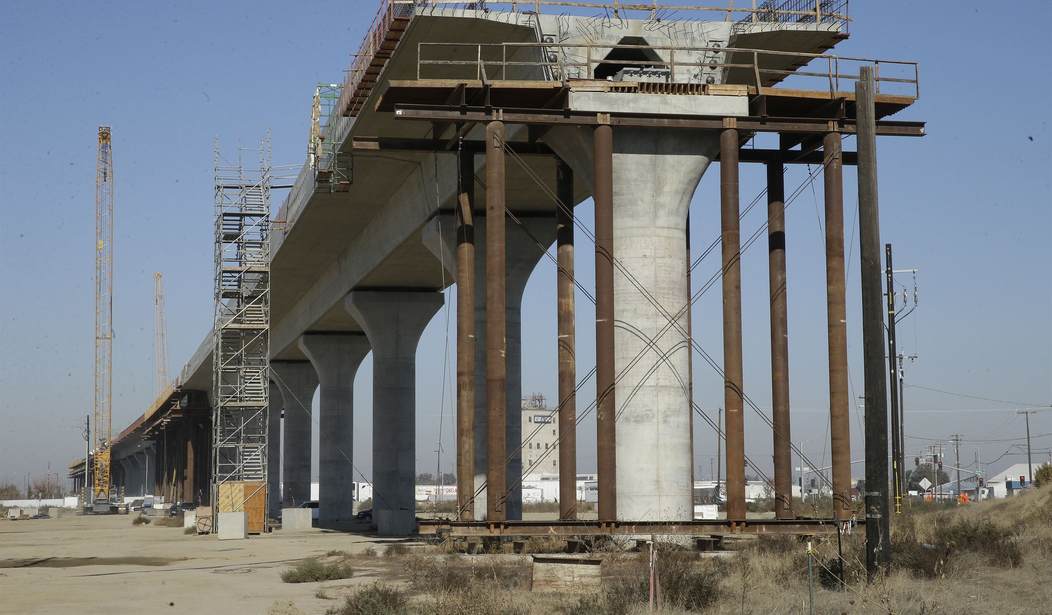
I have spent two decades as an expert witness testifying about where other people's money goes missing. Pension funds looted by trustees who knew the rules better than the regulators. Family trusts gutted by fiduciaries who mistook other people's capital for their own severance package. None of that prepared me for California's high-speed rail line, which voters approved in 2008 at a projected cost of $33.6 billion and which the Authority's own 2026 business plan now prices at $126.2 billion, without laying a single mile of track between two cities anyone outside the Central Valley could find on a map.
Here is the part nobody in Sacramento wants to explain. The rail project runs under a Community Benefits Agreement, a project labor agreement that hands craft work to union hiring halls and requires most workers on site for more than eight days to pay union dues. Every construction contract the High-Speed Rail Authority signs carries this agreement, straight from the Authority's own paperwork.
Now follow the money, because I have spent a career doing exactly that for a living. In 2008, when California voters were deciding whether to approve the $9.95 billion bond that got this train rolling, the California Alliance for Jobs put up $616,500 for the “yes” campaign, nearly a quarter of the roughly $2.7 million raised. Operating engineers' locals kicked in another $575,000. Add in the laborers' council and the building trades, and construction unions bankrolled a meaningful share of the campaign that authorized a project whose contracts were then, by design, steered back to those same unions. They did not do this out of civic charity. As Edward Ring at the California Policy Center put it, “the unions get behind these projects because they're big.”
If a broker did this, we would call it self-dealing and the SEC would open a file. A fund manager who steered client capital into a vehicle that paid his own firm a fee would not get to call it a coincidence. But government contracting runs on a different rulebook, and California wrote a specific exemption into it. Section 84308 of the Government Code is the state's pay-to-play law. It bars a company seeking a noncompetitive contract from handing more than $500 to the officials who will vote on it. Sounds sensible. Except the statute carves out one category entirely: labor agreements. A union entering a collectively bargained project labor agreement with a public agency is explicitly exempt. The very arrangement most likely to reward a union's political spending with guaranteed work is the one arrangement the law declines to police.
I coached youth sports for years, and I told teenagers constantly that rules apply evenly or they mean nothing. California is teaching grown adults with billions of taxpayer dollars the opposite lesson: the rules bend for whoever wrote them.
None of this is new, and it is not unique to California. Boston's Big Dig was sold to taxpayers in 1985 at $2.8 billion. It finished construction at $14.8 billion, a 429 percent overrun, and when you tally the interest on the bonds that financed it, the true bill runs past $24 billion with payments stretching to 2038. The Big Dig ran on heavily unionized labor arrangements too. Cost estimators, project managers, and elected officials had reasons to lowball the number that got the project authorized. Milton Friedman had a name for this dynamic: nobody spends someone else's money as carefully as they spend their own, and government spends other people's money on other people, the worst combination of all four he identified. High-speed rail and the Big Dig are the same experiment run twice, with the same result.
To be fair, project labor agreements are not inherently corrupt, and precision matters here because precision is the whole job when you are the one under oath. PLAs can set real safety standards, apprenticeship pipelines, and dispute procedures, and union labor is often skilled labor. Prevailing wage rules exist for defensible reasons. The problem is not that construction workers organize or vote. The problem is a closed loop: officials write the labor mandate, the unions who benefit fund the campaign that authorizes the money, and the law carved out the one door that might have let sunlight in. Justice Louis Brandeis said sunlight is the best disinfectant. California's high-speed rail project runs mostly in the dark, and taxpayers catch the infection.
I am not alleging a crime here. Nobody needs a subpoena to see a feedback loop that Sacramento built on purpose and then exempted from its own transparency law. Call it patronage, call it a mandated procurement regime with a convenient blind spot, call it whatever you want. What it produces is a train with no track, a bill with no ceiling, and a Sacramento delegation that keeps getting reelected by the same interests that keep getting paid.
The fix does not require a special prosecutor. It requires the California legislature to close Section 84308's labor exemption and subject union contributions on public works to the same contribution limits and recusal rules that already apply to every other contractor angling for a government check. Competitive bidding on the labor side of the ledger would not kill a single legitimate union job. It would just mean the workers competing for taxpayer money have to win it instead of buying it in advance.
Epictetus taught his students to sort the world into what they control and what they don't. Whether a union spends its dues on a ballot campaign isn't Sacramento's call, and it shouldn't be. Whether the law rewards that spending with a guaranteed monopoly on the work is entirely Sacramento's call, and lawmakers have chosen, year after year, to keep the reward in place. That is the part worth getting angry about. Until the legislature closes the loophole it wrote for itself, every Californian holding this bond debt is funding both ends of the transaction: the campaign that authorized the project and the contractor who gets paid to never finish it.
Jay Rogers is a financial professional with more than 30 years of experience in private equity, private credit, hedge funds, and wealth management. He has a BS in criminal justice from Northeastern University and has completed postgraduate studies at UCLA, UPenn, and Harvard. He writes about issues in finance, constitutional law, national security, human nature, and public policy.
Editor’s Note: Do you enjoy Townhall’s conservative reporting that takes on the radical Left and woke media? Support our work so that we can continue to bring you the truth.
Join Townhall VIP and use promo code FIGHT to receive 60% off your membership.


Join the Conversation
VIP members get the ability to comment on articles.