







Author's Note: All previous volumes of this series are here. The first 56 volumes are compiled in the book "Bible Study For Those Who Don't Read The Bible." "Part Two," featuring volumes 57-113, was published in December 2022
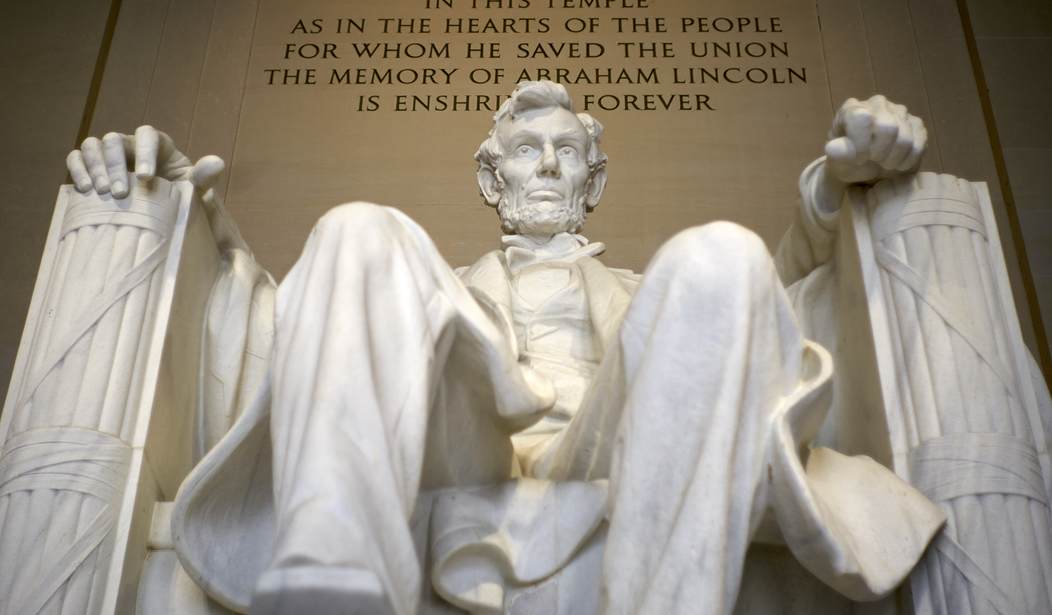
Thanks for joining our study today. As part of Townhall’s 250th-anniversary coverage, we are discussing President Abraham Lincoln’s second inaugural address, known for its biblical quotations and Christian themes. The address is so revered that it is carved into a marble wall at the Lincoln Memorial in Washington, D.C.
Built in 1922, the memorial opened 57 years after his death by assassination on April 15, 1865. Only 42 days earlier, on March 4, Lincoln gave this now-famous, sermon-like 701-word inaugural address to a war-torn nation. The address focused on three themes:
First, the Civil War was caused by slavery in the South. (Later, “states' rights” came into vogue as an equal cause, but Lincoln clearly stated that the cause was slavery.)
The second theme was that the war was a divine punishment for the entire nation that benefited from the economic wealth generated by slavery.
Third, with the Confederates’ surrender on April 9, 1865—unbeknownst to Lincoln, just 36 days away—the president advocated for healing and reconciliation with the South.
Let’s examine the long third paragraph in which Lincoln used biblical quotes to convey those three themes. For our purposes, we treat these as separate paragraphs, and I flag the biblical quotes or add a comment. We begin the third paragraph of Lincoln’s Second Inaugural Address with his words always in italics:
“Neither party expected for the war the magnitude or the duration which it has already attained.” (True, since both sides fully expected a short victory.)
“Neither anticipated that the cause of the conflict might cease with or even before the conflict itself should cease. Each looked for an easier triumph and a result less fundamental and astounding.” (Meaning: slavery ended, but the war continues. Effective on January 1, 1863, Abraham Lincoln issued the Emancipation Proclamation when “all enslaved people within the rebellious Confederate states were permanently free.”)
“Both [sides] read the same Bible and pray to the same God and each invokes His aid against the other.” (In this Christian Bible reading nation, each side asking God to strike down the other was itself a sin, as Lincoln continued below.)
“It may seem strange that any men should dare to ask a just God's assistance in wringing their bread from the sweat of other men's faces” (He references Genesis 3:19: “By the sweat of your brow you will eat your food...” God described to Adam how hard he would have to work the land to eat. Thus, Lincoln is chastising Southern slave culture since the slaves had to work hard so Southerners could eat. Then, Lincoln continues quoting Matthew 7:1, warning the Union’s people “but let us judge not that we be not judged.”)
Note that in one sentence, Lincoln quotes God in Genesis and Jesus in Matthew. Here are Lincoln’s words without interruption:
“It may seem strange that any men should dare to ask a just God's assistance in wringing their bread from the sweat of other men's faces, but let us judge not that we be not judged. The prayers of both could not be answered ~ that of neither has been answered fully.”
Lincoln continues and again quotes Jesus in Matthew:
“The Almighty has His own purposes. 'Woe unto the world because of offenses, for it must needs be that offenses come, but woe to that man by whom the offense cometh.’” (Lincoln quotes Matthew 18:7 from the King James Version. A modern translation reads: “Woe to the world because of the things that cause people to stumble! Such things must come, but woe to the person through whom they come!”)
Next, in one long sentence, Lincoln explains God’s punishment for those who perpetrate sinful offenses:
“If we shall suppose that American slavery is one of those offenses which in the providence of God must needs come but which having continued through His appointed time He now wills to remove and that He gives to both North and South this terrible war as the woe due to those by whom the offense came shall we discern therein any departure from those divine attributes which the believers in a living God always ascribe to Him.”
What does that mean in modern English? Answer: Slavery was morally wrong, yet God allowed it to exist. Now God “wills to remove” slavery and gave the “North and South this terrible war” to punish the entire nation for its involvement in slavery. Then Lincoln asks the nation to consider whether we should see this punishment (the war) as inconsistent with God’s justice and goodness.
Lincoln continues:
“Fondly do we hope ~ fervently do we pray ~ that this mighty scourge of war may speedily pass away.” (Sadly, the “scourge of that war” impacted the USA for untold decades. Even recently, at the Great American State Fair on the National Mall, there was controversy because the North Carolina booth displayed a Confederate flag.)
Lincoln continues:
“Yet, if God wills that it continue until all the wealth piled by the bondsman's two hundred and fifty years of unrequited toil shall be sunk and until every drop of blood drawn with the lash shall be paid by another drawn with the sword as was said three thousand years ago, so still it must be said 'the judgments of the Lord are true and righteous altogether.’”
Let’s unpack that long sentence. If God’s will is to continue the war until all the wealth gained from the previous 250 years of unpaid slave labor is destroyed and all the blood spilled by slave owners' whips is paid for in blood that is shed in battle, then we must accept God’s judgment upon our nation because the Bible said, “The judgments of the Lord are true and righteous altogether” (Psalm 19:9 KJV).
Lincoln is admitting collective national sin, and we must accept God’s punishment upon the nation because “the judgments of the Lord are true and righteous altogether.” So, I ask, “How powerful is that?” Then, 42 days later, Lincoln died on Good Friday. Was he sacrificed for the sins of the nation? Lincoln's death shocked the country. Both sides understood the gravity of his passing. The last most quotable paragraph has Lincoln asking for national healing with God’s help to “bind the nation’s wounds”:
"With malice toward none with charity for all with firmness in the right as God gives us to see the right let us strive on to finish the work we are in to bind up the nation's wounds, to care for him who shall have borne the battle and for his widow and his orphan ~ to do all which may achieve and cherish a just and lasting peace among ourselves and with all nations." (End Lincoln’s words.)
As our nation celebrates its 250th anniversary, the Civil War remains a subject of study and debate, regarded as a turning point in our history. Then consider that in 1917, only 52 years after the Civil War ended, the United States of America entered World War I with grandsons of Union and Confederate soldiers fighting side by side.
In his second inaugural, Lincoln positioned the war’s unspeakable pain and suffering in biblical terms as punishment for a nation’s collective sin with lasting consequences that needed to be healed with God’s guidance.
Was God’s justice done? A horrific war was self-inflicted upon a largely Christian nation for man’s sin against man. The verse Lincoln quoted was true then and is today: “The judgments of the Lord are true and righteous altogether” (Psalm 19:9 KJV).
Myra Kahn Adams is a conservative political and religious writer. Her book "Bible Study For Those Who Don't Read The Bible" reprints the first 56 volumes of this popular study. "Part 2," reprints Vols. 57 –113. Order it here.
Myra is also the Executive Director of the National Shroud of Turin Exhibit. You can help support our six-month exhibit at the Basilica in Orlando, Florida. Read more here. Contact: Myraadams01@gmail.com
Editor's Note: Do you enjoy Townhall's conservative reporting that takes on the radical left and woke media? Support our work so that we can continue to bring you the truth.
Join Townhall VIP and use promo code FIGHT to receive 60% off your membership.

Join the Conversation
VIP members get the ability to comment on articles.