





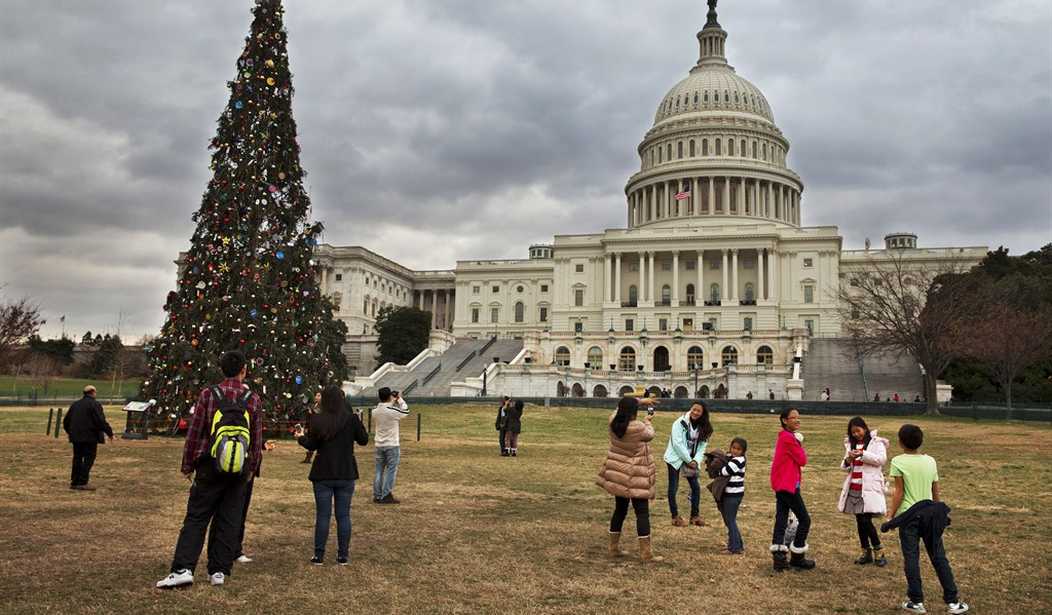
WASHINGTON -- 'Tis the season for creche display controversies and public school decoration debates and First Amendment argumentation, when all the ideologues get a little extra outrage or victimization in their stockings. The holiday is observed across the nation with injunctions and festive debates on cable television. Little children wait in line at the mall to have their picture taken with Bill O'Reilly or the Rev. Barry Lynn. (That last part, to my knowledge, is not true, but it should be.)
This year's celebration is all the more poignant in the light of a fallen reality television star who manufactures duck calls and culture war imbroglios. Some liberals, it turns out, can act with the zeal of theocrats. And some Christians, it seems, hold a faith that more closely resembles the prejudices of Southern, rural culture than the teachings of Christ. (See the contrast -- the vast, cosmic contrast -- between the patriarch of "Duck Dynasty" and the current Bishop of Rome.)
These debates persist because there are often no easy or final answers. They are conducted on a slippery slope. Some forms of speech are rightly stigmatized. But tolerance is the virtue of permitting room for speech we think is wrong. Some public expressions of religion are inconsistent with pluralism. But true pluralism is a welcoming attitude toward all faiths, not the imposition of a rigid secularization -- itself the victory of one, dogmatic faith.
Ultimately all of these disputes resolve into an argument about power: Who has the ability to define and enforce the boundaries of the acceptable? In America, thank God, this is generally a legal and social disagreement. In other places, advocates evangelize with the gun or gallows.
Particularly in this season, what is most conspicuous about these disputes is their disconnection from the actual content of Christmas, which involves an alternative definition of power.
It is easy to downplay or domesticate the Christmas story. The whole thing smacks of squalor and desperation rather than romance -- the teen mother, the last-choice accommodations, the company of livestock. Whether or not the birth was accompanied by angel choirs, it was certainly attended by buzzing flies.
If you ascribe eternal significance to these events, they are theologically and socially subversive. Rather than being a timeless Other, God somehow assumed the constraints of poverty and mortality. He was dependent on human care and vulnerable to human violence. The manger implied the beams and the nails. To many in the Roman world -- and to many since -- this seemed absurd, even blasphemous. Through eyes of faith, it appears differently. Novelist and minister Frederick Buechner sees the "ludicrous depths of self-humiliation [God] will descend in his wild pursuit of mankind."
In the story, politics plays a marginal but horrifying role. King Herod perceived a vague threat to his power and responded with systematic infanticide.
But the incarnation has unavoidable social implications. If the deity was born as an outcast, it is impossible to view or treat outcasts in quite the same way. A God who fled as a refugee, preferred the company of fishermen, and died as an accused criminal will influence our disposition toward refugees, the poor and those in prison. He is, said Dorothy Day, "disguised under every type of humanity that treads the earth."
This birth and life had an entirely unpredictable historical outcome. The proud, well-armed empire that judicially murdered Jesus of Nazareth exists only as a series of archaeological digs. The man who was born in obscurity and died an apparent failure is viewed as a guide and friend by more than a billion people. Our culture -- its history, laws and art -- is unimaginable without his influence.
Which brings us back to the meaning of power. It is unavoidable for citizens to argue over the definition and limits of religious liberty. But Christian influence is not expressed in the grasping struggle for legal rights or political standing. It is found in demonstrating the radical values of the incarnation: Identifying with the vulnerable and dependent. Living for others. Trusting that hope, in the end, is more powerful than cunning or coercion. The author of this creed sought a different victory than politics brings -- the kind that ends all selfish victories.
Or so the story goes. "The night deepens and grows still," says Buechner, "and maybe the only sound is the birth cry, the little agony of new life coming alive, or maybe there is also the sound of legions of unseen voices raised in joy."

Join the Conversation
VIP members get the ability to comment on articles.