





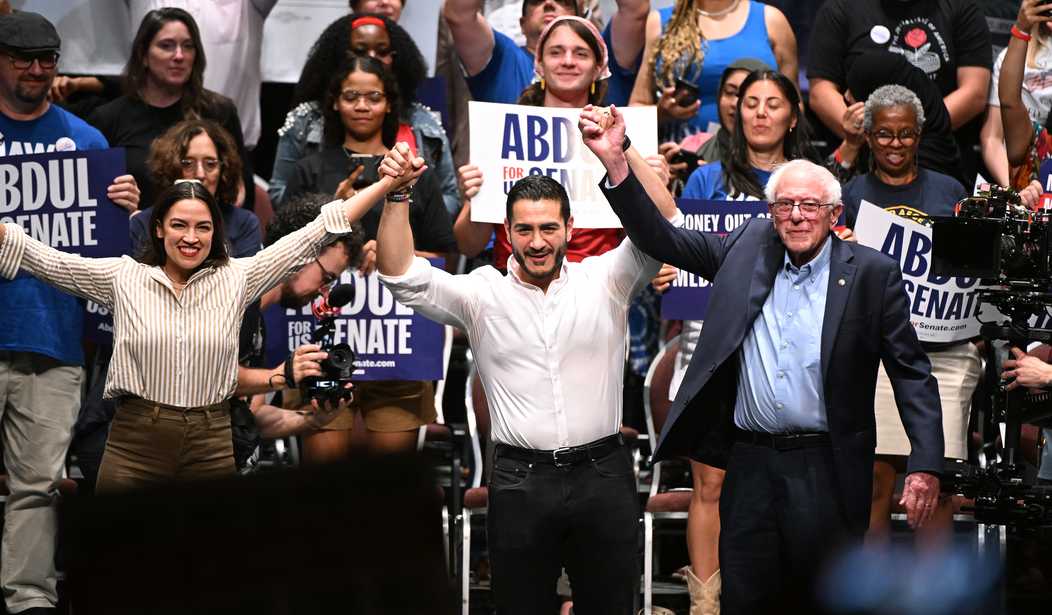
It's worth poking around the entrails of the returns for the agonizingly close and, given the pre-primary polls, surprising results of recent Democrat primaries in the key swing Midwestern states of Michigan and Wisconsin, with a side look at Minnesota.
These results highlight a basic split between the constituencies that have suddenly come to dominate the Democrat primary electorate, neither of which much resembles the white working-class demographic, the memory of which Democrat politicians invoke nostalgically, though its members mostly vote for Trump Republicans these days.
In both Michigan's senatorial and Wisconsin's gubernatorial primaries, the results were so close that it's useful to express them in the usually supererogatory tenths of a percentage.
In Michigan, the Woke 2 (to use Democrat Rep. Alexandria Ocasio-Cortez's (NY-14) terminology) candidate Abdul El-Sayed beat Democrat Rep. Haley Stevens (MI-11) by a margin of one percentage point. In Wisconsin, the establishment choice, Milwaukee County Executive David Crowley, beat Assemblywoman Francesca Hong by 0.4 percentage points.
Switches of just 8,000 votes in Michigan and 2,000 votes in Wisconsin would have changed the results.
Just as El-Sayed's victory does not prove that a candidate who emphasized issues out of the Democratic Socialists of America playbook is a sure winner, Hong's defeat does not prove that such a candidate is a sure loser.
Both have proven that a DSA-type candidate can be a serious contender for the Democratic presidential nomination in 2028, a year in which, if current trends continue, the Democrat nominee would be favored to win the presidency.
Looking back, one can see how changes in the Republican Party's constituencies foretold the success of Donald Trump's candidacy. In the 2008 and 2012 presidential primaries, Mike Huckabee and Rick Santorum carried the noncollege demographic and nonmajor metropolitan areas in seriously contested Midwestern primaries.
In 2016, those groups were key to Trump's plurality wins in crowded primary fields and to his upsets of Hillary Clinton in the key Midwestern states of — yes, the same ones again — Michigan and Wisconsin.
Midwestern Democrat primaries were once dominated by blue-collar workers in major factory towns. But less than half of Michigan's primary vote this month came from metro Detroit, which favored the establishment candidate Stevens, 51 percent to 45 percent. El-Sayed's margin and more came from the state's college and university counties, where some 14 percent of all Democrat primary voters supported him over Stevens, 59 percent to 37 percent.
There were splits within the metro areas as well. El-Sayed, who is Muslim and spoke out constantly against Israel, carried heavily Arab American Dearborn, 78 percent to 20 percent, while Stevens carried next-door and majority-black Detroit, 62 percent to 34 percent. In Oakland County, heavily gay Ferndale voted 78 percent to 21 percent for El-Sayed, while neighboring and heavily Jewish Oak Park voted for Stevens, 60 percent to 33 percent.
As elections analyst Ryan McComb notes, precinct returns showed El-Sayed ran strongest in places where a majority of adults had college degrees and incomes below $100,000. That's the "downward-mobile educated class," as he put it, or the "graduate student proletariat," a term I've used since Jesse Jackson won the 1988 Michigan presidential primary.
We don't yet have such fine-grained analyses of Wisconsin, but there are some obvious reasons why Hong fell just short. Her chief weakness was in her home turf, Dane County, which she carried by just seven percentage points. It's home not only to the state's flagship university but also to the state capital, Madison.
Hong seemed far less adroit and charming than El-Sayed. For the last two weeks, she parried with difficulty questions about her past advocacy of abolishing prison and police. Even Madison denizens may have feared her opposition to Thanksgiving and Valentine's Day might strike normie voters as bizarre. In contrast, El-Sayed's disparagement of football, Fourth of July fireworks, and Mackinac Island seem to have become public only after the primary.
Another difference: Incumbent Gov. Tony Evers (D-Wis.) not only endorsed Crowley (just as Michigan Gov. Gretchen Whitmer endorsed Stevens) but campaigned strongly for him. He plausibly depicted Hong as a sure loser in November and a threat to public employee unions.
Crowley carried his home turf, metro Milwaukee, 44 percent to 39 percent, based on strong support from Blacks and affluent whites.
Still, Hong carried counties beyond Madison and Milwaukee, not just college towns like La Crosse, Eau Claire and Stevens Point but also Wausau, Oshkosh, Appleton and Green Bay. My guess is that's due to strong support from low-income college grads — we'll see if that's right from finer-grain analysis.
Meanwhile, in Minnesota, the one clear contest between a DSA-type progressive and a more conventional Democrat resulted in a solid left-wing victory: Lt. Gov. Peggy Flanagan (D-Minn.) beat Democrat Rep. Angie Craig (MN-2), 59 percent to 39 percent. Minnesota is dominated by the Twin Cities metro, which includes the flagship state university in Minneapolis and the state capital of St. Paul. It's also the home of 62 percent of the state's population and 74 percent of Democrat primary voters.
That's why it's been a further reach for Republicans than Wisconsin or Michigan. Democrats are still favored in this fall's Senate race, even though Republican nominee Michele Tafoya is a well-known former NFL sideline reporter, and Flanagan is a radical who was seen wearing a T-shirt showing a knife between the words "Protect Trans Kids." Evidently, she thought that, as my Washington Examiner colleague Tim Carney wrote, "people should stab anyone who didn't agree that a man became a woman by identifying as a woman."
In any case, it's wrong to conclude, "Socialist wave hits wall with upset in Wisconsin." There's a large segment of the Democrat Party that is "charged up and ready to go," in Barack Obama's phrase, and could capture the party's presidential nomination — and maybe the White House. Something like that happened in 2016 and could happen again in 2028.
Michael Barone is a senior political analyst for the Washington Examiner, resident fellow at the American Enterprise Institute and longtime co-author of The Almanac of American Politics. His new book, "Mental Maps of the Founders: How Geographic Imagination Guided America's Revolutionary Leaders," is now available.
Editor’s Note: Do you enjoy Townhall’s conservative reporting that takes on the radical Left and woke media? Support our work so that we can continue to bring you the truth.
Join Townhall VIP and use promo code FIGHT to receive 60% off your membership.

Join the Conversation
VIP members get the ability to comment on articles.