





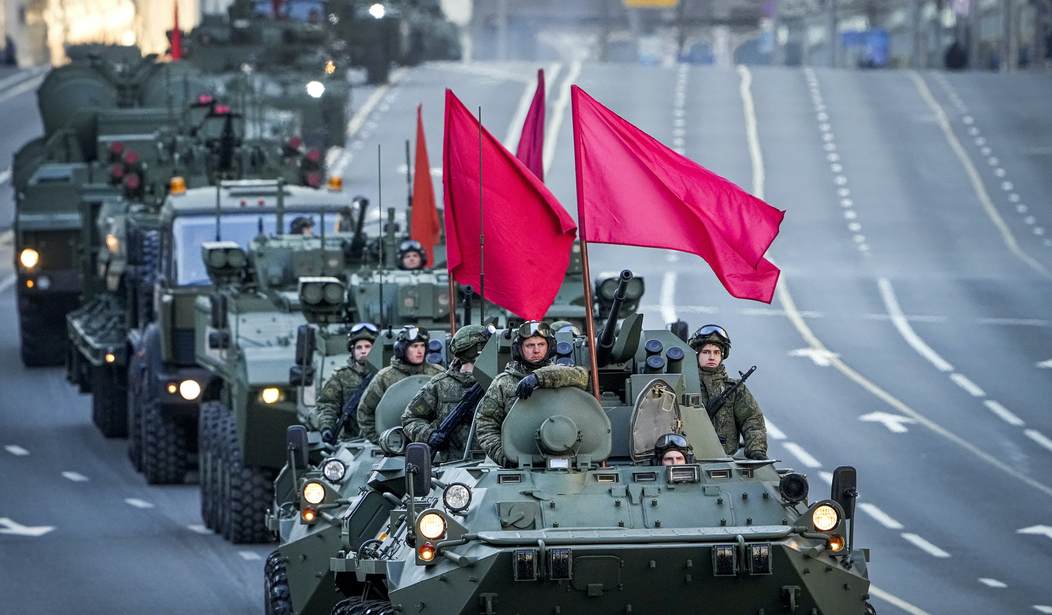
Will 2022 turn out to be a hinge year, as a moment when long-standing trends in geopolitics suddenly shifted in a different direction? This week, two important writers, one a long-established and prolific historian, the other a provocative presence on the internet, have argued persuasively that the answer is yes. But there's one other interesting point in common: Neither sees the United States as having played a decisive role in the sudden shift.
Over the years, Niall Ferguson has written admiringly about the 19th century's Rothschilds and the 20th century's Henry Kissinger and has highlighted the positive achievements of Britain's empire and America's internationalist foreign policy. Over the past dozen years, he argues in his latest Bloomberg column, the world has "entered a new and more dangerous era, in which a superpower rivalry is likely to be associated with the economic crisis, a 'democratic recession' ... and increased conflict."
This sort of thing has happened before. Just as the World War I settlement was opposed by 20th-century revisionist powers (Germany's Adolf Hitler, Italy's Benito Mussolini, Japan's military), so America's 21st-century vision of rule-based, democratic-dominated world order has been challenged by today's revisionists: Russia's Vladimir Putin, China's Xi Jinping, Iran's mullahs.
Revisionists gained ground through daring and luck in the 1930s and, in the awful years of 1940 and 1941, seemed on the brink of world domination. Twenty-first-century revisionists seem to have made serious blunders and to have run out of luck in 2022.
Ferguson has backed U.S. aid to Ukraine and has called for more. He is pleased that "Putin has shrunk in stature on the international stage" as his plans to annex Ukraine have dissolved in pathetic failure. "A leader I have long defined as a Mafia godfather is looking less and less like Michael Corleone and more and more like Tony Montana in the last scenes of 'Scarface.'"
And China, which many thought was heading toward economic superiority over the U.S. and strategic dominance in Asia, suddenly seems in sharp decline. "The stifling effect of Xi's COVID policy on the Chinese economy is real," notes Ferguson, "as are the dire demographic trends and the latent financial crisis within the real estate sector."
He doesn't predict Putin's or Xi's quick overthrow. But he predicts "the Chinese Communist Party will not celebrate its centenary in power" in 2049.
Unlike Ferguson, Richard Hanania, an academic and relative newcomer (2018) to Twitter, advocates something like an isolationist foreign policy for America. But like Ferguson, he has been pleasantly surprised by Putin's debacle in Ukraine.
In a Substack essay, he argues events in 2022 have vindicated Francis Fukuyama's 1989 "end of history" thesis, that after the vanquishing of communism, "there would be no serious alternatives to liberal democracy."
In his view, the Russian and Chinese alternatives are now discredited. Putin's Russia has proved "to be fundamentally incompetent and lacking in appeal even to Russians themselves that live outside its borders." A skeptic about U.S. aid to Ukraine, Hanania seems content that "Russia is certain to remain a poor, backward country indefinitely into the future, regardless of whether it adds a few million more pensioners in the Donbas."
Hanania quotes tech billionaire Peter Thiel's observation that China is "a weirdly autistic country." He calls Xi's zero-COVID program "an insane policy choice," given that even China's vaccine mostly prevents deadly illness in the non-elderly. China's rigid lockdowns have choked off economic growth and personal initiative in ways that seem difficult to overcome.
"I used to think that China could be the kind of autist that builds SpaceX," Hanania writes. "Instead, it's the kind that is afraid to look strangers in the eye and stays up all night playing with his train collection." If "Russia was too risk-acceptant and intoxicated with masculine dreams of conquest," then "China has been too risk-averse, and shown itself to be too neurotic to be able to respond to threats in a measured way."
Both American political parties, as Hanania notes, have supported Ukraine against Russia and have signaled support for Taiwan against invasion by China. U.S. aid, doled out sparingly by the Biden administration, has at least marginally helped Ukraine, and U.S. support may be deterring China from invading Taiwan.
But the bulk of the damage to Russian and Chinese revisionist ambitions has been self-inflicted and serious enough to make 2022 look like a hinge year in history. And maybe for the U.S., too -- a subject for a later column.
Michael Barone is a senior political analyst for the Washington Examiner, resident fellow at the American Enterprise Institute, and longtime co-author of The Almanac of American Politics.

Join the Conversation
VIP members get the ability to comment on articles.