





In the clashing commentary about whether lockdowns and stay-at-home orders should continue, or whether businesses and stores should be reopened, one senses a yearning for consensus. Why can't everybody just agree?
One reason is that we continue to be ignorant on many important points. How many people have been infected with the disease? Some fragmentary evidence has come in, but since many infected people are asymptomatic, no one knows the death rate per infection.
How is the virus disseminated in different environments? No one really knows. Some attribute the high number of deaths in New York to transmission in the subway. Others disagree. One governor is blocking superstore shoppers from buying garden equipment and seeds.
The yearning for definitive information and the assumption it will produce policy consensus are understandable but deeply wrongheaded. In this crisis, as in the other unanticipated, regime-shaking crisis of the post-Cold War era, the financial crisis of 2008-09, the facts are unclear and change so rapidly that even the most experienced experts cannot be sure what's happening. In such circumstances, mistakes are not just possible but inevitable.
Consider the financial crisis. The Federal Reserve chairman then was Ben Bernanke, the leading economist historian of the Great Depression of 1929-33. Yet even he did not predict the crisis.
Neither did the Treasury secretaries of 2008-09 -- Hank Paulson, former head of the premium investment bank Goldman Sachs, and Timothy Geithner, former president of the New York Federal Reserve Bank. Impeccable credentials, imperfect foresight.
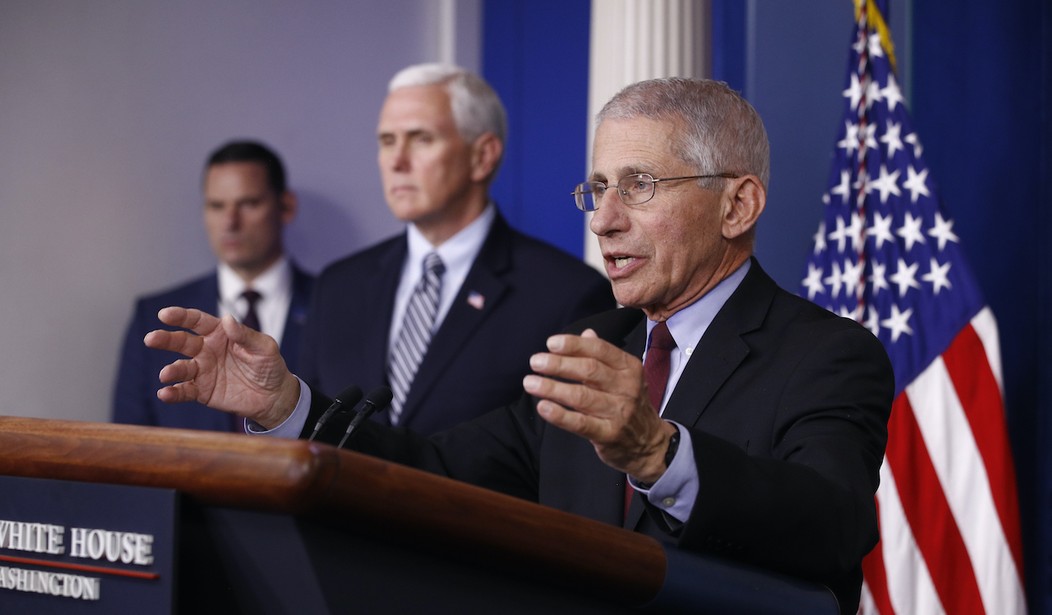
President Donald Trump's leading infectious disease expert is Dr. Anthony Fauci, who filled similar roles in the administrations of former Presidents Ronald Reagan, George H.W. Bush, Bill Clinton, George W. Bush and Barack Obama. No one has superior credentials or greater accomplishments. Yet in February, relying as he had to on Chinese government information, he said COVID-19 wasn't a pandemic.
It's possible to argue further that these two crises were the product -- perhaps the inevitable product, in retrospect, though unrecognized at the time -- of public policies enjoying broad bipartisan consensus.
The policy behind the 2008 financial collapse was encouraging homeownership by easing requirements for obtaining mortgages, especially for Hispanics and blacks supposedly barred from the market by racial discrimination. Clinton and Bush administration regulators rewarded firms that issued such mortgages and sanctioned the packaging of the often-shaky results in mortgage-backed securities that became worthless when, contrary to consensus expectations, housing prices crashed nationwide.
The COVID-19 pandemic can be seen as resulting from the policy followed by the United States and other Western nations for almost half a century: opening up trade with China, interlacing our economy with China's, integrating China into a keystone position in the world economy. A key moment came in 2000 when Congress, urged on by then-President Clinton and then-Gov. George W. Bush, voted for normal trade relations with China.
The consensus argument -- the hope -- was that China would embrace free markets, the rule of law and ultimately some form of democracy. Unfortunately, that hasn't happened. China concealed and lied about the virus and let it spread around the world.
In this crisis, experts at centralized government agencies have failed at their tasks.
The Centers for Disease Control and Prevention, for example, failed to develop working tests for the coronavirus, as has been documented by extensive Washington Post and New York Times reporting.
The Food and Drug Administration rigid bureaucracy prevented private firms from developing tests. Its nitpickers delayed approval of antibody tests by, as Wall Street Journal columnist Andy Kessler noted, requiring that a copy be submitted "by paper mail with a CD-ROM with the files burned on it."
It's easy to criticize such bureaucratic incompetence, just as it's easy to criticize what in retrospect seems to be the failure, in February and into March, of President Donald Trump, Gov. Andrew Cuomo and many others to recognize the potential of the pandemic. Not many experts got it right either.
But private profit-making firms and nonprofit research institutions have stepped into the lurch, researching and developing tests and vaccines. "Part of the genius of America," as Bush administration official and advocate of many consensus policies Robert Zoellick recently wrote, "is not what comes out of the White House, it's what comes out of the private sector and our institutions."
And part of that genius is a recognition that one-size-fits-all consensus policies don't always work well in a nation that has always been economically, culturally and ethnically diverse. We don't need a consensus on when to move from lockdown to reopening. We need, as Trump seems to recognize, to let states and governors grapple with the question and learn from the results.
Michael Barone is a senior political analyst for the Washington Examiner, resident fellow at the American Enterprise Institute and longtime co-author of The Almanac of American Politics.
Join the Conversation
VIP members get the ability to comment on articles.