





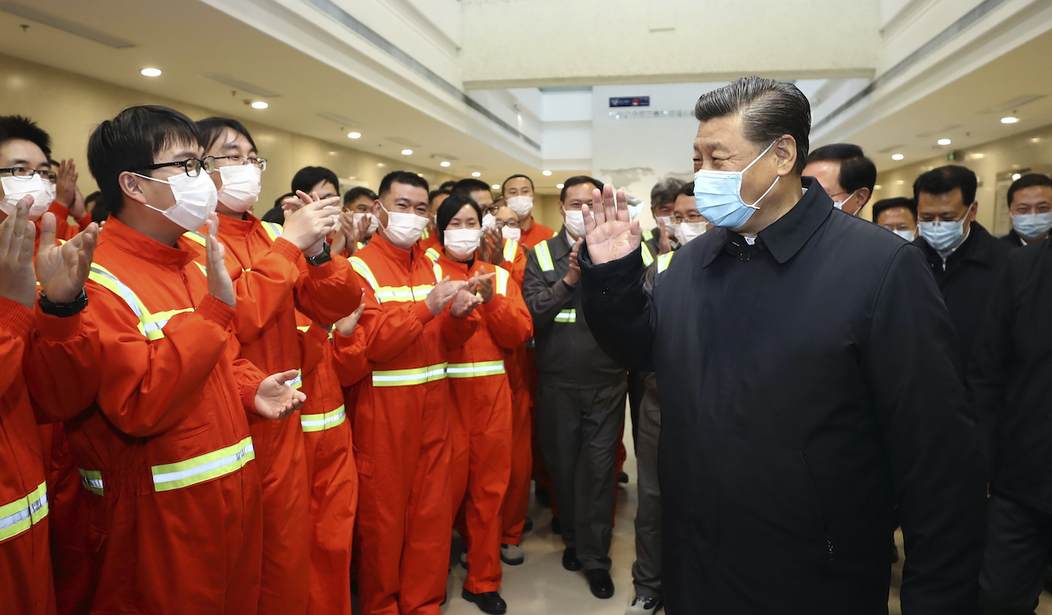
There's no greater contrast between how countries have treated COVID-19 than that between nations on both sides of what might be called the Asian Iron Curtain. It's a contrast that tells us much about how to handle the virus -- and how events now in the distant past can determine the fates of hundreds of millions of people today.
On one side is the People's Republic of China, where COVID-19 apparently transferred from animal to human hosts. The government has deliberately lied about human-to-human transmission, persecuted to the point of death doctors who warned of its dangers and is still almost certainly lying about its continuing prevalence.
On the other side of this Iron Curtain -- actually, this virtual barrier penetrated, until the virus appeared, by dozens of airline flights every day -- are places that seem to have responded most successfully to the pandemic: Taiwan, South Korea, Singapore and Hong Kong.
Each is largely ethnically or culturally Chinese. Each had authoritarian government, and each has (or clearly wants) rule-of-law democracy.
It's a divide as sharp as the one former Defense Secretary Donald Rumsfeld used to show visitors in a photo of the Korean peninsula at night, with South Korea lit up brightly and North Korea almost entirely pitch-black: a one-picture lesson in the difference between capitalism and communism.
Taiwan intensively screened passengers flying in from China, produced and distributed record numbers of facial masks, and strictly enforced quarantines. South Korea had an intensive testing and contact-tracing program. Hong Kong reduced land border crossings to and from mainland China from an average of 300,000 daily to 750 and had strict quarantines. Singapore had mandatory quarantines for arriving airline passengers and stringent contact tracing.
All four have had relatively low numbers of deaths and seem to be on track to stop the spread of the virus. And all have done so with a transparency that's a vivid contrast to the concealment and lies that are standard practice in the People's Republic of China.
Just as in Rumsfeld's photo, it's clear that regime character makes an enormous difference. Taiwan, South Korea, Singapore and Hong Kong have shown how people raised in Chinese or Chinese-influenced cultures of social cohesion and observation of rules can behave in a situation of unanticipated stress.
It's hard to avoid reflecting how much better off East Asia and the world would be if the billion-plus people of mainland China were to live in such a regime. But that was foreclosed when the Red Army led by Mao Zedong declared victory in the Chinese civil war and took power 71 years ago, in September 1949.
Regret over that unhappy event has been largely verboten in American political discourse since the discrediting of the "Who lost China?" campaigns of former Sen. Joe McCarthy and others in the early 1950s. Some even charged that President Harry Truman and Gen. George Marshall, in opposing military aid to Chiang Kai-shek's Nationalist army, were pro-communist.
The American diplomats known as "China hands," who regarded Mao as a domestic reformer, were called traitors and their careers destroyed. They were wrong about Mao but sincere in their beliefs. And Truman and Marshall were surely correct that the American people, after having just lost 450,000 soldiers, would not support involvement in an Asian civil war.
Two decades later, President Richard Nixon and Secretary of State Henry Kissinger pioneered a new policy of strategic engagement with China, and later presidents welcomed increasing trade with China including normal trade relations in 2000. The hope, expressed succinctly by Deputy Secretary of State Robert Zoellick in 2005, was that China would "become a responsible stakeholder" in the international system and more democratic, or observant of human rights, at home.
Those hopes have not been dashed. The low-priced China manufactures that Americans have been buying seem to have carried too high a cost. President Xi Jinping's China has become more hostile to human rights at home and more menacing abroad.
Despite attempts at cover-up, the COVID-19 pandemic has brought both these aspects of the communist regime in full view. The contrast with the behavior of Taiwan, South Korea, Hong Kong and Singapore could not be stronger.
Of course no one can change what happened in 1949, and the Chinese Communist Party, unlike Russia's, seems entrenched in power after three score and 11 years. But we can at least regret Mao's victory and hope that China's East Asia neighbors, not China, are the wave of the future.
Michael Barone is a senior political analyst for the Washington Examiner, resident fellow at the American Enterprise Institute and longtime co-author of The Almanac of American Politics.
Join the Conversation
VIP members get the ability to comment on articles.