







The 2020 presidential race has got the Democratic Party, the oldest political party in the world, twisted in knots. Its basic character and enduring values -- its political DNA -- which have enabled it to rebound from multiple political disasters, may be producing another disaster this year.
Consider the Democrats' concept of fairness in representation. The party's delegate allocation rules, not just this cycle but going back years, favor proportionate representation.
This comes naturally to a party that has always been a coalition of out-groups, of segments of America's always-diverse population that can form a majority when they stick together.
This can be carried to extremes. From its second national convention in 1836 up through 1932, the Democratic Party required its presidential nominees to win a two-thirds supermajority of delegates. That gave each of its various subgroups -- segregationist Southerners, big-city Catholic immigrants -- an effective veto over the choice of nominee.
Republicans, a party always centered on a core constituency of people thought of as typical Americans but who are not by themselves a majority, have a different concept of fairness: winner take all. They've always given near-unanimous support for a Republican president, even a Republican as initially unconventional as Donald Trump.
Four years ago, winner-take-all delegate allocation enabled the party interloper Trump to go from amassing less-than-50% primary victories to a nearly insuperable delegate lead, even before he got his first 50%-plus win in New York on April 19.
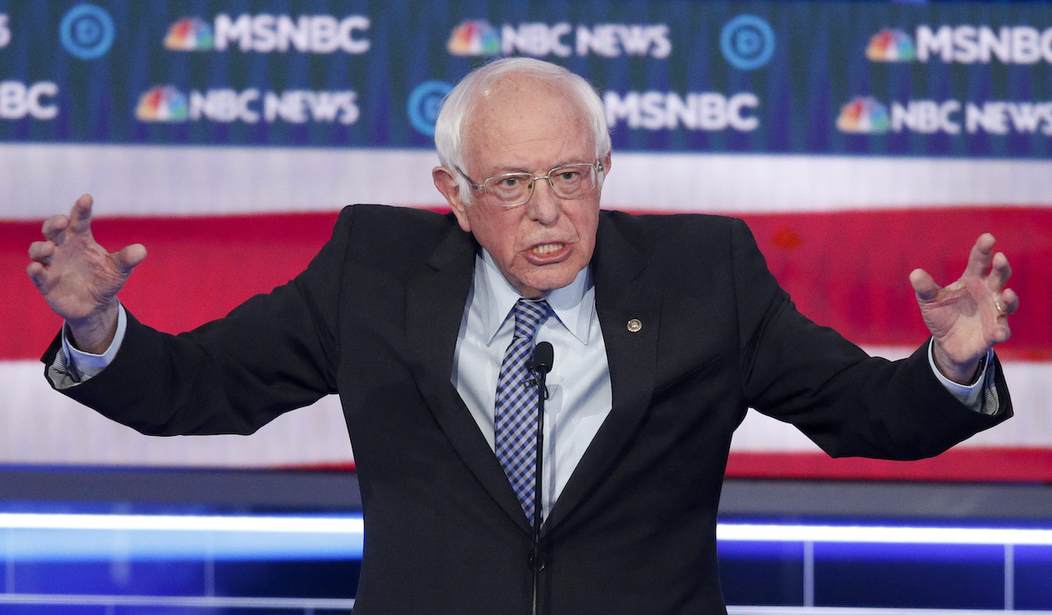
That will be harder for Democratic Party interloper Bernie Sanders. National polling shows him leading with 28% of the vote, but with four other candidates -- Joe Biden, Michael Bloomberg, Elizabeth Warren, Pete Buttigieg -- not too far behind with 10% to 18%. Others -- Tom Steyer, Amy Klobuchar -- reach that level in polling in soon-to-vote Nevada and South Carolina. Proportionate representation could give each a bunch of delegates.
But there's a catch. Democratic rules tend to require candidates to get 15% to get any delegates at all. That makes sense when there are just two or three serious candidates. But when there are five or six, a poll leader like Sanders might be the only candidate to get 15% and win delegates. Possible result: a Sanders leading in delegates but far below 50%.
It's no secret that Democratic Party leaders and their confreres at MSNBC and CNN consider Sanders a disastrous nominee and are searching for someone else. Unfortunately, at that point they come up against the Democrats' traditional professions of abhorring money in politics.
Republicans were never embarrassed by their party's fundraising advantages in the early and mid-20th century. Democrats are embarrassed to the point of denial at their party's fundraising prowess over the past 30 years. They continue to denounce the Supreme Court's 2010 Citizens United decision, which overturned limits on corporate political spending, even though studies have shown it's had zero impact.
Democrats still love to see themselves as representing the little guy against the big corporations. But in this century, their presidential nominees have outraised and outspent their Republican opponents, and they've been running ahead of Republicans in the highest income groups.
Yet as Democratic pols and pundits search for someone to stop Bernie Sanders, whom do they alight on? Not Joe Biden or Elizabeth Warren, whose support has been visibly waning. Probably not on Pete Buttigieg, who's struggling to win any perceptible support from blacks, or Amy Klobuchar, whose support seems confined to white college grads.
Instead they're looking to Michael Bloomberg, with his $56 billion fortune. Over the past several weeks, he has passed some $400 million in campaign expenditures -- the same amount former President Barack Obama's reelection campaign spent over two years.
Bloomberg wasn't on the ballot in Iowa or New Hampshire and isn't in Nevada or South Carolina. But his heavy spending has made him competitive in big states like California and Florida, where no opponent can come close to matching his ad buys.
Even before he has won a single delegate, his backers are calling on other candidates to drop out so he can take on Sanders one on one. But this isn't going to happen at least until after Super Tuesday (March 3), and maybe not then.
In the meantime, Bloomberg may be roadblocking the paths upward for Buttigieg or Klobuchar (or back upward for Warren or Biden), while revelations of his politically incorrect and, in some cases, repellent past utterances may impede his own rise. Which would leave things open for Sanders, who is beating the other Democrats in Yahoo News/YouGov's one-on-one pairings? Feel the Bern?
Michael Barone is a senior political analyst for the Washington Examiner, resident fellow at the American Enterprise Institute and longtime co-author of The Almanac of American Politics.
Join the Conversation
VIP members get the ability to comment on articles.