





Elections are a form of communication. Voting tells politicians, and the press if they're capable of getting the message, what citizens will tolerate and what they won't. The Democrats haven't voted yet, but they've been campaigning for more than a year and have just had their last debate before the Iowa caucuses two weeks from Monday.
That's time enough to learn some useful things from the majority of the two dozen-plus declared candidates who have already dropped out and from those still in the race.
The first thing we've learned is that voters -- Democratic voters -- have a limited appetite for free stuff. Many candidates have been promising free college and free health care, and offering free Ben & Jerry's ice cream.
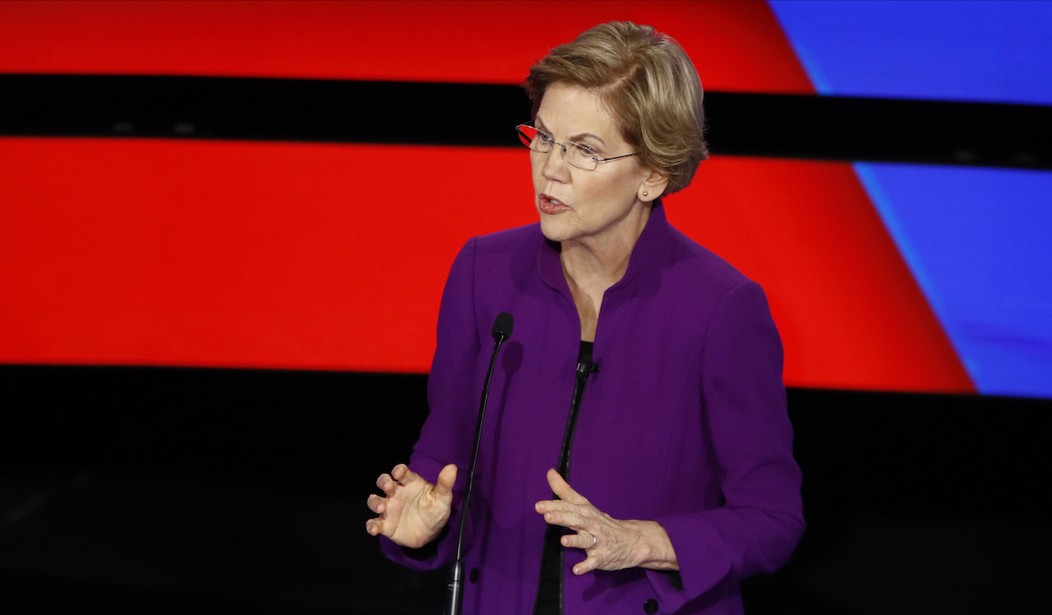
Sounds good at first, as when Sen. Elizabeth Warren backed Sen. Bernie Sanders' "Medicare for All" proposal. But the refusal of the I-have-a-plan-for-that candidate to say how she'd pay for it didn't fly. And when she did answer that question, that flopped, too, and she fell back on saying it would be delayed till her second two years or second term.
The second thing we've learned is related: As blogger Glenn Reynolds puts it, "Go woke, go broke." Sen. Kirsten Gillibrand, former Rep. Beto O'Rourke, Sen. Kamala Harris, former Secretary of Housing and Urban Development Julian Castro and Sen. Cory Booker -- all candidates who have taken some moderate stands -- chose to emphasize how hip they were. They embraced positions like free medical care for illegal immigrants, reparations for descendants of slaves, abortions for men who have transitioned to be women.
These things sound reasonable to fans of Rep. Alexandria Ocasio-Cortez. To Democratic primary voters, not so much. All five are now ex-candidates.
Third, identity politics has proved to be a loser, too. Harris and Booker got only single-digit percentages from black voters. Castro made zero progress with Hispanics. Things were quite different in 1988, when Jesse Jackson carried blacks, Michael Dukakis white ethnics, Al Gore Southern whites and Dick Gephardt union members.
Identity politics is big on campus, where you get denounced for wearing a serape on Halloween if you don't have Mexican ancestors. But voters don't care so much. Harris and Booker failed to duplicate the frisson inspired by then-candidate Barack Obama in 2008, probably because you can only elect the first black president once. Catholics were similarly excited by John F. Kennedy in 1960 but haven't been similarly inspired by any Catholic candidate since.
Fourth, the white college graduates -- gentry liberals -- who are, for the first time in history, one of the Democratic Party's largest constituencies, are a fickle bunch. Black and elderly Democrats have consistently given former Vice President Joe Biden large pluralities, and Hispanic and low-income non-college Democrats have shown some affinity for Sanders. That largely accounts for the buoyancy of support for these 77- and 78-year-old candidates.
But gentry liberals have been bouncing around. They were briefly smitten with Harris after she bopped Biden on school busing. They swooned longer for Warren when she kept repeating, "I have a plan for that," and then they were taken charmed by Mayor Pete Buttigieg's crisp and self-assured articulateness.
The gentry liberals' fling with Harris didn't last long, and current polling suggests their crushes on Warren and Buttigieg are over. But there's still plenty of room for these voters to swing decisively in February's first two contests, for they are numerous among those who bother to attend the Iowa caucuses and demographically a large share of the population of New Hampshire.
That's what happened in 2008, when high-education Iowans swung to Obama, which convinced black voters that he, unlike Jesse Jackson, could win whites' votes and the nomination. But gentry liberals are hard to gauge because what they're after is not government aid but morally satisfying reassurances, not substance but style.
Finally, Democrats -- or their many friends in the press and social media -- have an obsessive yearning for "diversity," which turns out to mean racial quotas and preferences. There is moaning about not having any "people of color" on the latest debate stage, as if the party had a responsibility to somehow field a group of candidates who are demographically identical to the population.
Actually, the six candidates at the last debate come from a wide range of American backgrounds, reasonably appropriate for a party that, in its 188-year history, has always been a coalition of out-groups. What's important is not what the field of candidates looks like but who will be the party's nominee, who will inevitably be of one gender and a limited number of ancestries. That is something Democratic voters have not taught us yet.
Michael Barone is a senior political analyst for the Washington Examiner, resident fellow at the American Enterprise Institute and longtime co-author of The Almanac of American Politics.

Join the Conversation
VIP members get the ability to comment on articles.