





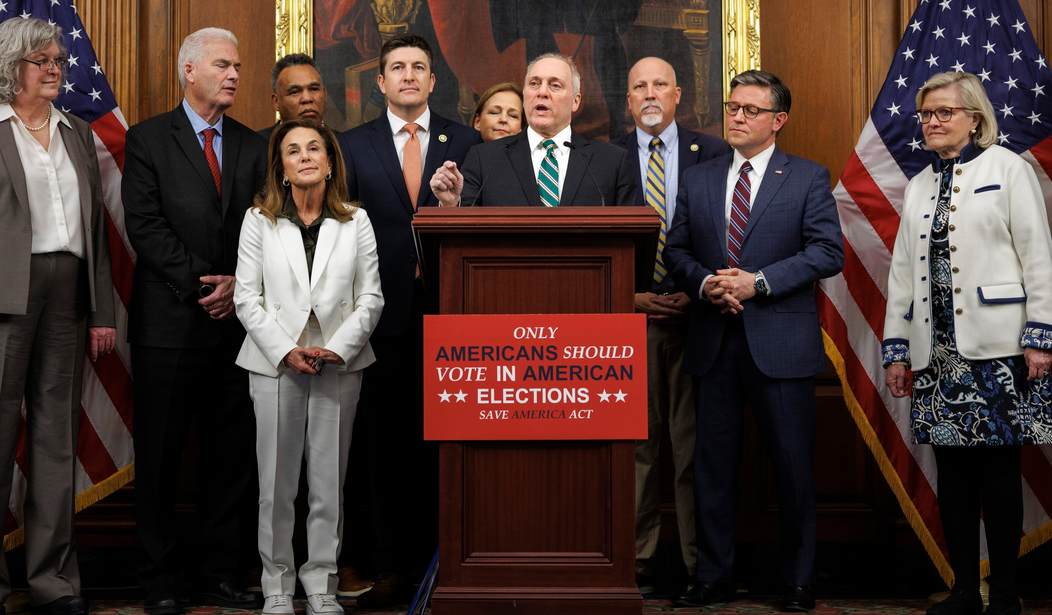
Democratic politicians continue to obstruct voter identification laws even though most Americans overwhelmingly support them, and that disconnect exposes the structural crossroads our country now faces. According to Pew Research, 83 percent of Americans support requiring a government-issued photo ID to vote, and 84 percent support paper ballot backups, with even 71 percent of Democrats backing voter identification requirements. At the same time, only 17 percent of Americans say they trust Washington to do what is right. That combination is a product of a low-trust era. Voters are demanding elections that are not only accessible, but verifiable and auditable. Resistance to commonsense safeguards signals a defense of administrative discretion at the very moment the public is demanding accountability.
Predictably, opponents of the SAVE Act, which requires proof of U.S. citizenship to register in federal elections, argue this is voter suppression. While this is a politically convenient talking point, it does not stand legal scrutiny. The real question is far more structural: should federal elections operate under one uniform national verification baseline, or should flexible standards and discretion remain embedded in the system?
The authority is clearly defined in the Constitution. Article I, Section 4, known as the Elections Clause, gives states responsibility for administering federal elections but explicitly grants Congress the power to “make or alter” those regulations. Throughout our history, Congress exercised this authority by establishing uniform election dates, passing the Voting Rights Act, enacting the National Voter Registration Act, and modernizing voting systems through the Help America Vote Act. Requiring citizenship for federal voter registration is in line with the constitutional framework and authority.
The real objection is not about whether Congress has the authority, but who controls the mechanics of election administration.
A uniform national election standard limits administrative discretion. When election rules differ across jurisdictions, enforcement inevitably becomes uneven, and uneven enforcement fuels litigation. The battleground then shifts from voters to judges. At that point, election outcomes can hinge not simply on ballots cast, but on how courts interpret regulatory language, making judicial interpretation consequential. In a polarized election environment, that is a redistribution of power away from the electorate and into the hands of judges.
In a low-trust environment, reducing voter uncertainty means ensuring a clearly articulated national standard delivers three structural benefits that the current patchwork framework fails to achieve.
First, it creates one national rulebook for verifying voter eligibility, including citizenship verification at registration and identity verification at the time of voting. Establishing these safeguards so they apply equally in every jurisdiction promotes consistent enforcement, rather than allowing political pressures or partisan control to influence how the rules are implemented.
Second, it strengthens transparency and audits. The Help America Vote Act of 2002, enacted after the disputed 2000 election, advanced the use of paper records to ensure votes could be reviewed and verified. When paper audit trails are paired with citizenship verification at registration, the result is a clear voter eligibility record and ballots cast. In an era of historically low institutional trust, the ability to conduct meaningful audits is the minimum requirement for public confidence.
Third, it removes the political advantage that complexity creates. When election standards vary across states, and procedural exceptions accumulate, inconsistent administration follows, and transparency declines. We saw this dynamic during the 2020 election, when differing state rules on absentee and mail-in ballots, signature verification, and ballot curing generated confusion and widespread litigation. In that environment, disputes moved from ballots to courtrooms, and outcomes often turned on how courts interpreted statutory language rather than solely on votes cast. Uniformity reduces ambiguity and makes election results easier to explain, audit, and verify.
National election uniformity does not prevent access; it strengthens it. The majority of Americans, according to polling by Pew, support both expanded voting options, such as early voting, and secure identification requirements. Voters do not see accessibility and integrity as competing values. They understand that both are necessary to legitimize and safeguard our elections.
So the real question becomes this: if a clear majority of Americans support national verification standards, why is resistance from Democratic leadership so intense? The answer is simple. It is about control over election administration. Americans are required to show identification to board airplanes, open bank accounts, access federal benefits, and even enter certain federal buildings. They accept verification as routine in every serious civic transaction and as a basic safeguard of legitimacy. Expecting similar standards for federal elections is consistent. If Democratic leaders truly believed voter confidence was strong, they would not oppose uniform safeguards that a clear majority of Americans already support.
The debate over the SAVE Act is about whether federal elections will be governed by consistent national rules or by flexible interpretation. In a polarized country with eroding institutional trust, broad discretion creates distrust. Clear, uniform verification restores confidence.
In a low-trust era, verification is the cost of legitimacy.
Editor's Note: The Democrats are doing everything in their power to undermine the integrity of our elections.
Help us tell the truth about the SAVE America Act and how it will prevent voter fraud. Join Townhall VIP and use promo code FIGHT to get 60% off your VIP membership.


Join the Conversation
VIP members get the ability to comment on articles.