





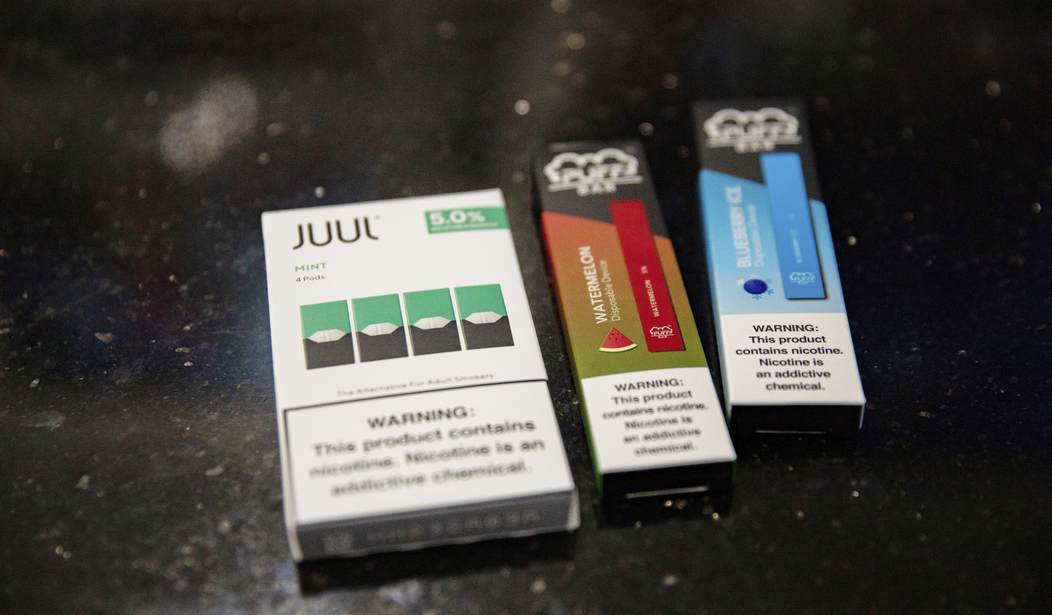
The Wall Street Journal has reported that Juul Labs, the e-cigarette manufacturer which became a scapegoat for youth vaping in the United States, is in discussion with major tobacco companies to engineer a sale of the company or perhaps another solution to rescue it from oblivion.
This development is just the latest in a long line of potentially revolutionary products designed to reduce combustible tobacco use being snuffed out by so-called anti-smoking groups.
Appearing on the market in 2015, the inventors of the JUUL vaping device (Adam Bowen and James Monsees) spoke eagerly about how their product could make smoking obsolete and no doubt expected to be lauded by the public health establishment. Unfortunately, that could not have been further from the truth.
Sales of the new device initially took off and by May 2019, Juul made up 74.6 percent of the U.S. e-cigarette market. But, from the moment they launched, the tobacco control industry had the company in its sights and systematically worked to destroy it. Last year, the Food and Drug Administration (FDA) denied JUUL pre-market authorization for their products on spurious grounds, only for the agency to issue a stay on the denial. The same year, the company faced court claim after court claim, totalling more than two billion dollars after a vicious campaign of demonization against the company.
American public health organizations have a long and sordid history of policy decisions which end up protecting the combustible cigarette trade from competing products which are orders of magnitude less harmful than smoking.
Anti-smoking group, Campaign for Tobacco-Free Kids (CTFK), arguably saved the tobacco industry from calamity with the Master Settlement Agreement in 1998. The landmark settlement entitles states to receive reimbursement for their tobacco-related health-care costs in return for regular payments based on cigarette sales.
The final stroke of a pen to seal the doom of reduced risk products was the FDA deeming regulations, which was supported by CTFK. This means that any product not on the market by February 15, 2007, requires authorization to prove it is “appropriate for the protection of public health.” Absurdly, this meant millions of products carrying a fraction of the risk of combustible tobacco would end up being banned from sale while cigarettes got a free pass.
It is under this regulatory swamp in 2015 that Swedish Match, a company producing snus (a refined smokeless tobacco pasteurized to remove all carcinogens) responsible for Sweden boasting the lowest smoking rate in Europe, applied to the FDA for permission to remove health warnings and was denied. This despite there being more than 50 years of epidemiological evidence showing the product is overwhelmingly safer than cigarettes. The FDA would finally allow limited reduced risk claims four long years later.
Similarly, Star Scientific Inc., which made a dissolvable smokeless tobacco product, decided to stop production in 2012. The company cited FDA restrictions on their ability to accurately convey the lesser health risks of their product compared to cigarette smoking as the reason it was "extremely difficult to effectively market."
Time and again, opportunities for health advocates to change the nicotine market and prevent millions of deaths have been wasted in favor of a war against industry. This only serves to protect sales of the most harmful of nicotine delivery systems, the cigarette.
At the end of 2021, the FDA granted a new tobacco company (22nd Century Group) the right to market a brand new combustible cigarette. The FDA reportedly funded trials of the product with $100 million of taxpayer money.
Behind this abject failure on the part of the American public health establishment is an abstinence-only approach to consumer nicotine that often involves misleading statements, dismissal of sound objective science, and a refusal to put the public’s health above stubborn ideology.
Rather than protect the public, the FDA and public health institutions routinely fight against lower risk nicotine products which can lure people away from smoking and deny the public information they could use to substantially reduce their risk of potentially fatal cancer, heart, and lung disease.
The demise of Juul once again illustrates the extraordinary ineptitude of anti-smoking campaigns in the U.S. and emphasizes the need for fundamental change in how nicotine products are regulated. A system which protects combustible cigarettes from competition while far less harmful products repeatedly struggle for survival cannot be right.
Martin Cullip is the International Fellow at The Taxpayers Protection Alliance's Consumer Center and is based in South London, UK.



Join the Conversation
VIP members get the ability to comment on articles.